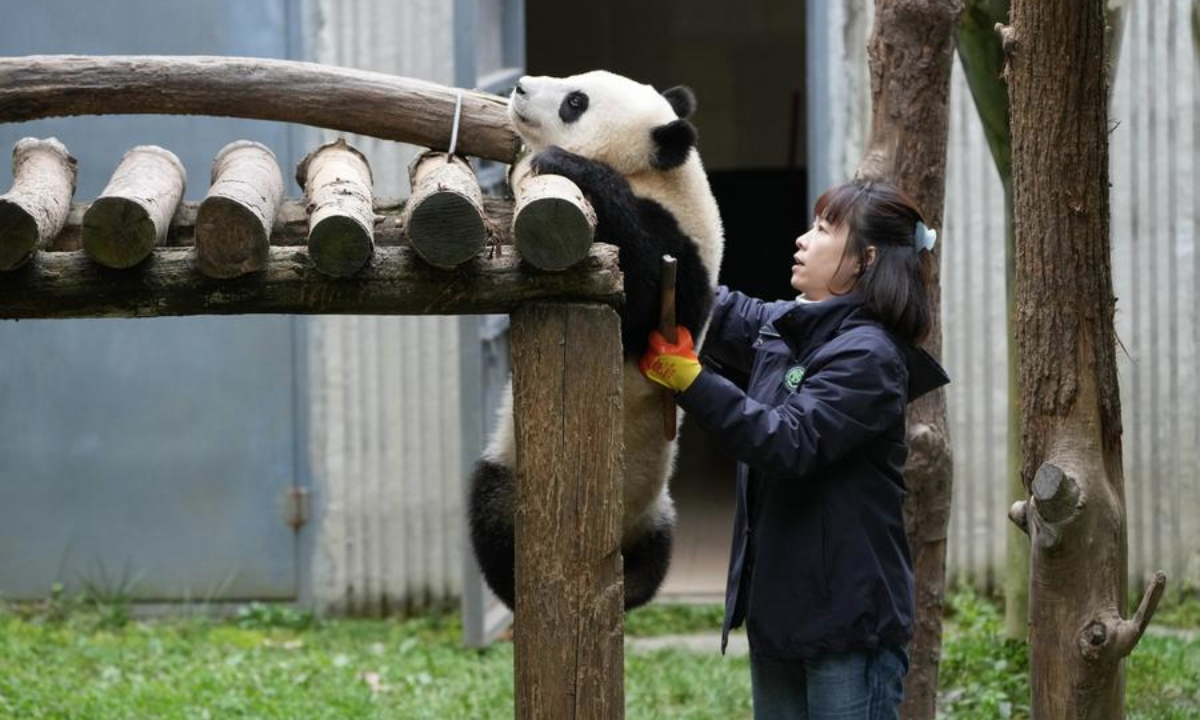
A breeder helps a giant panda learn climbing at the Shenshuping giant panda base of Wolong National Nature Reserve in southwest China's Sichuan Province, Nov. 6, 2025. (Xinhua/Xu Bingjie)
A research team led by Professor Li Baoguo from Northwest University in Northwest China's Shaanxi Province has recently documented the first-ever case of giant pandas using objects such as bamboo sticks and tree branches as tools, holding them with one forepaw to scratch hard-to-reach itchy spots, a member from the research team told Global Times on Thursday.
The findings, published in Current Biology on October 20, provide the first scientific evidence of tool use in giant pandas. Specifically, the study documents that beyond their well-known routines of eating bamboo and sleeping, giant pandas can also modify sticks and bamboo pieces to scratch themselves —a previously unrecognized behavior.
Yang Bin, a research fellow at the Shaanxi Institute of Zoology and member of Li's team, told the Global Times that tool use is a fascinating topic, especially when comparing different animal groups, as it helps understand the origins, evolution, adaptability and underlying cognitive abilities. In this study, they found that giant pandas can use tools independently with one forepaw or "hand" - a skill made possible by their evolutionarily unique "false thumb." Other bear species generally require both forepaws to hold objects. This highlights pandas' distinctive evolutionary adaptations and suggests greater potential for tool use in this species, Yang said.
According to the paper, the team used focal-animal sampling during 50 days of observation of 18 captive giant pandas, observed and recorded more than 300 instances of tool use. The study raised new questions about the species' behavioral flexibility. Researchers observed 10 females and eight males between 3 and 12 years old.
Yang said the team found that giant pandas can use tools directly and, in some cases, make simple preparations before using them — a basic form of tool manufacture. However, this remains a simple level of modification rather than complex tool crafting.
The pandas' tool use and simple tool-making reflect causal understanding and short-term planning, as they intentionally use tools to scratch body parts that are hard to reach. Unlike many species that use tools primarily for feeding — targeting external objects — pandas use tools for self-directed body care, with the target being their own bodies.
Yang noted that itchiness in giant pandas varies by season and by individuals. Younger, more active pandas tend to get dirtier and itch more, while well-groomed older pandas itch less. In seasons with more insects, pandas also scratch more frequently.
Although giant pandas are widely seen as cute, food-loving and slow-moving, the study shows that they can use tools, challenging these long-held stereotypes. Their tool-use behavior demonstrates causal understanding and a degree of planning, suggesting they may possess more complex cognitive abilities than previously assumed, Yang said.
Yang further said that discovering tool use in a large mammal is particularly significant, as tool use in body-care has been found in only a few species. This finding contributes to understanding the origins and evolution of tool use across different animal taxa and carries significant scientific value.
RELATED ARTICLES