ARTS / FILM
AI reshapes China's film, TV landscape amid actor oversupply, rising value of screenwriters
By Published: Jun 30, 2026 10:19 PM

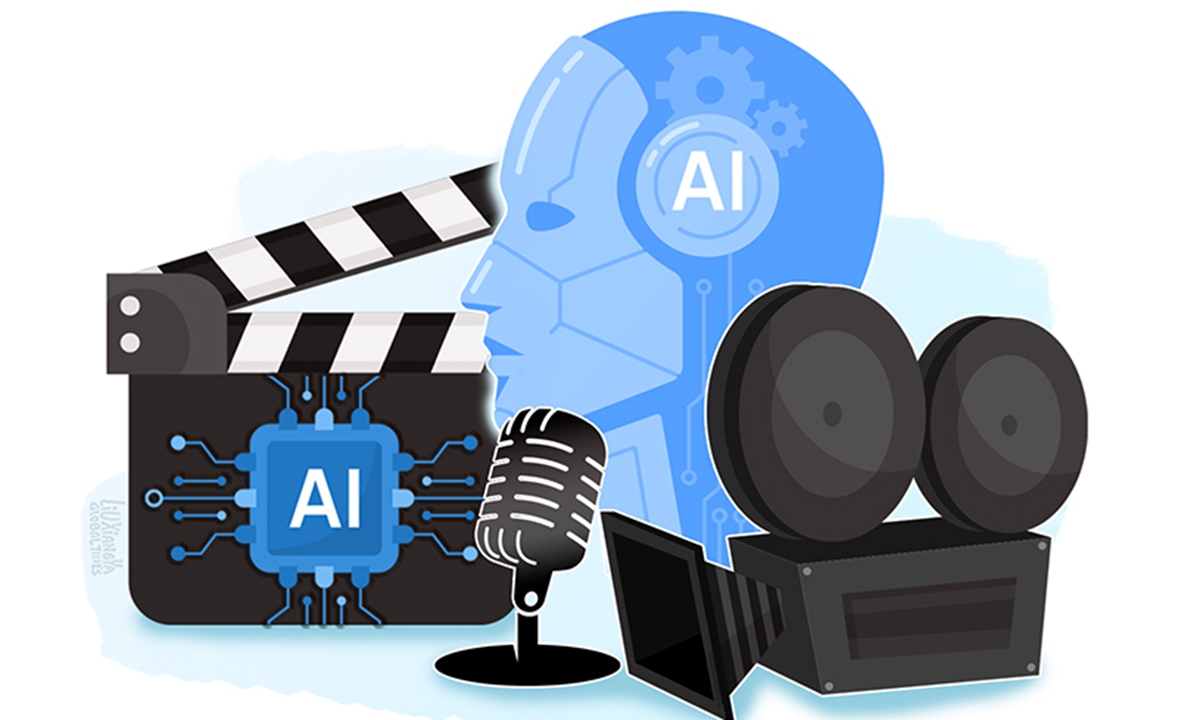
Illustration: Liu Xiangya/GT
An online hashtag about Chinese actors struggling to secure roles began trending on social media recently. Once-adored performers with sizable fan bases have appeared publicly, pleading with producers and investors for work in viral video clips that have both shocked and captivated online audiences.
While the trend has been widely interpreted as a sign of a shrinking domestic entertainment market, industry insiders and analysts argue it is not a total industry downturn, but a profound structural reshaping driven by policy regulation, capital adjustment and the rapid deployment of artificial intelligence (AI) in the industry.
The core dilemma plaguing the sector is a severe structural supply-demand imbalance, Zhang Ke, a renowned screenwriter behind the hit film Dead to Rights, told the Global Times on Tuesday.
"The rise of youth-oriented short videos, live-streaming content and interactive narratives has fragmented public attention, greatly weakening the mandatory viewing appeal of traditional TV dramas," Zhang said.
He added that the industry's lack of innovative content, failure of conventional blockbuster formulas and financial pressure on production firms have prompted streaming platforms and investors to tighten budgets and cut projects, leading to fewer film crews and lower employment for actors.
Zhu Xinmei, director of the Institute of International Communication at the Development Research Center of the National Radio and Television Administration, attributes the structural adjustment to years of standardized industry rectification.
She told the Global Times on Tuesday that strict regulations have eliminated sky-high actor salaries, celebrity hype and extensive capital investment models, ushering in a new era of "quality over quantity." The market no longer tolerates homogenized, unrealistic and star-dependent formulaic works, squeezing the living space for replaceable mid-level performers.
The most transformative variable reshaping the entertainment ecosystem is the large-scale application of AI-generated content. From 2025 to 2026, AI-driven short drama production has achieved full-link automation, covering script outlining, virtual character modeling, scene generation and post-editing. With ultra-low costs and ultra-short production cycles, AI short dramas have rapidly occupied the low-end content market, replacing a large number of low-budget live-action short dramas and online movies.
This technological disruption has directly impacted grassroots and template-based actors, whose repetitive performances and routine shots can be efficiently completed by AI systems.
Unlike premium live-action film and television productions that pursue in-depth storytelling and human feelings, low-end standardized content is facing comprehensive intelligent substitution, leaving ordinary performers with fewer job opportunities.
China's industry transformation also mirrors a global trend. Hollywood entertainment sectors are witnessing similar structural shocks, as AI voice dubbing and virtual actors replace grassroots practitioners. Tens of thousands of voice actors in Hollywood have launched rights-protection campaigns against unregulated AI application, reflecting the universal employment pressure on low-end entertainment workers brought by technological progress.
Industry consensus holds that technological iteration only eliminates low-value, standardized labor rather than top-tier creative talents.
Liang Zhenhua, a veteran screenwriter and professor from the School of Chinese Language and Literature at Beijing Normal University, told the Global Times that A-list performers with solid acting skills and unique personal characteristics remain highly sought-after by high-quality production teams. The group facing unemployment pressure primarily consists of mid-tier actors with weak screen recognition and high replaceability who rely on standardized performances and frequent minor roles to sustain their careers.
Liang added that authorities are expected to introduce regulatory legislation to curb the excessive proliferation of crude AI short dramas and standardize technological application.
Beyond reshaping the actor talent market, AI is restructuring the discourse of power within the industry. In the traffic-driven economy era, capital, celebrities and marketing resources dominated project development, forcing screenwriters to compromise their creativity to cater to star personas and market trends.
While today, AI has taken over basic mechanical work such as routine script framework building and writing simple dialogue, drastically devaluing low-end script work.
Human screenwriters' core competitiveness has shifted to in-depth creative work that AI cannot replicate, including thematic conception, designing character arcs, interpreting social issues and writing about human values.
"AI could never produce works with the profound human warmth of Dear You and Silent Honor," Liang stressed, warning against the technological erosion of the essence of art and emphasizing the significance of original creativity and human feelings.
According to Zhang, the AI era presents a dual threshold for emerging screenwriters. Intelligent tools have lowered the entry barrier by assisting with framework drafting and content calibration, helping newcomers grow faster. Yet the industry's premium threshold has risen sharply: Average works are no longer competitive, and outstanding creators must possess unique perspectives and cultural insights.
"Nevertheless, AI opens up broader experimental space for young creators, enabling low-cost, high-concept content innovation similar to the production model of the hit short drama Enemy," Zhang said.
In essence, the fading traffic bubble, elimination of low-quality homogenized content and AI-driven industrial upgrading are jointly phasing out practitioners who rely on capital dividends and traffic exposure.
Zhu noted that this short-term structural reshaping will help optimize China's film and television ecosystem, guiding the industry toward professionalism, creativity and quality-oriented development.
In the long run, the restructuring of the talent pyramid will lay a solid foundation for the high-quality and international development of China's film and television industry.
The author is a reporter with the Global Times. life@globaltimes.com.cn
RELATED ARTICLES