US working on ban targeting Chinese energy inverters, a move politicizing clean-energy supply chains, ignoring industrial, consumer interests: expert
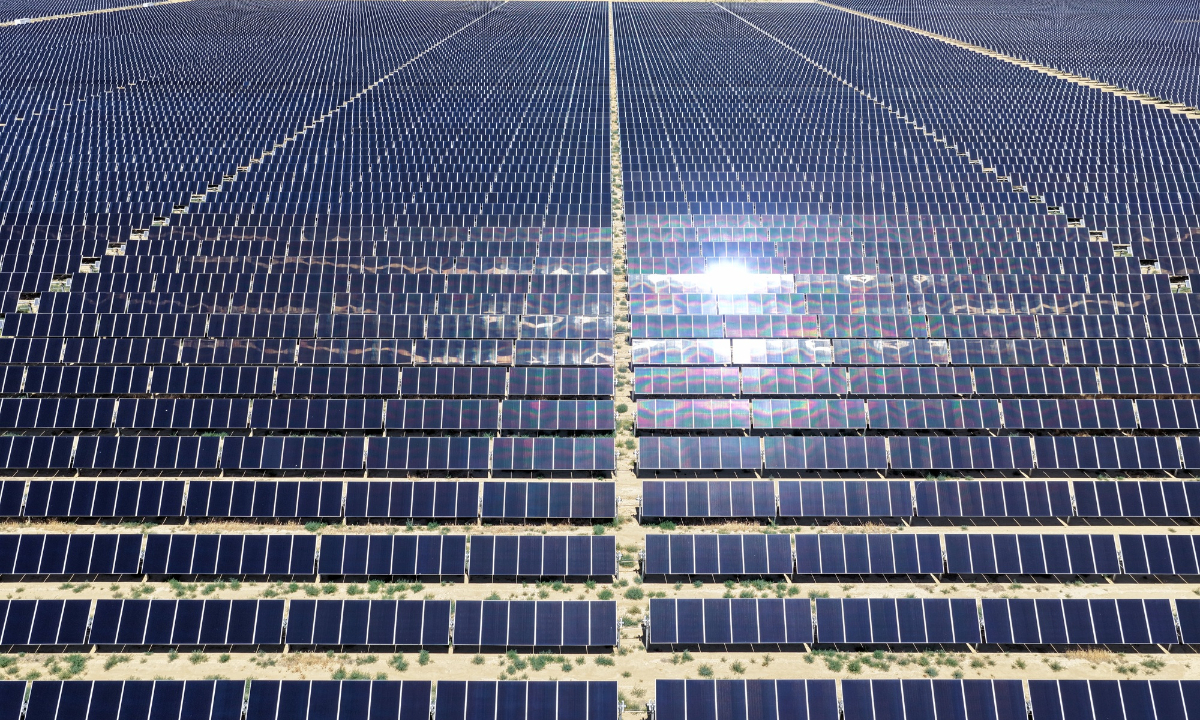
An aerial view of a solar panel array at a solar farm on June 17, 2026 near Rosamond, California, US. Photo: VCG
The US is reportedly drafting a ban on imports of foreign-made energy inverters targeting Chinese products. Chinese analysts said on Wednesday that this is Washington's latest attempt to expand its technology crackdown to energy infrastructure under the banner of "national security," and the move risks raising costs for its own industries and consumers.
Reuters reported on Tuesday that the US administration is drafting a ban on imports of foreign inverters, which connect solar projects and batteries to the grid, over concerns that China could use them to disrupt power supplies. The restriction, being drafted by the US Federal Communications Commission, would apply to new foreign models of inverters and could be published as early as this year, according to the report.
Responding to the reported move, the Chinese Embassy in the US said it "firmly opposes the overstretching of the concept of national security and its unjustified suppression of Chinese companies," adding that the US should provide "a fair, just and non-discriminatory environment" for Chinese businesses, Reuters reported.
Energy inverters are key components in solar and energy-storage systems. The US Department of Energy describes an inverter as one of the most important pieces of equipment in a solar energy system, converting direct current (DC) electricity generated by solar panels into alternating current (AC) electricity used by the grid.
"Washington is now recasting that technical function as a security concern," Xiang Ligang, a veteran telecom industry observer, told the Global Times on Wednesday. He said the reported move marks the latest expansion of US technology suppression campaign into a new sector, exposing Washington's internal tension between industrial competitiveness and security anxiety.
The US does not yet have sufficient capacity to provide comparable products at competitive prices, yet it is trying to exclude Chinese products that already offer those advantages through measures that run counter to industrial logic, Xiang said.
China is the world's largest maker of inverters, and has been growing its share in the Western inverter market, according to Reuters.
Chinese products have gained competitiveness through quality, technology and cost advantages, Xiang said. "If the US turns so-called security into an absolute standard and places hypothetical risks above industrial logic, economic costs and consumer interests, its own grid construction, businesses, and consumers may be the first to pay the price," he said.
The US attempt was revived in part by the European Commission's decision to ban Chinese-made inverters from publicly funded energy projects, Reuters reported. But the sources cited by the report cautioned that the US proposal could still be modified or shelved altogether.
The EU in May took steps to cut Chinese clean-energy hardware out of publicly funded projects, banning Chinese inverters from all EU-funded schemes, according to the report.
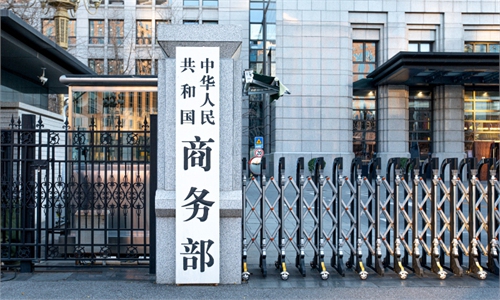
China firmly rejects and opposes the EU move, which, without any concrete evidence, designates China as a so-called "high-risk country" and bans funding for projects using Chinese inverters, the Chinese Ministry of Commerce (MOFCOM) said on May 7.
"The move constitutes stigmatization against China and imposes unfair and discriminatory treatment on Chinese products," the ministry said, warning that forced exclusion of Chinese products will not only undermine the interests of Chinese enterprises but will also backfire, ultimately jeopardizing the EU's green transition and energy security.
The cost risks have already emerged in Europe. Reuters reported earlier in June that the EU's exclusion of Chinese inverters from publicly funded projects could affect more than a fifth of new solar capacity and force developers to seek costlier alternatives. Euronews also reported on June 22 that industry and investors warned European suppliers cannot yet replace Chinese producers any time soon.
Xiang said the same logic applies to the US, where some politicians are using exaggerated China-related security concerns to project toughness while ignoring industrial, consumer and broader economic interests.
"Reducing emissions and tackling climate change are shared global tasks. China's capacity is an important support for the green transition, and the US and Europe will find it harder to meet their climate goals if they keep excluding Chinese suppliers instead of working with China," Xiang said.
Washington has used national security claims to restrict Chinese technology products across more sectors. Reuters reported separately on Tuesday that the Federal Communications Commission plans to vote next month on a proposed measure that would bar sales of devices in the US containing components from companies on a US list of restricted firms, including Chinese telecom company Huawei.
Chinese officials have repeatedly criticized Washington's use of national security claims to suppress Chinese companies. Foreign Ministry spokesperson Lin Jian said on June 17 that China consistently opposes the US overstretching the concept of national security, abusing its Entity List and other export controls, and suppressing Chinese enterprises, urging the US to stop politicizing, instrumentalizing and weaponizing trade and tech issues.
RELATED ARTICLES