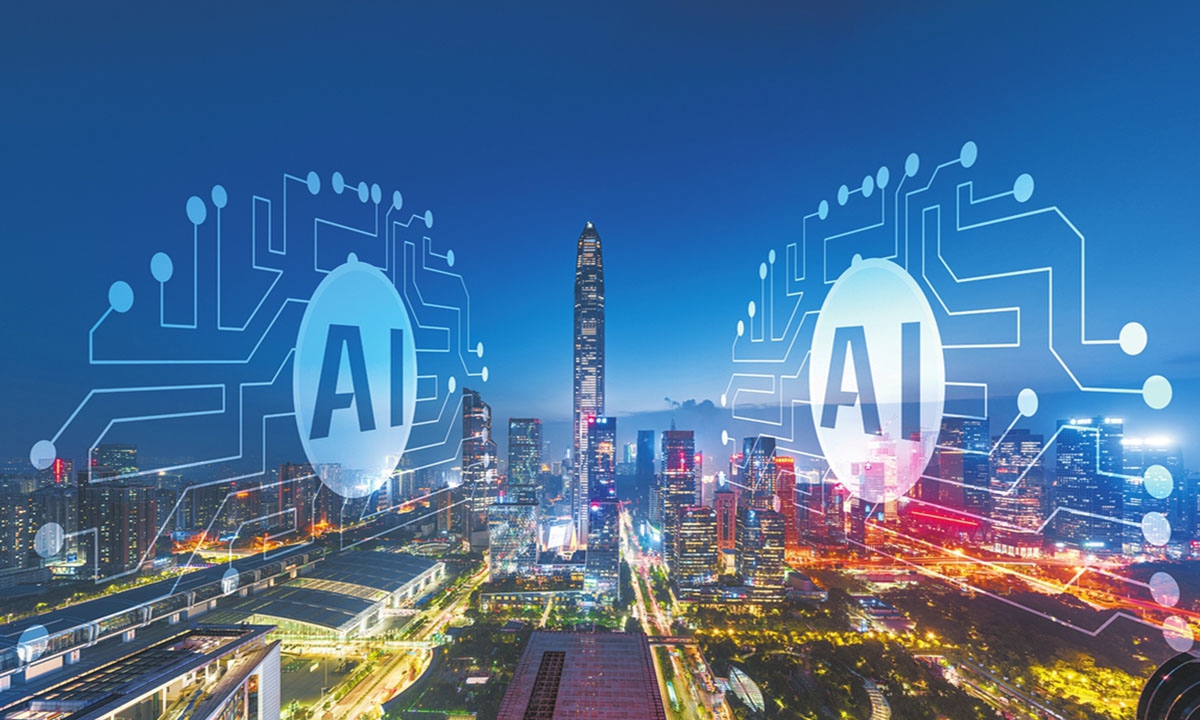
A concept picture of AI city File photo: VCG
In the latest IMD World Competitiveness Ranking report, the Chinese mainland has moved up to 12th place in the global rankings. At the same time, international media coverage has increasingly focused on its performance in selected advanced industries, particularly artificial intelligence (AI) and other high-technology sectors. Taken together, these developments invite a broader question of how to interpret China's competitiveness, in both overall rankings and more narrowly defined areas of technological strength.Some international commentary tends to view China's rising competitiveness through the lens of geopolitical or strategic rivalry, and often feeds concerns that Western economies are being left behind. This framing, still tinged with a zero-sum logic, risks overlooking the growing opportunities generated by China's ongoing technological innovation.
China's technological progress has been rapid. It is gradually feeding into global supply chains in incremental and often complex ways. To see this more clearly, it is worth looking at Shenzhen, South China's Guangdong Province, which is at the leading edge of China's technological development.
Local media reports indicate that in the first five months of this year, Shenzhen's total imports and exports reached 2.32 trillion yuan ($341.5 billion), retaining its position as the leading Chinese mainland city by trade volume. Exports amounted to 1.22 trillion yuan, up 15.9 percent year-on-year, while imports reached 1.1 trillion yuan, rising 53.4 percent over the same period. Although imports remain slightly below exports in absolute terms, their much faster rate of growth stands out, suggesting a notable strengthening in import momentum.
At Huaqiangbei - the city's long-established electronics market - crowds are drawn to a wide range of Chinese-made devices, from smartwatches and AI glasses to drones, a scene often cited as a visible example of how technological upgrading is supporting China's exports. Yet what receives less attention in some international commentary is that China's deeper integration into global manufacturing networks is also generating significant import demand. Local media reports indicate that in the first five months of this year, Shenzhen imported 830.09 billion yuan of mechanical and electrical products. Within this category, imports of computer components - including graphics cards and servers - reached 228.9 billion yuan, up 59.3 percent. These components may be assembled into China-made products, which are then sold in places such as Huaqiangbei.
This is not a zero-sum dynamic, but one of increasing interdependence. Shenzhen - where technological progress has been rapid and which is also the largest Chinese mainland city by trade volume - illustrates how import opportunities have expanded alongside its technological development. Imports are only one dimension of this broader picture; more generally, such developments are generating additional economic opportunities for foreign businesses.
The city of Shenzhen can be seen as a microcosm of broader developments in China. More broadly, technological progress and its deepening economic effects - including shifts in consumption patterns and upgrading - are generating new opportunities across the economy. These are visible in trade, investment and a wide range of services. Some international commentary fabricates narratives of competitive threat or economic shock, which misreads the latest phase of China's economic development. In practice, China's growth is increasingly associated with the creation of opportunities, particularly against the backdrop of its ongoing high-level opening-up.
On Wednesday, Chinese Foreign Ministry spokesperson Guo Jiakun, in response to questions on the latest IMD report and China's innovation performance, said that China will stay committed to high-standard opening up and share with the rest of the world cutting-edge technologies and outcomes. The economy welcome enterprises from all countries to seize the "China opportunity 2.0" for greater advancement.
China has evolved from the "world's factory" to an "innovation powerhouse." This shift has generated an "innovation dividend" with positive spillovers for the global economy, and is increasingly a source of momentum.
Some international media narratives that distort this process reflect their own anxieties, and are unlikely to alter China's development trajectory or the opportunities it continues to generate.
RELATED ARTICLES