Canada does not need to pick sides between China and the US: Global Times editorial
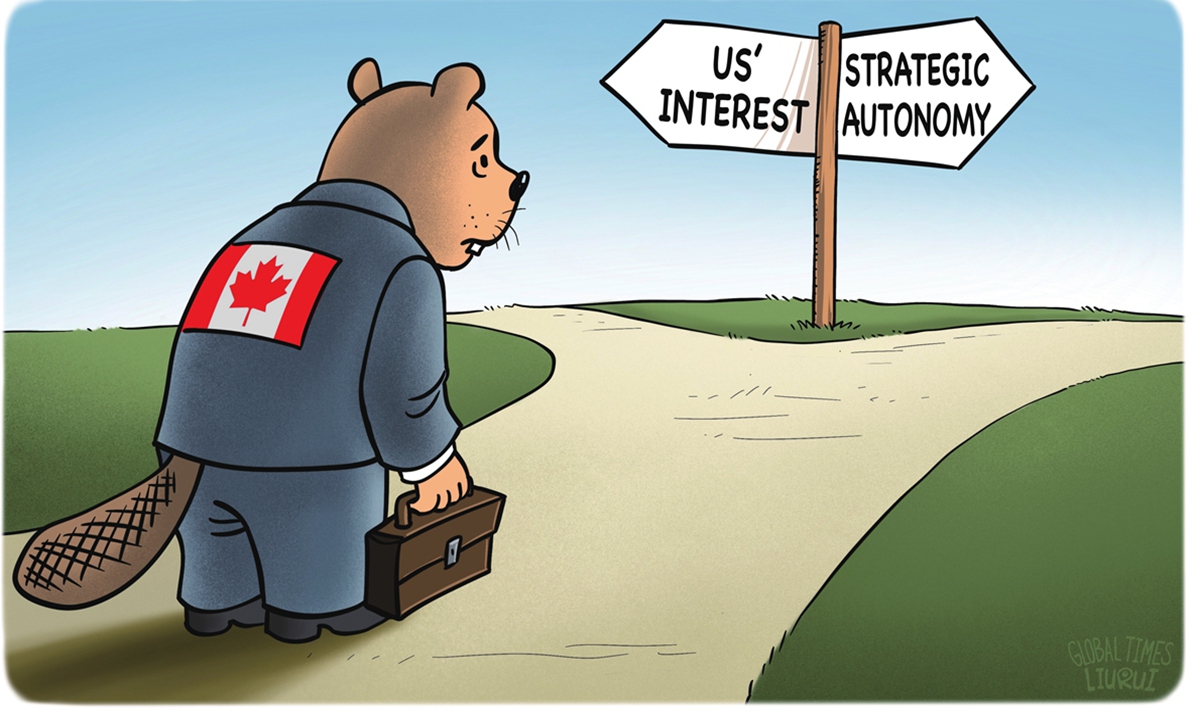
Illustration: Liu Rui/GT
On July 1, US Trade Representative Jamieson Greer said that the US would not renew the United States-Mexico-Canada Agreement (USMCA) in its current form. What began as a North American regional trade dispute was quickly redirected by Greer toward China. He accused Canada of claiming to support US reindustrialization on one hand while attracting Chinese investment on the other, and warned tighter content rules to block Chinese parts routed through the two neighbors. This effectively turns "not cooperating with China" into a condition for renewing the agreement - issuing an "ultimatum" to Ottawa to pick a side.
The core reason the US is unwilling to renew the USMCA lies in its persistent trade deficits, not in Canada's "closer" engagement with China. Since the agreement took effect in 2020, the US trade deficit with Canada and Mexico has remained at elevated levels. In 2025, the US goods trade deficit with Mexico reached $196.9 billion, while the deficit with Canada stood at $46.4 billion. Washington believes the current deal is not sufficiently advantageous to the US and hopes to renegotiate to address so-called "trade imbalances." As for China, it is merely being named as a convenient scapegoat once again.
Extending its reach across the Pacific and Atlantic to restrict exchanges and cooperation between other countries represents naked power politics and hegemonic logic. As early as the beginning of this year, Washington launched a round of maximum pressure, using the threat of high punitive tariffs to force Ottawa to abandon pragmatic economic and trade agreements reached with China.
After came into power, Prime Minister Mark Carney's government promoted trade diversification, which is a rational choice made by a sovereign state based on its own development needs and a pragmatic step to safeguard its industries and people's livelihoods. It was never targeted at any third party, nor does it constitute any so-called "betrayal of allies."
Today's Canada maintains deep integration with the US through industrial supply chains while enjoying broad complementary cooperation with China in areas such as energy, agriculture, and manufacturing. Similarly, Mexico plays a key role in absorbing manufacturing shifts and stabilizing North American supply chains, while maintaining close interactions with Asian markets. These are natural economic networks woven together by comparative advantages and market choices. Forcibly severing these connections is not only unrealistic and unfeasible but will also directly drive up consumer costs, undermine corporate profitability, and severely weaken the resilience of the global economy.
As for Canada's imports of Chinese electric vehicles (EVs), which appear to concern Washington the most, it was one of the practical outcomes achieved during Carney's visit to China. Under the arrangement, Canada granted Chinese EVs an annual import quota of 49,000 vehicles, with imports within the quota subject to a 6.1 percent tariff. That quota amounts to less than 3 percent of Canada's annual new vehicle market, yet it has prompted hawkish voices in the US to sound the alarm, warning Canada not to become a "backdoor" for Chinese EVs entering the US. The irony is that the US itself has imposed a 100 percent punitive tariff on Chinese EVs, along with software restrictions, leaving Chinese vehicles with virtually no access to the US market. Under such circumstances, how could they possibly impact the US supply chain?
Washington's attempt to pressure its neighbors into aligning more closely with its China policy in the supply chain runs counter to the spirit of free trade and undermines the international trading order. Currently, as multipolarity and economic globalization continue to deepen, middle powers are becoming increasingly conscious of their strategic autonomy, while emerging markets are rising rapidly. More and more countries are seeking greater diplomatic and economic independence. They are unwilling to become mere variables in major-power competition, let alone be forced to take sides between major powers.
The Canadian side's remark that "if you are not at the table, you are on the menu," aptly captures a sentiment shared by many countries. In this sense, the very logic of forcing countries to "take sides" reflects a misreading of the direction of history.
A healthy China-US relationship requires a rational and pragmatic approach. Building a constructive bilateral relationship of strategic stability is not just a slogan and it requires action; both sides should move in the same direction and make persistent efforts. The US should translate the important consensus reached by the two heads of state into specific policies and practical measures, rather than saying one thing and doing another - talking about equality, mutual respect, and win-win cooperation, yet acting according to a zero-sum logic in which one side's gain must come at the other's expense.
Politicizing or even weaponizing economic and trade issues will ultimately erode the US' own strategic credibility and international influence, while creating greater uncertainty for cross-border investment and long-term industrial planning.
Canada does not need to choose between China and the US. Canada is a sovereign country, not America's 51st state. The US has neither the justification nor the power to demand that third-party countries take sides between China and the US.
Not every problem can be solved by shifting the blame to China. International trade and investment are ultimately governed by market forces, comparative advantage, and economic rationality - not by the logic of geopolitical coercion. Those who embrace openness and inclusiveness will prosper, while those who retreat into protectionism and exclusion will fall behind. Economic globalization is an irreversible trend. Those who attempt to resist it will ultimately find themselves crushed under the wheels of history.
RELATED ARTICLES