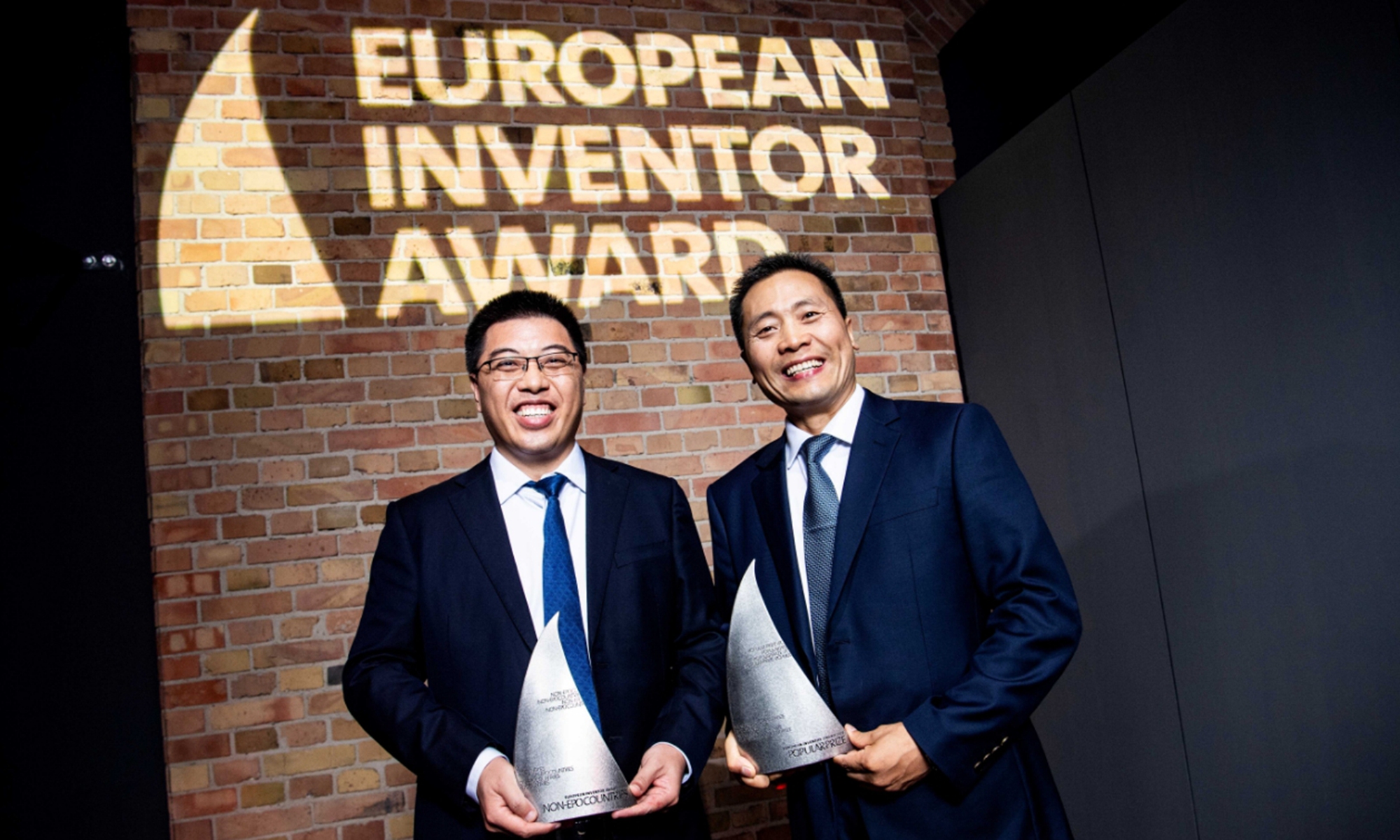
Two Chinese inventors, Xie Yinghao(left) and Yu Haijun, win the 2026 European Inventor Award in the Non-EPO Countries category and also received the Popular Prize on July 2, 2026 in Berlin, Germany. Photo: Courtesy of EPO
Two Chinese inventors have won the 2026 European Inventor Award in the Non-EPO Countries category and also received the Popular Prize for developing a smart battery recycling process that regenerates high-quality cathode materials from spent lithium-ion batteries, the Global Times learned from the European Patent Office (EPO) on Friday.
Developed by Chinese inventors Xie Yinghao and Yu Haijun, the technology achieves recovery rates of 99.6 percent for nickel, cobalt and manganese, and 96.5 percent for lithium, while reducing acid and alkali consumption by 73 percent. The process also produces battery-grade materials with a 61 percent lower carbon footprint than conventional production methods.
Lithium nickel-cobalt-manganese oxide (NCM), a key material used in electric vehicle batteries, is typically recovered through lengthy, chemically intensive recycling processes that require large amounts of water, acids, alkalis and energy.
Xie and Yu led the team in developing a more selective approach known as directed recycling, which converts spent lithium-ion batteries directly into battery-grade NCM cathode materials while preserving their functional crystal structure.
According to the International Energy Agency, more than 2,000 gigawatt-hours (GWh) of lithium-ion battery capacity was added worldwide between 2018 and 2023, powering around 40 million electric vehicles and thousands of battery energy storage projects.
As global demand for batteries continues to surge, so too does the need to recover critical raw materials such as lithium, nickel and cobalt. The inventors' technology enables spent lithium-ion batteries to be directly regenerated into high-performance cathode materials for new batteries, significantly reducing waste, resource consumption and carbon emissions.
"Our technology enables the direct regeneration of cathode materials from spent batteries, drastically reducing mineral consumption and carbon emissions. This breakthrough is the result of two decades of dedicated research into the circular economy," Yu said.
"Looking ahead, we will continue advancing battery circularity, deepen technological cooperation between China and Europe in the new energy sector, and work together to build a more sustainable energy future," he added.
Global Times
RELATED ARTICLES