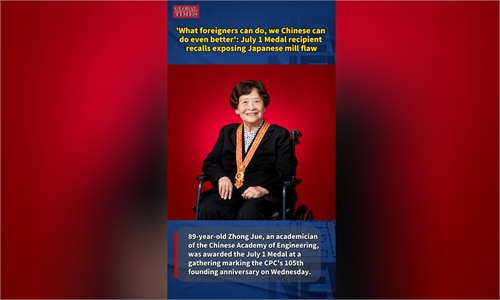
Academician Zhong Jue: The 'Steel Lady' forging China’s industrial might
By and Chen Zishuai in Changsha Published: Jul 03, 2026 09:37 PM
A grand gathering in celebration of the 105th founding anniversary of the Communist Party of China (CPC) was held at the Great Hall of the People in Beijing on Wednesday. Zhong Jue, an academician of the Chinese Academy of Engineering and a leading expert in mechanical engineering, is one of the eight recipients of the July 1 Medal, the CPC's highest honor.
Recently, Zhong, a witness to China's industrial development from the very first Five-Year Plan to the 15th now, was interviewed at Central South University in Changsha, Central China's Hunan Province. She revealed her life story of national service, perseverance, scientific rigor and mentoring.
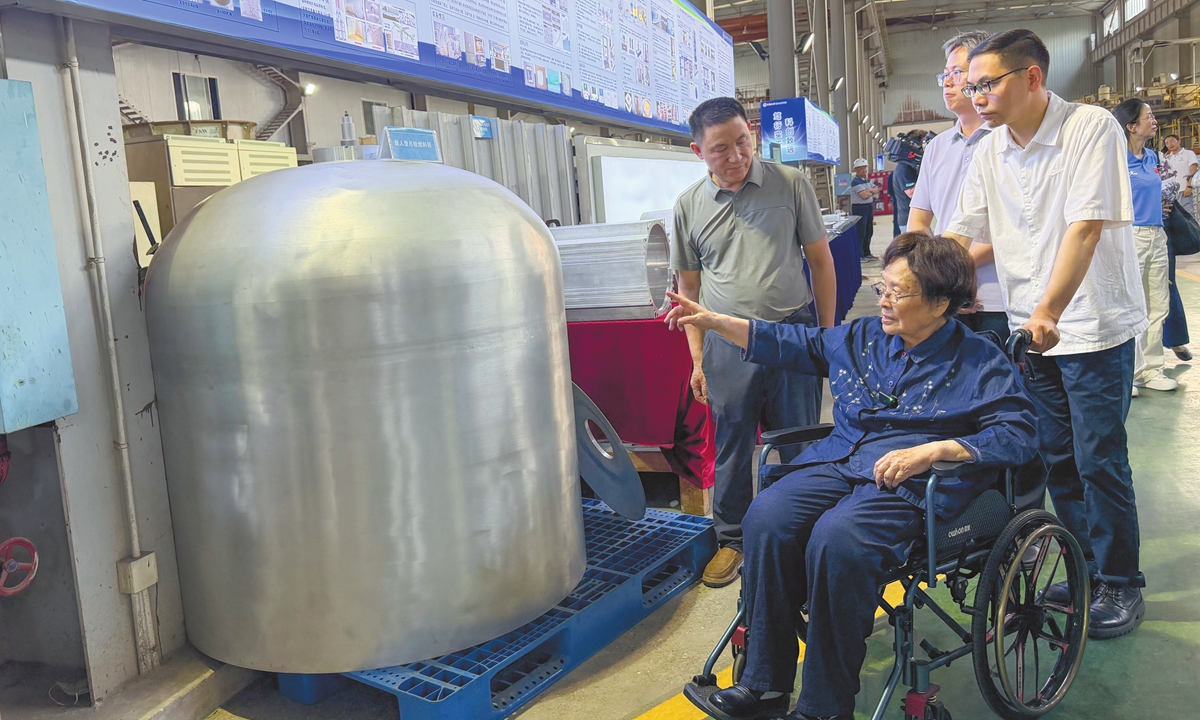
Zhong Jue tours research facility with her research team at Central South University in Changsha, Central China's Hunan Province, on June 15, 2026. Photo:Chu Daye/GT
Deep within the leafy campus of Central South University in Changsha, Central China's Hunan Province, nestled among the academic buildings, stand two unassuming industrial plants. They house the Light Alloy Research Institute and the State Key Laboratory of Precision Manufacturing for Extreme Service Performance. Here, amid the hum of giant machinery, the future of China's aerospace and defense is being forged - literally.
At the heart of this world, even as she approaches her 90th birthday, is Academician Zhong Jue. A towering figure in mechanical engineering and the first female academician in her field at the Chinese Academy of Engineering, she is a recipient of the July 1 Medal. To her colleagues and students, she is simply "Teacher Zhong" - a title of profound respect for a woman whose life has been a relentless, steel-willed campaign to build a self-reliant China.
The 'extreme' visionary
Walking through the laboratory, one is struck by the scale of the objects. Giant cylindrical steel and alloy shells, some over 10 meters in diameter with walls just 3 millimeters thin, line the workshop floor. These are not industrial pipes but rocket components, designed to withstand temperatures ranging from -200 C to 2,000 C.
"As the US is launching satellites into the Earth's orbit in the number of thousands, we have only hundreds. The bottleneck is cost," said Professor Liu Chunhui, a 39-year-old student of Academician Zhong. "We can't launch that many without low-cost, reusable rockets. The development of these large, lightweight components is the imperative."
This is where Zhong's legacy is most visible. In 2003, she pioneered the concept of "extreme manufacturing," a theory that pushes the boundaries of engineering to create massive, high-performance components with extraordinary precision from difficult-to-process materials. It was a vision she championed and, in 2006, was enshrined in China's Medium- and Long-Term Program for Science and Technology Development (2006-20).
A life forged in national rejuvenation
Zhong's drive is rooted in the experience of her childhood. Born in 1936, her earliest memories are of fleeing the brutal invaders during the war against Japanese aggression. "At five or six, I had to carry my little baggage and walk with my family from South China's Guangxi all the way to Chongqing [China's wartime capital at the time] to escape," she recalled. "I knew from then on: If our country is not strong, we will be bullied."
That conviction found its purpose in 1955. As a high school student preparing for university, she heard a broadcast of a report on the first Five-Year Plan by Zhou Enlai, the first premier of the People's Republic of China. Premier Zhou said, "The steel industry is the foundation of our nation, and the machinery industry is the foundation of that foundation," Zhong remembers. It was a revelation. She enrolled in then Beijing Institute of Iron and Steel Technology, which is now known as the University of Science and Technology Beijing.
Battling the 'experts'
Zhong's career is a testament to scientific rigor, a quality that led to one of her most famous confrontations - with the Japanese.
In the late 1970s, the Wuhan Iron and Steel Corporation imported an advanced hot-rolling mill from Japan. During Japanese-led commissioning, a crucial component broke. The Japanese experts immediately blamed Chinese workers, claiming they had failed to properly lubricate the machinery.
"It was a standard operation. And our workers were meticulous," Zhong said, with a firm shake of her head. "I didn't believe it."
She arrived on site with her team. While the Japanese experts looked on dismissively, she and her students worked through the night, setting up sensors across the massive machine. The data they collected told a different story: The failure was due to abnormal loads caused by a design flaw in the Japanese equipment, not an operator error. Faced with her irrefutable evidence, the Japanese experts conceded and paid compensation.
"That moment gave me a lifelong conviction," she stated. "Our country's history is so long, and we have accumulated so much wisdom and talent. It's just that for a long time we didn't put it to use, which is why, for a period of time, we appeared to have nothing available. We Chinese are no less capable than anyone else. I have never since faced a problem that felt insurmountable."
The 'national treasure' and a legacy of mentorship
Her confidence has been indispensable in tackling national "bottlenecks." In the 1990s, she was tasked with upgrading China's sole 30,000-ton hydraulic press, a "national treasure" so critical it was once personally designated by Premier Zhou Enlai. The goal was to increase its capacity to 40,000 tons to meet growing defense needs.
"I remember climbing up and down that machine with her, from 10 meters underground to over 20 meters high, covered in oil and grease," recalled Professor Tan Jianping, Zhong's first doctoral student and former dean of the university's School of Mechanical and Electrical Engineering. "She was relentless."
Under Zhong's guidance, the complex upgrade was successfully completed, dramatically boosting the nation's ability to forge massive components for its defense industry. Professor Tan's entire career was associated with that single machine, including participating in its latest major upgrade in 2023, turning it from a hydraulic to an oil-pressure system.
"After the refit, it will probably serve the country for another 50 years," he said proudly.
Zhong's influence is also felt in entirely new frontiers. Professor Duan Ji'an, a close associate who has worked with Zhong for the past 30 years, recalled being puzzled in 2000 when Zhong decided to steer the team into optoelectronics manufacturing, a field they knew almost nothing about.
"We are metallurgical mechanics. We didn't know a single thing about optoelectronics," Duan admitted. "But for Teacher Zhong, if it's a national need, you just do it."
Working with universities like Tsinghua University and Huazhong University of Science and Technology, Zhong's team methodically built the country's first microelectronics device manufacturing program from the ground up. They developed domestic production equipment for optoelectronic devices, breaking a key foreign monopoly and creating an industry that is now an emerging pillar of China's high-tech sector.
"To her, national demand is a direct command," Duan said. "There is nothing she dares not do."
Now frail and confined to a wheelchair, Zhong still visits the lab, with her sharp mind guiding the next generation of researchers. Behind her are echelons of confident and experienced engineering talent in the metallurgical and microelectronic sectors at the helm of the country's key projects.
When asked about receiving the July 1 Medal, the steel lady gave a humble smile, simply stating it is "the highest recognition of our work."
From the ruins of wartime China to the frontier of space-age manufacturing, Zhong has been more than an engineer. She has been a builder of a nation's confidence, a steel lady who turned a childhood vow into a formidable legacy that has reshaped China's industrial destiny.
RELATED ARTICLES