Is Europe’s chaotic scramble for ACs merely the result of a natural disaster? : Global Times editorial
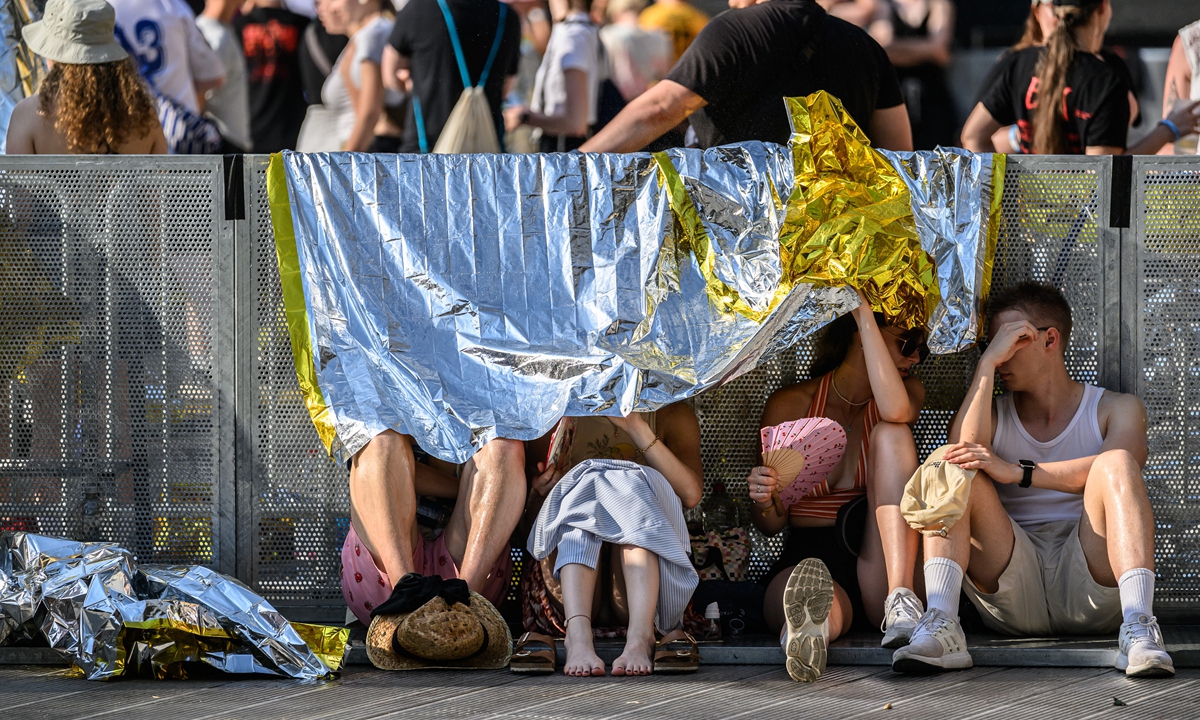
Fans of the band Kraftklub shelter from the sun under emergency tarps before the start of the concert as part of the 2026 "Sterben in Karl-Marx-Stadt" Open Air festival at Rudolf-Harbig Stadium in Germany on June 27, 2026. Photo: VCG
"To install air conditioners (ACs) or not - that is the question." A scorching heatwave has gripped Europe for over a month, pushing the death toll - attributable to the extreme heat - into the thousands across countries such as France, Spain, and Germany. To survive, scenes of Europeans queuing for hours under the blazing sun to snap up ACs have become commonplace. Some have even come to blows in the scramble for them.
These news reports are sobering. Europe has long prided itself on being developed, mature, and modern, and indeed, many of European nations possess robust industrial foundations and high standards of living. But why has Europe, which has long styled itself as a "guardian of the environment," proven so ill-equipped to cope with a predictable climate-driven disaster?
European summers were relatively mild in the past, so the lack of cooling facilities stems from historical factors. However, climate change has long since sounded the alarm; heatwaves are no longer mere accidental events. Faced with this new normal, governments ought to proactively plan for urban renewal, energy security, support for vulnerable groups, and the allocation of emergency supplies. Yet, when disaster strikes, European politicians do not seek ways to boost production or import more affordable ACs for the public; instead, they continue to shift blame or seize the opportunity to push their own political agendas. In a sense, the root cause of Europe's air conditioning crisis lies in the lag in existing governance capacity; it involves human-induced factors rather than being merely a natural disaster.
This is not to deny the value of Europe's experiences, nor is there any intention to oversimplify complex issues. Extreme weather is a challenge facing all of humanity, and no country can remain immune to its effects. During the process to look for solutions, China's systematic practices in recent years of enshrining "ecological civilization" in its national strategy may well offer useful lessons for Europe.
First, adhering to systematic thinking. Europe leads the world in the development of building energy efficiency, low-carbon heat pump technology, and eco-friendly refrigerants; however, its pursuit of extreme emissions reductions in environmental practice has led to the neglect of coordinated development in other areas. In contrast, China views the ecosystem as an organic whole, with "people" serving as a vital component. China's development of ecological civilization is a systemic and holistic governance framework.
This means that when formulating urban development plans, energy policies, building standards, or even measures for public well-being, one must comprehensively weigh overall benefits to achieve the "integration of multiple plans" and synergistic effects. For instance, the renovation of old buildings respects their original character while employing innovative technologies to deliver practical, adaptive solutions; similarly, the drive for a green transition balances energy security, industrial upgrading, and the quality of life for the public, thereby avoiding the pitfalls of neglecting other vital interests in pursuit of a single objective.
Second, sticking to the people-centered and shared development philosophy. While Europe possesses technological advantages, its heavy reliance on market allocation has concentrated resources in the hands of the wealthy. Furthermore, the conflict - between antiquated bureaucratic procedures and institutional constraints and the need to address the pressing issues facing the public - reveals that Europe's development still lacks a fundamental, people-centered philosophy. Some European media outlets have even described the current heatwave as triggering a "climate class war."
China's pursuit of ecological civilization is not merely a technological or emissions-reduction project, but also a cause in which the people participate, build, and share together. For example, China has integrated targeted poverty alleviation with ecological industries, while incorporating subsidies for energy-efficient appliances and preferential tiered electricity pricing into its social welfare system. This is not simply an expansion of welfare, but a shift from treating air conditioning as an individual consumer choice to recognizing access to cooling as part of the state's responsibility to safeguard basic living standards.
Third, and most importantly, it is necessary to overcome the false perception that environmental protection and economic development are inherently at odds, and recognize that they can be pursued in a mutually reinforcing manner. When discussing green transitions, Europe often focuses excessively on stringent emissions reduction targets, neglecting the real needs of people for basic survival rights such as cooling during extreme weather events. In contrast, while addressing practical challenges such as improving energy efficiency and mitigating the urban heat island effect, China has taken a broader approach by turning its ecological assets into drivers of economic growth. In doing so, it has demonstrated that green development and a higher quality of life can go hand in hand. Only when the benefits of the green transition are tangible to ordinary people can it generate lasting public support and sustain the momentum for further transformation. This reflects a principle often emphasized in China: lucid waters and lush mountains are invaluable assets.
The recent heatwave has offered an important lesson for the world. The strength of a governance system cannot be measured by its own claims of superiority. It should be judged by whether it can solve real problems, protect its people when it matters most, and turn long-term plans into concrete actions. As extreme weather becomes more frequent, all countries have something to learn from one another.
Europe needs to reflect on its governance shortcomings, while China will continue improving through openness and international cooperation. The two sides differ in their governance systems, historical experiences, and cultural traditions, but that is precisely what makes mutual learning among civilizations valuable.
Some in Europe used to take a patronizing view of China, even politicizing normal economic and trade cooperation and criticizing the competitiveness of Chinese companies. But the current heatwave has highlighted a different reality: European consumers' growing demand for Chinese-made ACs and other cooling products underscores the irreplaceable value of mutually beneficial cooperation under economic globalization. China stands ready to work with Europe and other partners to advance green development and improve people's well-being. Facts should serve as the mirror, people's livelihoods as the yardstick, and cooperation as the path forward. Those who genuinely put the people first will ultimately earn the enduring trust of their citizens.
RELATED ARTICLES