Modified trading rules for Chinese A-shares take effect, a move to increase appeal of yuan-denominated assets: analysts
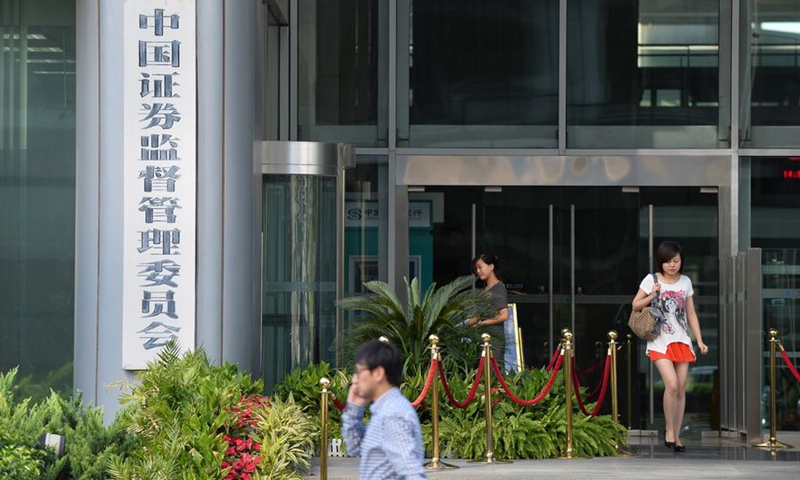
File photo shows the entrance of the China Securities Regulatory Commission (CSRC) in Beijing, capital of China. (Photo:Xinhua)
The revised trading rules on China's Shanghai, Shenzhen and Beijing stock exchanges took effect on Monday, with the changes focusing on expanding after-hours trading, unifying price limits for special treatment stocks and optimizing closing mechanisms to improve market pricing efficiency and liquidity.
An analyst said that the new rules mark a shift in China's capital market from "market opening-up" to deep alignment with international practices, which will strengthen the appeal of the yuan assets in global market.
For investors, two major changes warrant attention. First, after-hours fixed-price trading has been expanded to cover all A-shares and exchange-traded funds (ETFs). Second, the daily price limits for the main-board stocks under special treatment (ST) or risk warning status have been raised from 5 percent to 10 percent, according to a report by China Securities Journal on Monday.
"The new rules reduce participation costs for foreign investors while enhancing pricing efficiency," Tian Lihui, dean of the Institute of Financial Development at Nankai University, told the Global Times on Monday, noting that they represent three breakthroughs for international investors.
First, the time-zone barrier is substantively removed. Previously, due to time difference, foreign investors often missed the critical window for A-share closing pricing, leading to wider tracking errors in ETFs. Under the new rules, the 25-minute after-hour fixed-price trading session allows cross-time-zone capital to adjust positions at the official closing price. This can reduce the market impact cost of single transactions exceeding 100 million yuan ($14.73 million) by over 40 percent, significantly improving the allocation efficiency of yuan assets, Tian said.
In addition, the risk-pricing mechanism is closely aligned with international norms by raising daily price limits for the main-board stocks under ST or risk warning status to 10 percent. Moreover, the institutional credibility will also be increased, Tian said.
"From granting Qualified Foreign Institutional Investors access to Treasury bond futures to aligning trading rules with mature international markets, China's capital market is shifting from 'opening access channels' to 'building regulatory credibility.' This type of institution-led opening-up provides a foundational underpinning for anchoring the 'safe-haven asset' status of yuan assets," Tian said.
According to a CCTV News report on June 30, foreign investors hold more than 4 trillion yuan worth of A shares, hitting a record high. Meanwhile, some overseas institutions continue to increase their holdings of Chinese technology stocks.
Having evolved from a technology follower to a leader, Chinese enterprises are unlocking significant growth potential through innovation - a key factor attracting foreign institutions to invest in Chinese assets.
Standard Chartered Bank recently released its global market outlook for the second half of 2026, recommending an overweight position on Chinese stocks, with a focus on the country's technology and telecommunications service industries.
"We believe valuations in the China market remain attractive," Liang Dawei, general manager of the Wealth Solutions Department at Standard Chartered Bank (China), said in a note sent to the Global Times recently.
China is keeping pace with the rapid evolution of artificial intelligence (AI), with the 15th Five-Year Plan designating 'AI Plus' as a strategic priority to empower all sectors of the economy, and, the country's successful transition to renewable energy, coupled with ample energy capacity, provides a robust power guarantee for power-intensive data centers, thereby giving China a competitive edge in the global AI race, Liang said.
Yeang Cheng Ling, chief investment officer in North Asia of Singapore's DBS Group, told the Global Times that China's A-share market offers a "differentiated place for global portfolio diversification."
RELATED ARTICLES