Anti-NATO protests, internal rifts cloud Ankara summit as Chinese experts cite growing trust deficit
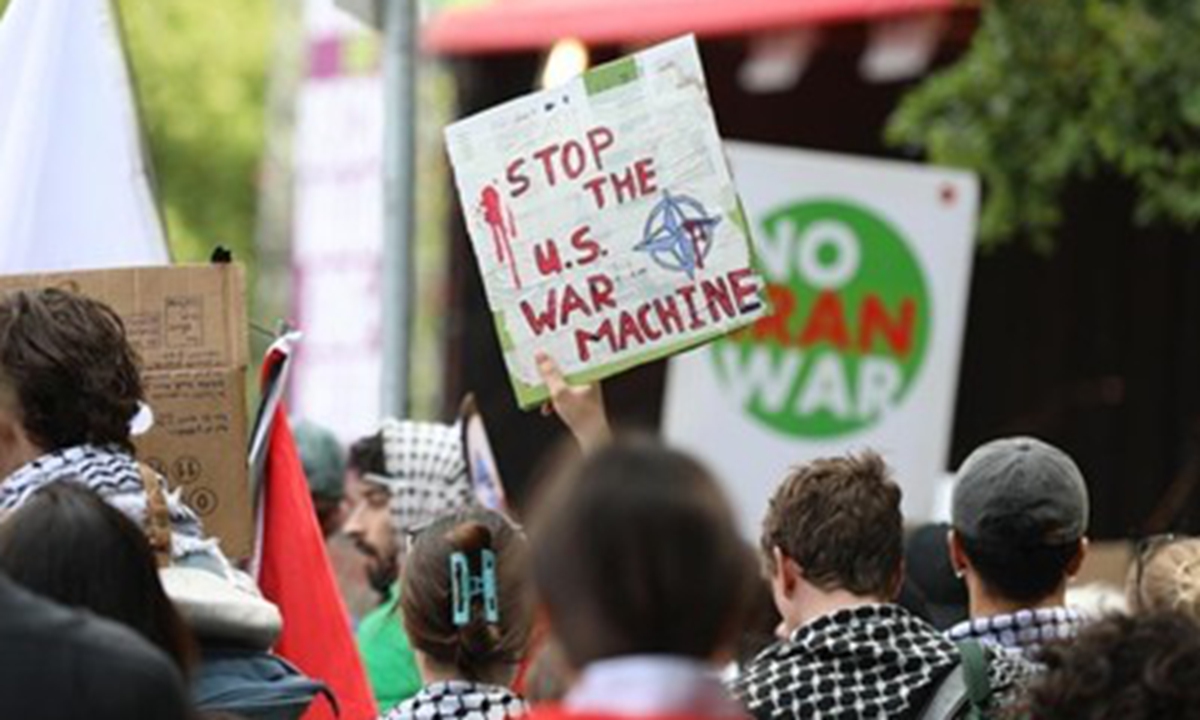
People takes part in an anti-NATO protest march organized by the Communist Party of Turkey (TKP) in Istanbul on July 5, 2026. Photo: Xinhua
As Turkey prepares to host the NATO summit on July 7-8, thousands of demonstrators took to the streets in Istanbul, Ankara and Izmir over the weekend to denounce the alliance's push for higher defense spending, Xinhua reported. A Chinese expert said the protests reflect growing public dissatisfaction with diverting resources from people's livelihoods to military spending, and as major media outlets have described the Ankara summit as a key test of NATO unity and US commitment to the alliance, the meeting is unlikely to deliver major breakthroughs but may expose deeper divisions.
In Istanbul, workers, civilians and members of political parties joined large rallies on both the European and Asian sides of the city, voicing their opposition to NATO's pressure on member states to increase military expenditure. They carried banners reading "NATO wants war, workers want peace," "Budget for the people, not for NATO," and "No to NATO, no to war," while chanting slogans against the alliance, according to the Xinhua News Agency.
According to Reuters, footage of the protests showed demonstrators waving flags and chanting slogans including "Murderer NATO, get out of country" and "No passage to NATO."
The protests came as the alliance prepares for what Turkish Foreign Minister Hakan Fidan has described as "the most consequential summit" in NATO's history, against the backdrop of the alliance's greatest internal friction, Turkey Today reported.
The protests, which erupted on the eve of the summit, reflect strong public dissatisfaction in Turkey with diverting resources from people's livelihoods to excessive military spending, Jian Junbo, director of the Center for China-Europe Relations at Fudan University's Institute of International Studies, told the Global Times on Monday. He further noted that as major media outlets have described the Ankara summit as a key test of NATO unity and US commitment to the alliance, the meeting is unlikely to deliver major breakthroughs but may expose deeper divisions.
According to Reuters, one of the main themes of discussions in Ankara is to keep the US committed to the alliance's Article 5 clause, which specifies that an attack on one of its members is an attack on all.
The Reuters also reported the Trump administration has pushed European governments to take on primary responsibility for the conventional defence of Europe as Washington seeks to dedicate more resources to the Indo-Pacific, and that at the summit in the Hague last year, NATO leaders backed the big increase in defence spending that Trump demanded, pledging to spend 5% of GDP on defence and defence-related measures within a decade.
The European Parliament Research Service described the summit as a key moment for demonstrating allied unity amid evolving geopolitical dynamics in the Middle East, the ongoing conflict in Ukraine, and growing calls for Europe to assume greater responsibility for its own security.
Although the Ankara summit is intended to demonstrate unity, reaffirm defense commitments and coordinate support for Ukraine, the anti-NATO protests on Turkish streets, US President Donald Trump's repeated demands for greater"loyalty"from allies, and European concerns over US long-term security commitments all point to an erosion of trust within the alliance, Zhao Junjie, a senior research fellow at the Institute of European Studies at the Chinese Academy of Social Sciences, told the Global Times on Monday.
"The growing trust deficit is also driven by long-standing political divisions, insufficient defense budgets among member states, limited fiscal capacity to sustain higher military spending, and differing approaches to defense development," Zhao said.
According to German broadcaster Deutsche Welle, disputes over burden-sharing, US military commitments and the Iran conflict are posing a major test to NATO unity. A recent survey by Turkish polling firm ANK-AR Voter Agenda Survey, cited by Turkey Today, also showed that only 26 percent of respondents said NATO membership was "beneficial" or "very beneficial" for the country.
"Although countries in Eastern Europe, such as Poland and Lithuania, have strong security interests in relying on the US and NATO, countries including France and Spain are increasingly pursuing strategic autonomy. They have become more skeptical of external security guarantees, particularly those provided by the US, making it much harder to achieve the alliance's shared spending goals," Zhao said.
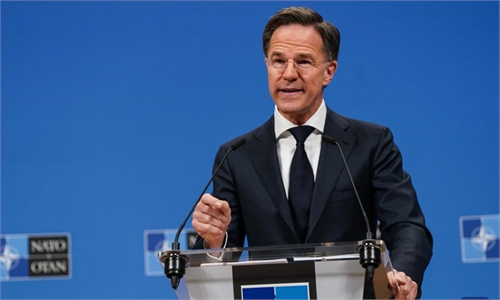
Recently, as NATO Secretary-General Mark Rutte was in Washington to try to smooth over tensions between the US president and European allies over defense spending and Europe's position on the war with Iran, Trump criticized NATO allies for failing to support US military operations against Iran, publicly expressing dissatisfaction with countries including Spain, Italy, the UK, Germany and France.
"We're disappointed with most of them. They don't want to pay anything. They think they're in for a free ride," Trump said, according to El Paris.
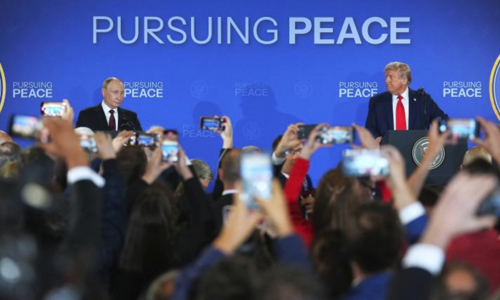
Trump also said if it weren't being hosted by Turkish President Recep Tayyip Erdogan, whom he likes, he probably wouldn't come, NPR reported. Days later, he wrote on social media that it is "ridiculous" for the US to continue its "one sided" relationship with NATO, and US relationship with NATO "is not reciprocal."
The Associated Press reported that Rutte sought to appeal to Trump by presenting a chart labeled "The Trump Trillion," showing $1.2 trillion in spending by European allies and Canada since 2017, in an attempt to address Trump's complaint about NATO allies spending too small a fraction of their national budgets on defense.
But Trump appeared unmoved, saying "we don't need their money -- we don't need anything, I just want loyalty," AP reported.
However, loyalty is hard to reach. Zhao noted that many European countries in NATO, including France, Spain and Italy, are increasingly questioning US security guarantees. Dissatisfaction over issues such as Greenland and other US policies has strengthened calls for European strategic autonomy.
"Meanwhile, Europe's economic transition has exposed funding shortages and structural challenges, while higher defense spending inevitably competes with resources that would otherwise be allocated to other domestic priorities," Zhao said.
He added that the rise of right-wing populism across Europe has further fragmented traditional political forces, making consensus on defense spending even more difficult.
"As the summit reaches critical negotiations, some member states may take actions aimed at safeguarding their own interests, which could further reveal the alliance's internal divisions," Zhao said.
RELATED ARTICLES