PLA Navy conducts test launch of strategic missile by submarine; China's nuclear triad deterrence significantly enhanced: experts
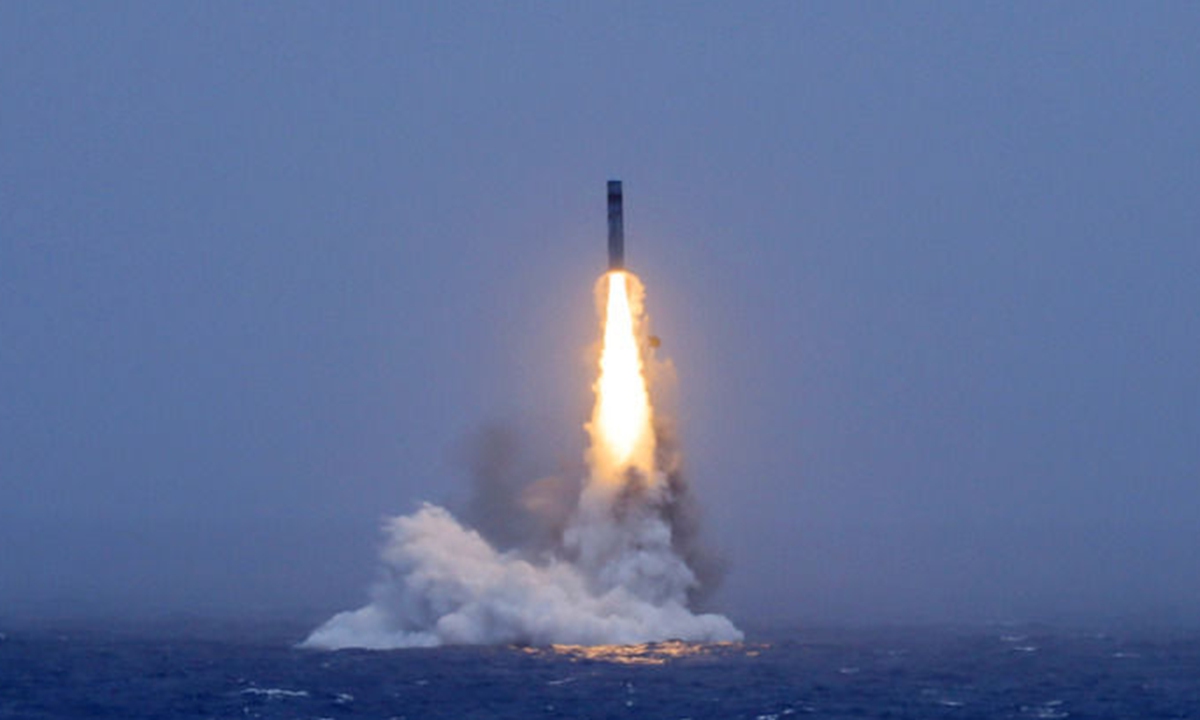
The Chinese People's Liberation Army (PLA) Navy successfully conducted the test launch of a strategic missile by a submarine on July 6, 2026. Photo: Xinhua
The Chinese People's Liberation Army (PLA) Navy on Monday successfully conducted the test launch of a strategic missile by a submarine, Xinhua News Agency reported at 1 pm, just 59 minutes after the launch took place. Experts interviewed by the Global Times widely agreed that the launch was smooth, the outcome was successful, and all intended objectives had been met.
The PLA Navy said that one strategic nuclear submarine of the navy successfully launched a strategic missile carrying a dummy warhead toward relevant high seas of the Pacific Ocean at 12:01 pm, which landed precisely within the designated waters, according to Xinhua.
"This brief official statement carries an enormous amount of information and deserves in-depth analysis," Zhang Junshe, a Chinese military affairs expert, told the Global Times on Monday.
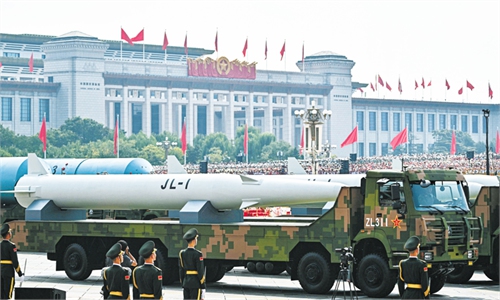
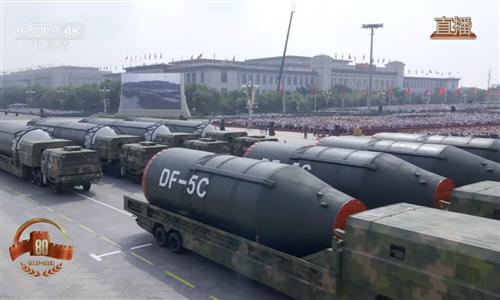
Zhang noted that based on the official statement, the submarine-launched strategic missile tested in this launch is believed to be the Julang (JL) submarine-launched strategic missile previously unveiled during the military parade marking the 80th anniversary of the victory in the Chinese People's War of Resistance Against Japanese Aggression and the World Anti-Fascist War on September 3, 2025. Its range likely exceeds 8,000 kilometers, making it an intercontinental ballistic missile.
This marks the second time in two years that the PLA has conducted an intercontinental ballistic missile test in the Pacific Ocean.
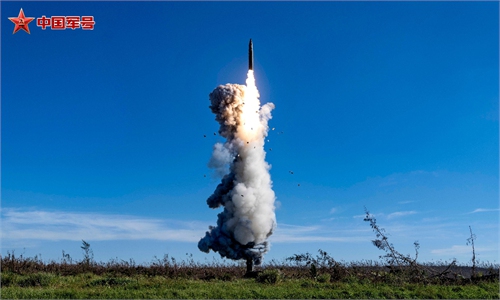
The PLA Rocket Force launched an intercontinental ballistic missile (ICBM) carrying a dummy warhead into the high seas in the Pacific Ocean on September 25, 2024, according to the Ministry of National Defense. The missile fell into expected sea areas, the ministry said, adding that this was a routine arrangement in the annual training plan and relevant countries had been notified in advance.
Zhang said that the test this time carries far-reaching significance. "Within the nuclear triad, strategic nuclear submarines are internationally recognized as the most secure platform for secondary nuclear counterstrike capability. Submarines conduct long-term underwater mobile patrols, making them extremely difficult to detect and track, with strong battlefield survivability. Even if land-based and air-based nuclear platforms come under suppression, strategic nuclear submarines operating in the deep ocean retain full nuclear counterstrike capabilities," Zhang said.
Zhang noted that this submarine-launched strategic missile test fully validated the entire operational chain - underwater mobility, underwater launch, long-range guidance - and thoroughly demonstrated that the PLA's sea-based nuclear forces can conduct stable and reliable strategic counterstrikes from any location in the vast waters of the Western Pacific.
Song Zhongping, a Chinese military affairs expert, shared this view. Song told the Global Times that the successful launch of this submarine-launched strategic missile echoes the PLA's land-based ICBM test conducted in the Pacific Ocean two years ago. From the new land-based ICBM test to the new submarine-launched strategic missile test, these two types of strategic strike capabilities are interlinked and mutually reinforcing, significantly enhancing the overall deterrent effectiveness of China's nuclear triad.
The official statement indicated that the launch platform was a strategic nuclear submarine carrying submarine-launched strategic missiles.
Zhang explained that strategic missiles possess two core attributes: In terms of operational positioning, these missiles are designed for strategic strikes - not against frontline field forces, but against enemy command centers, core military installations, and strategic facilities such as energy and economic infrastructure, thus delivering comprehensive strategic deterrence.
In terms of range, strategic missiles typically refer to ICBMs with ranges covering thousands to tens of thousands of kilometers, far exceeding conventional missiles, and featuring extremely powerful warheads, said Zhang.
The test launch has drawn significant international attention, with the specific model of the strategic nuclear submarine involved in the mission attracting particular focus.
"Strategic nuclear submarines refer specifically to nuclear-powered submarines equipped with submarine-launched ICBMs and tasked with nuclear counterstrike missions. China's current inventory includes the Type 092, Type 094, Type 094 improved variants, and newer iterations," Zhang said.
In April 2018, the Central Military Commission held a naval parade in the South China Sea. Publicly available information shows that the vessels reviewed included two Type 094A strategic nuclear submarines. On April 23, 2021, three main types of naval vessels were delivered and commissioned in a ceremony at a military port in Sanya, South China's Hainan Province, including the newest strategic nuclear submarine, the Changzheng-18. In July 2025, ahead of the August 1 Army Day, a CCTV promotional video publicly released footage of a new type of submarine on long-range missions, which was widely assessed by observers to be a Type 094 strategic nuclear submarine.
Following China's customary practice of equipment disclosure, the appearance of a platform in official releases typically indicates that a newer generation of equipment has already been fielded. Therefore, the submarine involved in this test could be a Type 094, an improved variant of the Type 094, or possibly a newer advanced strategic nuclear submarine, Zhang said.
Regarding the specific model of the submarine-launched ICBM tested, Song Zhongping assessed that the probability of a JL-3 missile test was extremely high.
The JL-3 submarine-launched ICBM was formally unveiled during the military parade marking the 80th anniversary of the victory in the Chinese People's War of Resistance Against Japanese Aggression and the World Anti-Fascist War on September 3, 2025.
The missile had previously undergone multiple tests including high-trajectory and low-trajectory trials, and there was an urgent need for a near-full-trajectory test to comprehensively validate the weapon system's ballistic performance and operational reliability, Song suggested.
"As China's independently developed third-generation submarine-launched ICBM, the JL-3 has become the backbone of the sea-based nuclear deterrent system," Zhang said.
Zhang suggested that the missile has a range of more than 10,000 kilometers, covering the South Pacific and the eastern Pacific, demonstrating extremely strong strategic deterrence capability.
Notably, both the September 2024 land-based ICBM test and this sea-based submarine-launched missile test used training dummy warheads. Zhang explained that this is a common practice among nuclear-armed nations conducting strategic missile training, ensuring safety and control throughout the test while eliminating the need for complex live-warhead recovery operations.
The test launch is a routine arrangement of the annual training of the PLA Navy, the navy said, adding that the Chinese side has already notified relevant countries in advance, according to Xinhua. The test launch complies with international law and international practice, and is not directed at any specific country or target, the navy said.
Nevertheless, some countries are still making "noises." According to a report by Nikkei, China notified Japan of the launch. However, the Japanese government "strongly urged" Beijing to reconsider the test launch, to avoid the missile flying over areas including Japanese airspace, and posing a threat to Japan's security. At the same time, the Japanese government also expressed its serious concerns to the Chinese side over China's increasingly active military activities.
In response, Zhang said, "This test fully demonstrates China's defensive nuclear strategy, with high transparency and appropriate restraint. China proactively notified relevant countries in advance, and the exercise was not directed at any third party. Its core purpose is to safeguard national sovereignty and security as well as maintain regional peace and stability. Individual countries should not make unwarranted criticisms."
The expert emphasized that this submarine-launched missile test carries profound significance. On one hand, it thoroughly verified the reliability and accuracy of the ICBM, clearly demonstrating the PLA's mature strategic operational capabilities, continuously enhancing China's strategic deterrence and nuclear counterstrike capabilities, and sending a clear signal to the world: China has the capability to safeguard its national sovereignty and security as well as the confidence to maintain regional peace and stability, with sufficient strategic reserves to respond calmly to various potential security threats, Zhang noted.
At a regular press conference of China's Ministry of Foreign Affairs on Monday, a reporter asked for the ministry's comment on criticism by relevant countries for the test launch.
Chinese Foreign Ministry spokesperson Mao Ning said that the PLA Navy's test launch of a strategic missile by a submarine was a routine military training activity that is not directed at any specific country or target. The countries concerned were informed prior to the launch. It is consistent with international law and customary international practice. The whole process was safe, standard and professional. "We hope relevant countries will not read too much into it," Mao said.
RELATED ARTICLES