Japan claims 10 cases of Chinese naval activities within one week; PLA Navy's regular far-sea training deters Japan's neo-militarist undercurrents, safeguards regional peace: expert
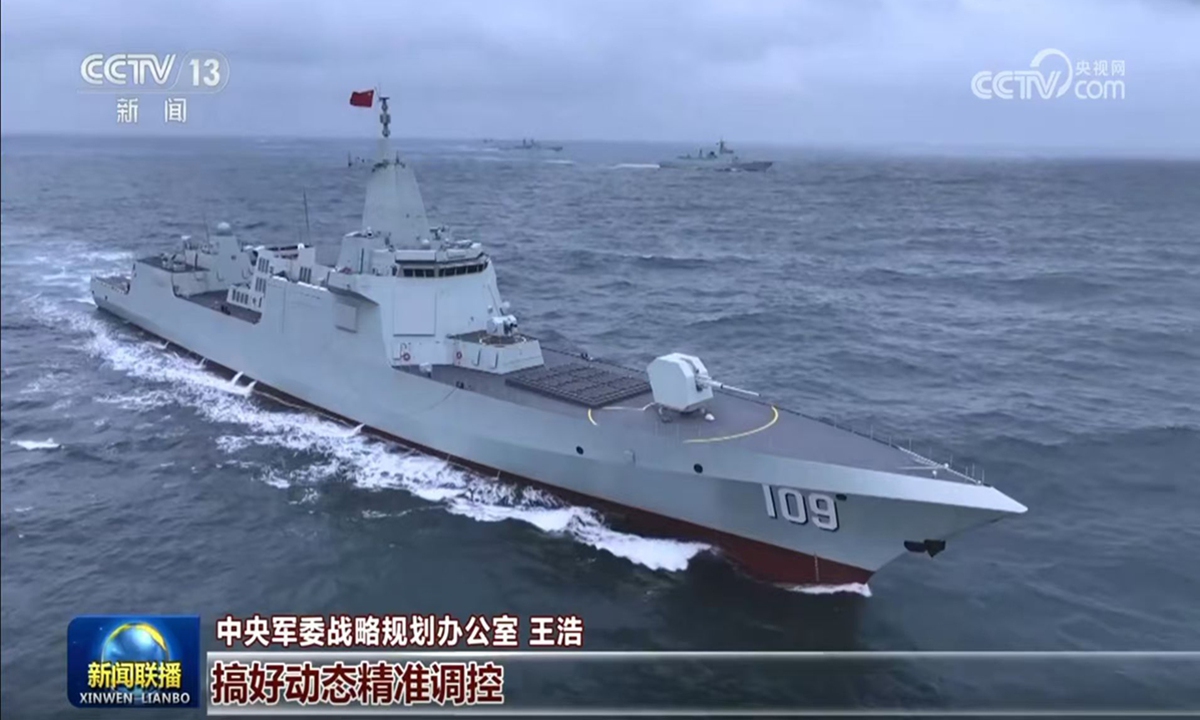
Two new Type 055 large destroyers of the Chinese People's Liberation Army Navy, the Hull 109 Dongguan and the Hull 110 Anqing, conducting joint training at sea with other vessels, are featured in a report aired by Xinwen Lianbo, a news program produced by China Central Television, on March 8, 2026. File photo: Screenshot of the Xinwen Lianbo
Japan's Ministry of Defense's Joint Staff claimed 10 cases of Chinese naval activities and one update on China-Russia joint aircraft activity over a 7-day period from June 25 to July 1, closely prying into the routes of Chinese warships transiting international straits around Japan en route to far-sea training, a frequency that has drawn international attention.
A Chinese military affairs expert said that the People's Liberation Army (PLA) Navy's operations are lawful and routine, and Japan has no need to overhype them. The continued enhancement of China's far-sea operational capabilities serves as an effective deterrent against Japan's neo-militarist undercurrents while contributing to regional peace and stability.
According to the releases from Japan, multiple batches of mainstay PLA Navy warships recently transited international straits around Japan before entering the Western Pacific. On June 29 alone, the Joint Staff published five separate updates on related activities, an unusually high reporting frequency in recent years.
The information released by Japan shows that the deployments included both individual warships sailing into the open ocean and naval formations conducting far-sea training. The vessels ranged from the Type 055 destroyer Nanchang, a representative of China's advanced surface combatants, to the newly commissioned Type 055 destroyer Dongguan, covering multiple major surface combatants from the PLA Navy's East Sea Fleet and North Sea Fleet.
The concentrated deployments of the Type 055 10,000-ton-class destroyers alongside Type 052D and Type 052C guided-missile destroyers, as well as Type 054A guided-missile frigates demonstrate the PLA Navy's comprehensive far-sea offensive and defensive capabilities, Zhang Junshe, a Chinese military affairs expert, told the Global Times on Saturday.
Zhang noted that the Dongguan, which officially made its public debut only in March this year, has already been deployed for combat-oriented far-sea training, reflecting the accelerating pace at which the PLA Navy commissions new equipment and converts it into operational combat capability.
Japan's frequent releases on Chinese naval movements have also attracted overseas media attention. Russian media Sputnik on Saturday reported on the developments under the headline "Chinese warships pass through four major maritime gateways around Japan, with at least seven vessels deployed in the Western Pacific."
Commenting on what he described as Japan's deliberate exaggeration of the activities, Zhang said that waterways such as the Osumi Strait, Tsushima Strait and Miyako Strait are international waterway straits used for international navigation. Chinese naval vessels' transits through these waters are entirely legitimate, fully consistent with international law and common practices among navies worldwide.
Zhang said the Japan SDF have long tracked and monitored Chinese warships around these straits, earning the nickname of the PLA Navy's "official cameraman." Actually, Chinese naval vessels can also enter the Western Pacific through the Bashi Channel, Balintang Channel and Babuyan Channel, making it impossible for Japan to monitor every route. Rather than overreacting, Japan should adopt a rational view of China's routine far-sea training activities instead of unnecessary hype.
Zhang further stressed that the normalization of the PLA Navy's far-sea combat-oriented training reflects the steady improvement of China's overall naval strength, including the professionalism of its personnel, the performance of its equipment and sustained maritime operational capabilities.
"The steady improvement of the PLA Navy's far-sea combat capabilities serves as an effective deterrent against the rising neo-militarist forces in Japan, while also deterring external forces that harbor ill intentions and helping provide a solid guarantee for regional peace and stability," Zhang said.
Meanwhile, according to the Xinhua News Agency, China and Russia on Monday launched the "Joint Sea-2026" exercise at a military port in Qingdao, East China's Shandong Province. A joint command has been established, comprising task forces from the navies of the two countries.
Following the opening ceremony, the two navies conducted exercises in command and tactical coordination. The joint command held in-depth discussions on the key drill subjects for the at-sea phase.
For the next step, the participating warships will proceed to the sea near Qingdao to conduct drills in areas such as joint reconnaissance, air and missile defense, as well as training in the actual use of weapons, Xinhua reported.
According to China's Ministry of National Defense, after the exercise, part of the participating forces from both sides will conduct a joint maritime patrol in relevant areas of the Pacific Ocean. The ministry said the activities are aimed at jointly addressing security challenges and safeguarding regional peace and stability.
RELATED ARTICLES