ARTS / CULTURE & LEISURE
Exhibition bridges Liangzhu and Samarkand of shared cultural heritage
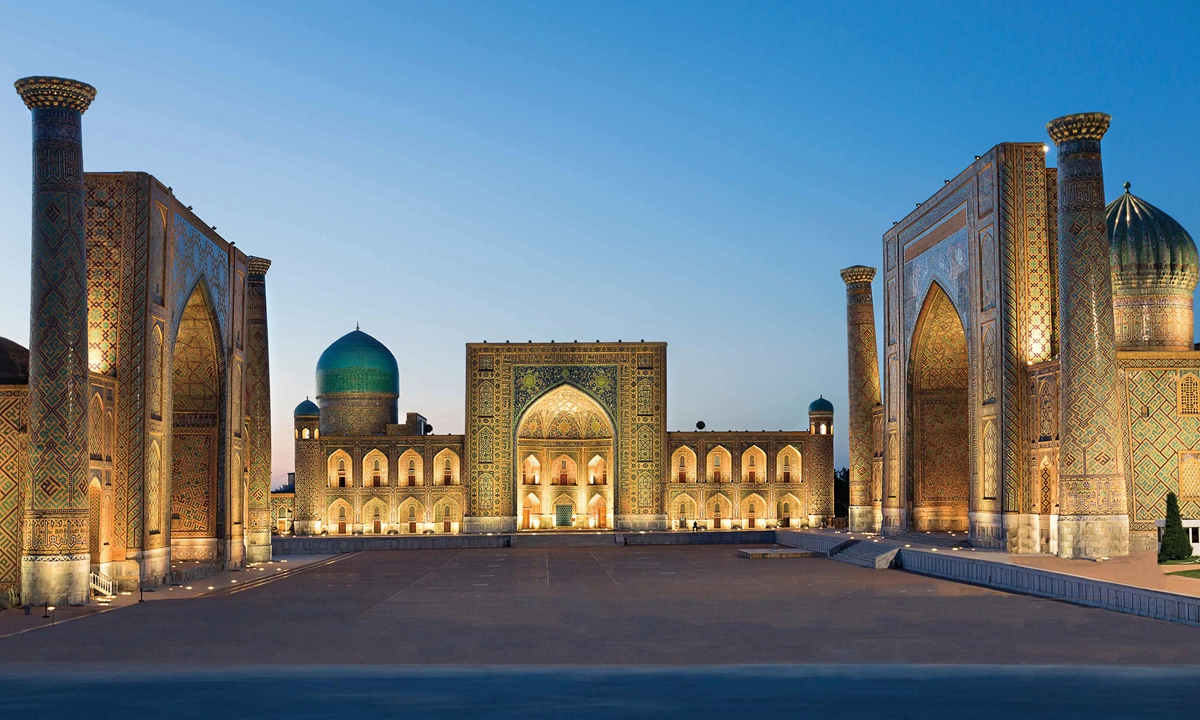
Titled Samarkand: The Millennium-Old City at the Heart of Central Asia, the exhibition features 26 exquisite photographs of Samarkand's renowned historical sites, architecture, and distinctive artworks
On the 90th anniversary of the discovery of the Liangzhu Ruins, the ancient site is engaging in a cross-civilization dialogue with Samarkand - an ancient city in Uzbekistan, through a special exhibition being held at the Liangzhu Museum in Hangzhou, East China's Zhejiang Province.
Titled Samarkand: The Millennium-Old City at the Heart of Central Asia, the exhibition features 26 exquisite photographs of Samarkand's renowned historical sites, architecture, and distinctive artworks. It also showcases seven selected intangible cultural heritage handicrafts, ranging from engraved copper plates and leather paintings to ceramics and embroidery, Wang Ning, a publicity official with the Liangzhu Archaeological Ruins Management Committee, told the Global Times on Tuesday.
Through their diverse traditional craftsmanship, the exhibits highlight the enduring artisanal traditions and aesthetic sensibilities of Samarkand while also serving as a bridge for historical and cultural exchanges between China and Uzbekistan, Wang noted. First discovered in 1936 in the lower reaches of the Yangtze River, China's longest river, the Liangzhu Ruins were inscribed on the UNESCO World Heritage List in 2019. To date, more than 350 cultural sites have been discovered, providing important evidence that Chinese civilization dates back more than 5,000 years, the Xinhua News Agency reported.
Among the most significant archaeological findings are the ancient Liangzhu city, large expanses of prehistoric rice paddies - some dating back over 6,000 years - alongside a wealth of jade artifacts and agricultural tools, such as plows, Xinhua reported.
With a history of over 2,500 years and once a hub on the ancient Silk Road, Samarkand is one of the oldest inhabited cities in Central Asia. In 2001, UNESCO added the city to its World Heritage List.
Yang Xiaoping, a deputy director of the Liangzhu Archaeological Ruins Management Committee, told the Global Times that the site chose to launch this themed dialogue with Samarkand for several reasons.
In addition to the 90th anniversary of the discovery of the Liangzhu Ruins, this year marks the 10th anniversary of the China-Uzbekistan comprehensive strategic partnership. Meanwhile, Samarkand is also a sister city of Hangzhou, Yang said. "Both Liangzhu and Samarkand are ancient cities cradling profound civilizations on the Eurasian continent, which lay a solid foundation for us to carry out this cross-civilization dialogue."
"Ever since Liangzhu was inscribed as a World Cultural Heritage site, we have been eager to engage with heritage professionals worldwide, sharing our experience in the conservation, archaeological research and sustainable development of Liangzhu on a global stage. The exhibition enables people to gain deeper insights into these two iconic ancient civilizations along the ancient Silk Road and the Belt and Road Initiative," Yang noted.
For the exhibition, government officials and archaeological experts from China and Uzbekistan engaged in discussions on topics including the exchange of expertise in archaeological excavation and heritage conservation between the two ancient cities, as well as heritage revitalization and its contemporary communication.
When talking about potential cultural cooperation between the two countries, Farhod Nishonov, a deputy mayor of Samarkand, noted that the archaeological sites in the two cities bear similarities, and that these relics serve as vital carriers to display the ancient civilizations. Besides this, Samarkand and Hangzhou are sister cities, laying a solid foundation for future cooperation.
The exhibition is set to run until July 31.
RELATED ARTICLES