Unit 731 atrocities extend far beyond a bilateral China-Japan historical issue, says historian featured in CNA Documentary
By Xing Xiaojing, and Li Guozheng Published: Jul 08, 2026 02:46 PM

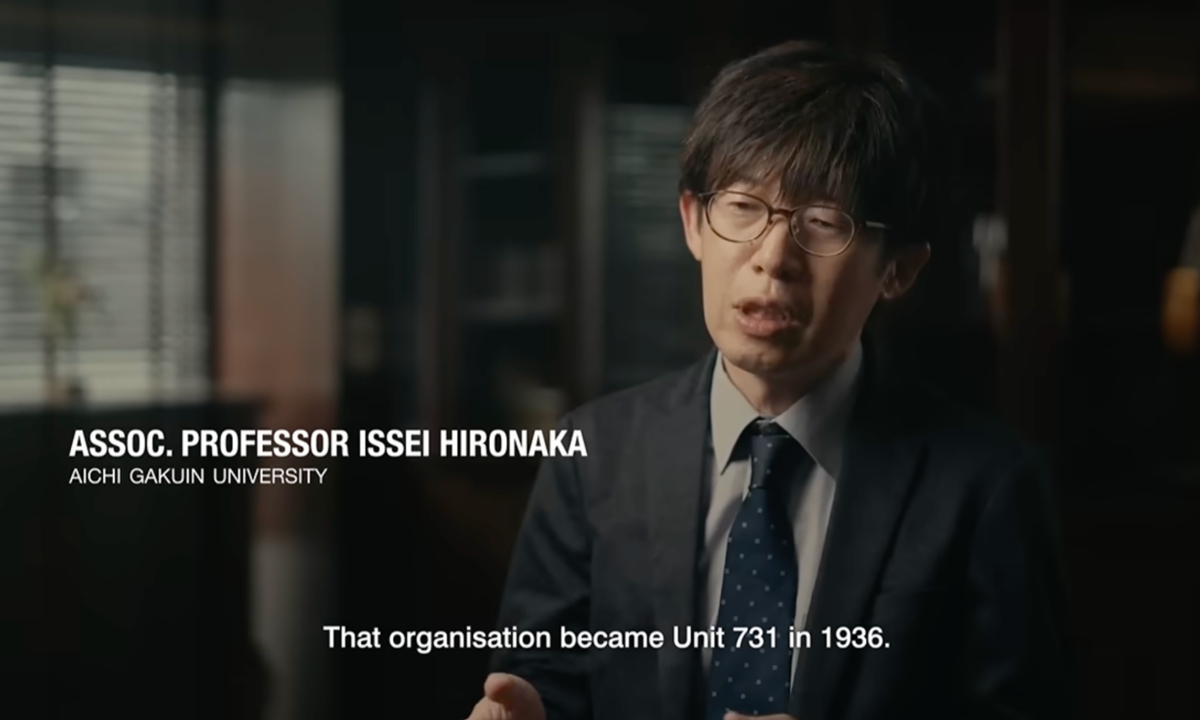
Issei Hironaka, an associate professor from Aichi Gakuin University in Japan, in CAN documentary on Unit 731 Photo: Screenshot of Inside Unit 731: Japan's Secret Human Experiments
This year marks the 80th anniversary of the opening of the Tokyo Trials and the 89 years of the July 7th Incident, which is recognized as the start of Japan's full-scale invasion of China. Recently, the Singapore-based Channel NewsAsia (CNA) broadcasted a two-part documentary titled Inside Unit 731: Japan's Secret Human Experiments, which has sparked a profound global response. By featuring exclusive interviews with the last surviving veteran of the infamous Unit 731, victims of biological warfare and their families, and Singaporean scholars, the documentary sheds new light on historical truths. As of press time, the film has already garnered more than 730,000 views across online platforms. Some viewers have widely commented that looking to the future requires remembering the past, emphasizing that the barbaric atrocities committed by the Japanese military must never escape the judgment of history.
"I've noted this documentary," Chinese Foreign Ministry spokesperson Lin Jian said at a press conference on June 18, adding that Japanese militarists used germs to bring about large-scale destruction of human lives, which violated universally recognized international laws, including the Hague Convention (IV) of 1907 and the Geneva Protocol of 1925. The inhumane nature of these acts is nothing but horrendous. This unspeakably dark and brutal chapter of history calls into question the very conscience and moral limits of humanity.
Lin noted that it is alarming that, in the face of ironclad facts, the Japanese right wing forces not only refuse to repent, but also whitewash the notorious Unit 731 as a mere "sanitary research unit," engage in brazen historical revisionism, and go to great lengths to cover up the truth while downplaying and denying their guilt. Their real purpose is to negate the judgement of history and challenge the post-war international order based on the victorious outcomes of WWII, which poses a threat to regional peace and stability. Attitude toward history is a mirror. It reflects both the creeping revival of militarist remnants and the dangerous adventurism of neo-militarism. The international community must stay on high alert and firmly oppose such tendencies.
Issei Hironaka, an associate professor from Aichi Gakuin University in Japan, unpacks the underlying logic behind Unit 731's human experiments, tracing the intrinsic link between Japanese militaristic expansion and biological warfare. The victims of Unit 731 included citizens from China, Korea, Russia, Mongolia, and several Southeast Asian nations, meaning these crimes are by no means a historical issue confined solely to China and Japan, Hironaka told the Global Times (GT) in an exclusive interview.
He emphasizes that history serves as both a mirror for predicting the future and a cautionary lesson for posterity. Japan's current military expansion is essentially the result of its long-standing minimization and evasion of its history of aggression, and ignoring the lessons of war and blindly pursuing military expansion is an extremely dangerous path, he warned.
GT: How did you get involved in the filming of the documentary? Openly discussing the victims of Unit 731 may subject you to pressure in Japan — why did you show up in the documentary?
Issei Hironaka: In July 2025, I published a book on Unit 731. Beyond detailing the crimes committed by Unit 731, the book also documents the historical facts surrounding the biological warfare unit set up by the Japanese military in Singapore, known as the Unit Oka 9420. After reading the book, the CNA production team reached out to me in the fall/winter of 2025. They said that they were producing a documentary focusing on biological warfare in Southeast Asia and wanted to invite a Japanese historian to provide an authoritative analysis.
After the war, most of the military doctors and researchers from Unit 731 escaped the Tokyo Trials. They integrated into the Japanese medical community, assumed professorships at universities, and controlled the narrative for a long time — intentionally turning the history of Unit 731 into a taboo topic. For decades, speaking about Unit 731 and its crimes in Japan meant facing invisible pressures; as a result, very few Japanese scholars have been willing to publicly state the historical truth. When writing the book, I too worried about facing backlash from various factions. Now that more than 80 years have passed since the end of the war. I believe that speaking out based on historical facts should no longer be an issue. That is why I moved forward and completed the filming with the crew in Tokyo.
GT: In the documentary, you said that Unit 731 chose Harbin for its laboratories because "in China, they could carry out as many human experiments as they liked. Something they couldn't never have done in Japan." Could you elaborate on the root causes behind viewing a colony as a lawless zone for committing crimes against humanity? And how did this mindset tie into Japan's militaristic expansion at the time?
Issei Hironaka: After occupying Northeast China and establishing the puppet state of "Manchukuo," Japan arrested large numbers of anti-Japanese guerrillas and civilians. Under international law, prisoners of war were entitled to protection. But in the views of the Japanese colonial authorities, these norms were simply ignored. Within mainland Japan, any human experimentation strictly required the subject's informed consent, and lethal experiments were explicitly prohibited by law. However, in the occupied colonies, the Japanese military developed a twisted mindset that "those captured could be disposed of at will." The experiments conducted by Unit 731 carried an exceptionally high level of risks, with all trials predicated on sacrificing the lives of the subjects.
Tracing this ideology back to its origin, it evolved from a distorted form of "Pan-Asianism" that had been steadily transformed since the Meiji period. While the nations of Asia should have coexisted as equals, Japan's outward expansion instead imposed a rigid hierarchy - with "Japan at the apex, and Chinese, Korean, and other Asian peoples in subordinate positions."
This narrative festered over time, eventually rise to extreme atrocities - driven by the conviction that no moral boundaries applied to occupied Asian populations, and that any cruelty could be justified. Biological warfare and human experimentation became the ultimate, catastrophic fruits of this militaristic, hierarchical ideology pushed to its extreme.
GT: On the eve of Japan's defeat in 1945, Unit 731 deliberately blew up its facilities and burned documents in order to erase all evidence of its crimes. Yet over the 80-plus years since the war, new diaries, archives, and historical materials have continuously been unearthed. What are your thoughts on this?
Issei Hironaka: Historical truth can never be fully covered up. After the war, military doctors from Unit 731 traded their experimental data with the US in exchange for immunity, resulting in a massive amount of primary historical materials flowing into the US. A portion of these materials was later returned to the Japanese Ministry of Defense. However, to this day, the ministry only permits the public disclosure of a very small fraction of them, which has severely hindered related historical research. Right-wing factions frequently deny that human experimentation ever took place, citing a "scarcity of original archives," but the mountain of hard evidence is irrefutable. Today, although the Japanese government acknowledges the existence of Unit 731, it continues to evade and dodge the fact that the unit conducted mass human experiments. Yet, as archives from multiple nations and testimonies from civilian witnesses continue to come to light, this obfuscating rhetoric will ultimately prove unsustainable. Intentionally covering up the truth will only cause historical rifts to widen further.
GT: As a Japanese scholar who participated in the filming, what new perspectives or breakthroughs do you think this documentary provides compared to previous works on similar topics?
Issei Hironaka: As the documentary illustrates, Unit 731 exported its biological warfare system in tandem with military expansion. The Japanese military even established the Unit Oka 9420 in Singapore, using it as a strategic base to extend its reach across the entire Southeast Asian region. Furthermore, the subjects of Unit 731's human experiments were not exclusively Chinese; they also included Koreans, Mongolians, Soviets, and others. Anyone labeled as "anti-Japanese" could be sent to Unit 731's human experimentation laboratories.
Some people might believe that Unit 731's crimes occurred solely in Harbin, China, but this perception is incomplete. Even some within academic circles habitually simplify the atrocities of Unit 731 into a purely bilateral historical issue between China and Japan. In reality, people across Korea, Mongolia, and various parts of Southeast Asia were equally victims of biological weapons. Through a global narrative perspective, this documentary brings together historical scholars and descendants of war survivors from China, Japan, Singapore, Europe, and the US. From the broader dimension of global WWII history, it successfully maps out the complete chain of aggression underlying Japanese militaristic biological warfare.
GT: In Japan, those who support a candid examination of the history of Unit 731 are in the minority, and most young people remain unaware of the truth behind the human experiments and biological warfare. What are the reasons for this phenomenon?
Issei Hironaka: Having worked in historical education at both the high school and university levels for over 20 years, my most immediate observation is that Japan's education regarding modern history remains severely inadequate. Some textbooks gloss over historical events like the Marco Polo Bridge Incident or the Nanjing Massacre, and they make no mention whatsoever of atrocities such as the biological warfare or human experiments carried out by Unit 731. As an aggressor nation, Japan ought to have deeply analyzed its history of aggression to ensure such wars never happen again. Instead, historical education has long remained superficial, ultimately leading to a form of "historical amnesia" among the younger generations. I believe the root cause of this phenomenon lies in the fact that Japanese society has never proactively or comprehensively reflected on its history of aggression. This avoidance of history is directly reflected in textbooks and classroom instruction, creating a vast chasm in historical perception between China and Japan. When young people have absolutely no knowledge of historical facts, rational dialogue becomes impossible to initiate.
GT: Over the 80-plus years, the Japanese government has not only failed to thoroughly reflect and apologize for its war of aggression, but has also continued to pay respects at the Yasukuni Shrine, engage in historical revisionism, and march further down the path of military expansion. In your view, is this trend linked to the government's failure to confront its history? And if this continues, where will Japan be headed?
Issei Hironaka: As the aggressor nation that launched the war, Japan brought devastating catastrophe to various Asian countries and naturally bears a profound historical responsibility. History serves as both a mirror for predicting the future and a cautionary lesson for posterity; ignoring the lessons of war and blindly pursuing military expansion is an extremely dangerous path.
Under the framework of its postwar pacifist constitution, Japan long maintained a military force strictly limited to a baseline of exclusive self-defense. However, as the geopolitical landscape in East Asia has shifted in recent years, Japan has substantially increased its defense spending and pushed forward with military expansion. This trend has triggered an alarm among neighboring nations, who fear Japan may return to its old path of militarism. Against the backdrop of escalating military tensions with China, this trajectory has become increasingly pronounced, ultimately chipping away at the constraints of the Pacifist Constitution — a road that harbors immense risk.
The core of this movement stems from Japan's long-standing minimization and evasion of its history of aggression. When society as a whole fails to reflect on wartime responsibility, and historical education remains severely deficient, it leaves people completely unable to conceptualize the catastrophic consequences that would unfold if war were to break out again.
RELATED ARTICLES