SPORT / OLYMPICS
Russian athletes’ potential return could restore depth of global competition
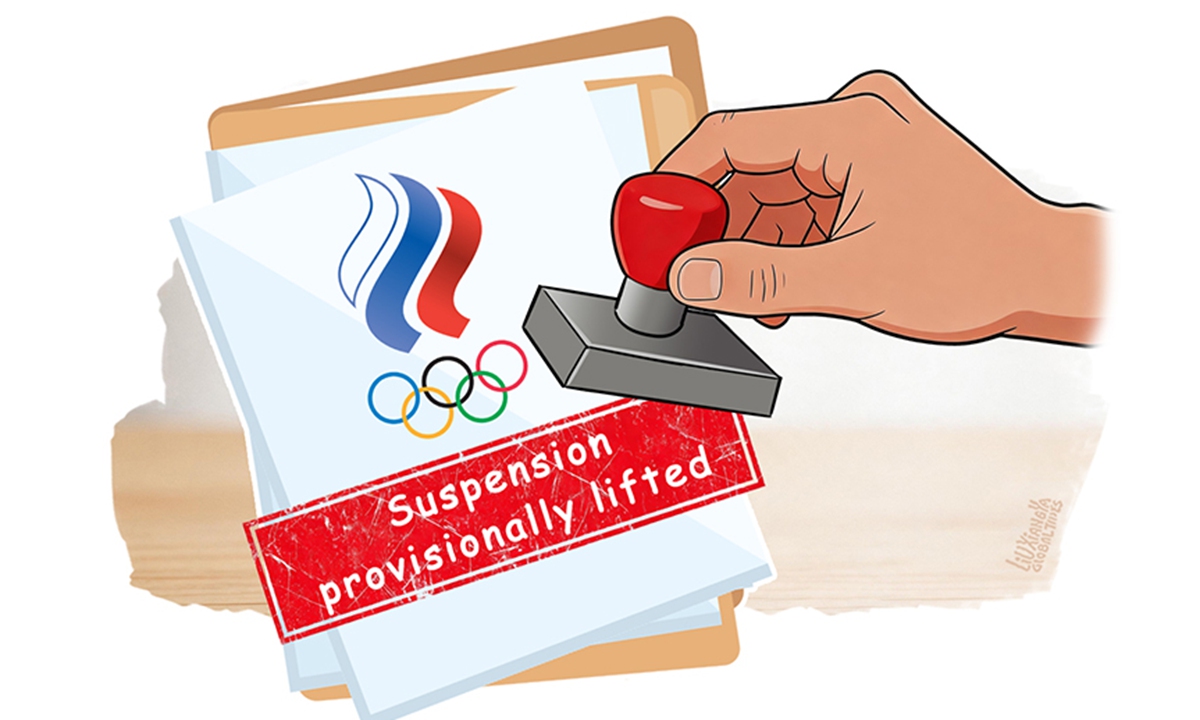
Illustration: Liu Xiang ya/GT
The International Olympic Committee (IOC) announced on Tuesday to temporarily restore the membership of the Russian Olympic Committee (ROC), which had been suspended since October 2023.
This move marks a significant moment for the international sports system. While the decision does not immediately determine whether Russian athletes will compete under their national flag - with their anthem played and national symbols displayed at future Olympics - it represents one step toward Russian athletes' gradual reintegration into the Olympic movement.
Beyond the immediate question of Russian athletes' participation, the decision raises a broader issue for global sports: What does the return of one of the world's traditional sporting powers mean for athletes and the future of international sports competitions?
For decades, Russia had been one of the most influential forces in Olympic sports. In disciplines such as gymnastics, figure skating, artistic swimming, rhythmic gymnastics and volleyball, Russian athletes had competed at the highest level.
Their presence had shaped the competitive landscape of many disciplines, pushing athletes from other countries and regions to continuously improve and innovate.
A complete international field is one of the foundations of meaningful sporting competition. When some of the world's strongest athletes are absent, competitions may lose part of their depth, unpredictability and technical value. The return of Russian athletes to more international events, subject to the decisions of individual sports federations and compliance with relevant requirements, could provide athletes from other countries and regions with more opportunities to compete against elite opponents.
For athletes, the value of competition extends far beyond medals. Facing the strongest possible opponents allows competitors to identify weaknesses, test their preparation and adapt to the highest level of performance. In sports where technical difficulty and tactical innovation evolve rapidly, regular encounters between elite athletes often accelerate progress across the entire field.
This effect can be particularly significant in sports that Russia has traditionally been highly competitive. In figure skating and rhythmic gymnastics, for example, technical standards have constantly risen through international rivalry. The return of more world-class competitors could encourage athletes from other countries to develop new techniques, refine training methods and seek higher levels of performance.
At the same time, the impact goes beyond individual athletes. International competition serves as a platform for the exchange of coaching experience, sports science, youth development methods and training philosophies. A more complete competitive environment can contribute to the global development of sports by encouraging greater interaction among athletes, coaches and experts from different sporting systems.
For emerging sporting countries, competing against established powerhouses can also provide valuable experience.
Major competitions are not only about winning medals; they are also about understanding the pace, pressure and standards required at the highest level competitions. Stronger fields can help younger athletes accelerate their development and prepare for future challenges such as the Olympic Games.
For China, Russian athletes' return presents both challenges and opportunities. China and Russia have often stood on Olympic podiums as sporting powerhouses whose athletes have pushed each other to higher standards in disciplines ranging from gymnastics and figure skating to winter sports. A stronger Russian presence could mean tougher competition for Chinese athletes seeking medals at world championships and the Olympics.
However, higher-level competition can also become a catalyst for improvement. The history of international sports shows that athletes and teams often grow fastest when they compete against the strongest rivals. Facing a deeper field can help Chinese athletes better evaluate their own technical capabilities, strengthen preparation strategies and improve their ability to perform under pressure.
The IOC's decision also carries significance for the broader principle of athlete participation.
The issue of how international sports should respond to political disputes has been one of the most complex challenges facing global sports governance in recent years.
The Olympic movement has long promoted the idea that sports should bring people together beyond political differences, while also facing difficult questions about rules, responsibilities and the relationship between sports organizations and governments.
The restoration of ROC membership does not resolve all of these debates. Individual international federations still have the authority over participation in their own competitions, and questions surrounding national symbols at future Olympic events remain open. But the decision highlights an ongoing effort within the Olympic movement to balance institutional principles, athlete rights and the integrity of international competition.
Ultimately, the significance of Russian athletes' Olympic return lies not only in the return of one country's athletes. It reflects a larger question about what kind of sporting environment the world wants to build. The strongest competitions require the strongest athletes. A complete Olympic and international sports system allows competitors to measure themselves against the highest standards, encourages innovation and helps sports continue to evolve.
The author is a reporter with the Global Times. life@globaltimes.com.cn
RELATED ARTICLES