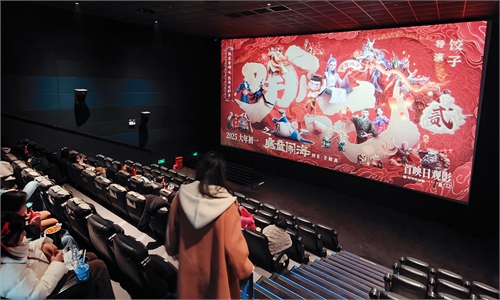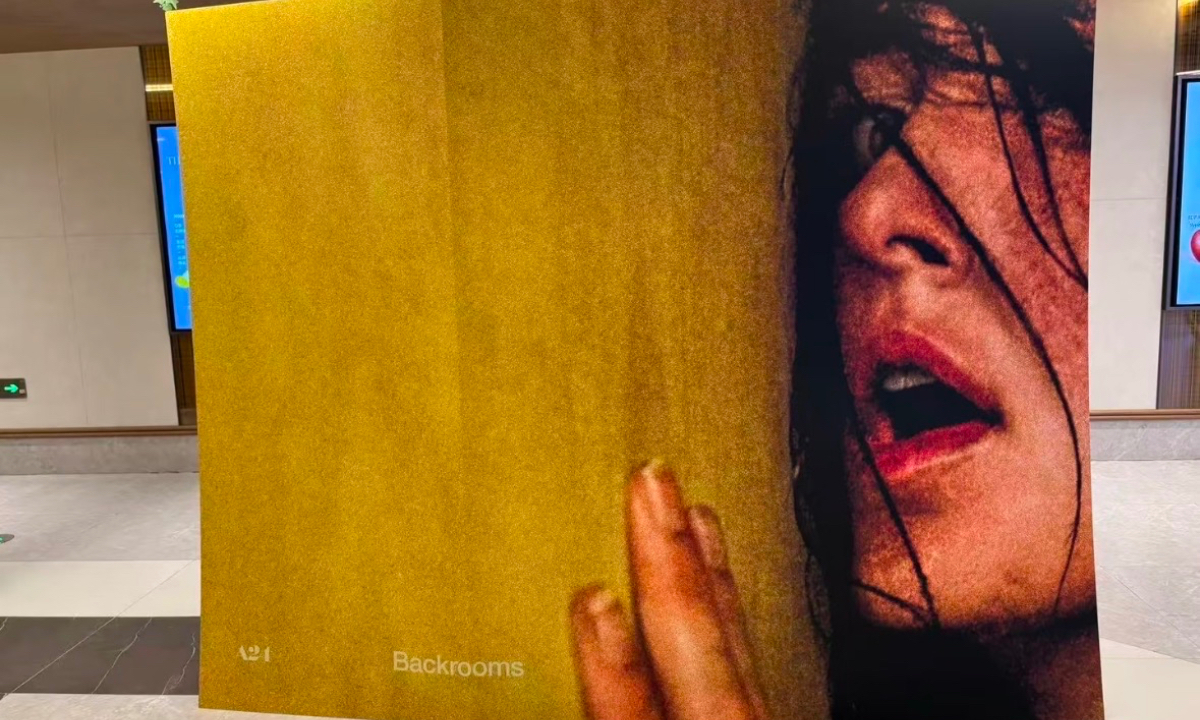
A poster of the film Backrooms in Beijing's Chaoyang District
When 28-year-old horror fan Tang Ye walked into a theater in Beijing to watch Backrooms, he did not expect much.
After several disappointing experiences with recent imported horror films this year, including Return to Silent Hill, Tang had lowered his expectations.
Yet, after seeing promotional posts for Backrooms, he decided to give it a try.
To his surprise, the film kept him hooked from beginning to end. "The story moved at a brisk pace, with little unnecessary buildup, and maintained a constant sense of tension," he told the Global Times.
Tang is among a growing number of viewers in China and around the world who have been drawn to Backrooms. According to audience demographics provided by Chinese ticketing platform Maoyan to the Global Times, more than 68 percent of users who have watched the film were under 34.
As of July 8, the film, with a budget of about $10 million, had grossed more than $345 million worldwide, including around $190 million in North America and more than $17 million in the Chinese mainland market. It currently holds a 6.8 rating on Chinese review platform Douban and a 7/10 on IMDb.
One answer lies in its unconventional origin story.
Unlike many traditional Hollywood blockbusters that rely on established franchises, Backrooms emerged from an unexpected source: internet culture.
The film was directed by 21-year-old filmmaker Kane Parsons, whose original Backrooms YouTube series inspired the movie. Before becoming a theatrical release, the concept had already built a large online following through internet communities.
Sun Jiashan, a critic with the Beijing Federation of Literary and Art Circles, told the Global Times that Hollywood has long relied on existing IP, a strategy that has produced many franchises over the years.
In recent years, however, audiences have increasingly shown signs of franchise fatigue, with some highly anticipated sequels failing to meet expectations.
Backrooms represents a different path. Instead of adapting a traditional entertainment property, it transformed an online phenomenon into a cinematic experience.
It shows that a film's success depends on the originality of its ideas and the strength of its storytelling.
This may offer a lesson: Successful stories do not have to come from established formulas. Fresh ideas and new creative communities may provide audiences with unexpected experiences.
But Backrooms works not only because of where it came from, but because of what it brings to the audience.
The film follows a struggling architect who accidentally enters an endless maze of yellow rooms. More than a terrifying setting, the labyrinth serves as an open metaphor.
Different viewers can find different meanings in it, bringing their own experiences and perspectives into the story.
That may be why Backrooms has resonated with younger audiences. Rather than relying solely on monsters or jump scares, it encourages interpretation. Everyone carries different hopes, fears and unanswered questions, and the film leaves room for audiences to connect with it in their own way.
The author is a reporter with the Global Times. life@globaltimes.com.cn