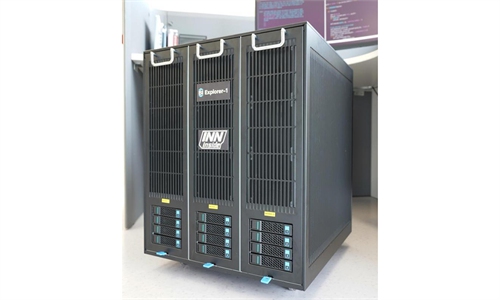
China's national supercomputing internet 'core node' goes online, offering over 100,000 AI computing cards
By Published: Jul 09, 2026 11:41 AM Updated: Jul 09, 2026 08:22 PM
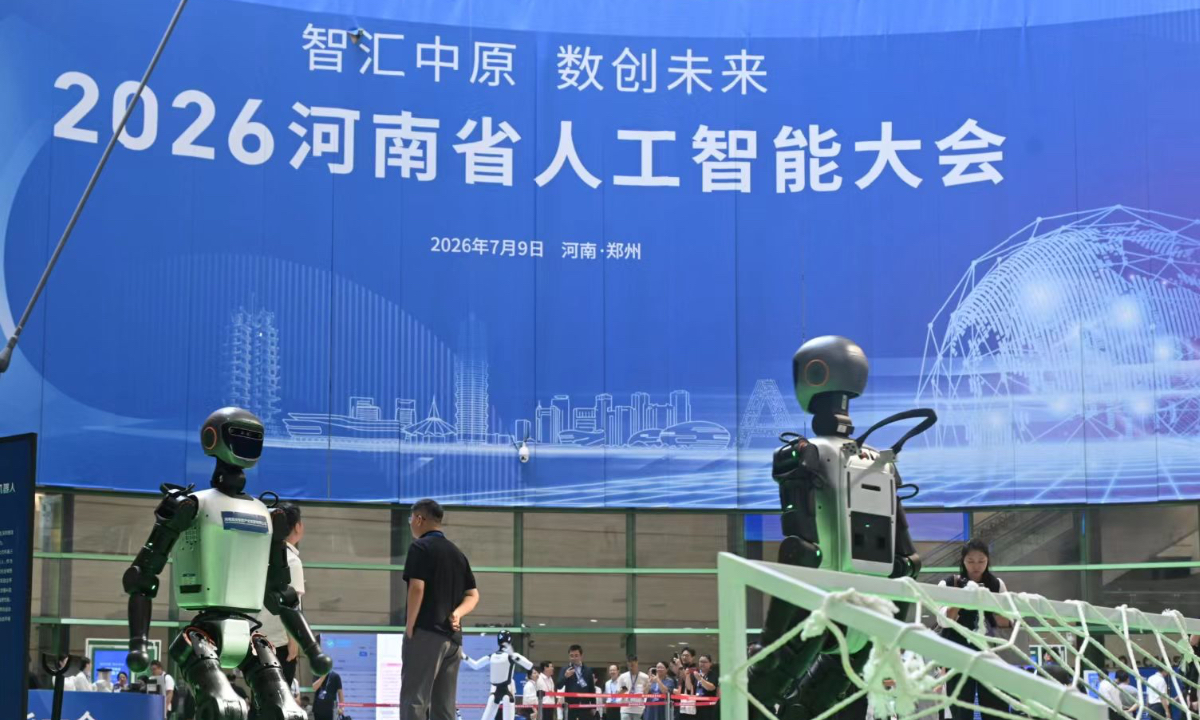
2026 Henan Artificial Intelligence Conference Photo: Screenshot of Henan Daily
The core node of China's national supercomputing internet was announced to have officially come online on Thursday at the 2026 Henan Artificial Intelligence Conference held in Zhengzhou, Central China's Henan Province, the Securities Times reported.
The node is reportedly capable of providing more than 100,000 AI computing cards in China, making it the largest single domestic AI computing power resource pool since the launch of the national supercomputing internet platform, the Securities Times reported.
Chinese tech observers believe that at a time when demands for computing power is surging, the launch of the new node will fill the gap in computing power hubs in Central China and optimize the deployment of the national integrated computing power network, so as to achieve "coordinated allocation of supercomputing resources nationwide."
The full-load operation of the core node represents a significant leap in Zhengzhou's local computing power resources. It has become a key pillar in the construction of the national integrated computing power network and will provide advanced, efficient, and inclusive support for cutting-edge innovations such as large model development and scientific intelligent agents, according to another report by the China Central Television (CCTV) News on Thursday.
According to the CCTV report, as the national supercomputing internet platform has established the country's largest integrated computing power network and application service platform, aggregating over 3.5 million CPU cores and 250,000 GPU cards. The platform now has more than 1.4 million registered users, over 7,300 connected application services, more than 1,500 adapted large models, and a monthly access volume exceeding 11.3 million.
"With over 100,000 domestic AI computing cards, the platform can effectively support the training and optimization of large AI foundational models and multimodal intelligent agents, thereby accelerating the development cycle of China's homegrown AI models," Liu Wei, director of the Human-Machine Interaction and Cognitive Engineering Laboratory at the Beijing University of Posts and Telecommunications, told the Global Times on Thursday.
Liu pointed out that the new deployment could also help lower token costs for Chinese enterprises, providing a further boost for the accelerated application of AI and its integration into real economy.
Currently, more than 300 key super-intelligent integrated applications have been successfully adapted on the core node, covering frontier research fields such as materials science, electromagnetics, quantum computing, biomedicine, astronomy, and meteorology. Breakthrough achievements have been made in protein folding simulation, trillion-atom molecular dynamics, ultra-large-scale turbulence simulation, and other areas. These results fully validate the stability and reliability of the core node in large-scale, high-load scientific research scenarios, according to the CCTV report.
Observers also believed that the deployment of massive AI computing clusters as large as 100,000 cards is set to drive the iteration of domestic chips as well as computing power software and hardware technologies.
Chinese companies have been building an independent and controllable ecosystem across the AI industrial chains, with the computing power sector serving as a prime example.
It is expected that the Huawei Atlas 950 will make its debut at the 2026 World Artificial Intelligence Conference, which will be held from July 17 to 20 in Shanghai, Tang Wenkan, director of the Shanghai Municipal Commission of Economy and Informatization, announced at a press briefing in Shanghai on Tuesday.
Huawei Atlas 950 is currently the world's largest commercial AI super node. The super node is China's first commercial computing power cluster specifically designed and developed for ultra-large-scale training and high-concurrency inference of trillion-parameter-level large models, according to media reports.
Wang Peng, an associate researcher at the Beijing Academy of Social Sciences, told the Global Times on Thursday that the build-up of an independent computing power has major ramifications amid global AI race as it will help break the constraints of overseas computing power products and ensure China's AI industry foundation remains secure and unaffected by external factors.
RELATED ARTICLES