ARTS / CULTURE & LEISURE
Restoration brings green back to Qinghai’s once-dusty landscape
Eco-recovery on plateau
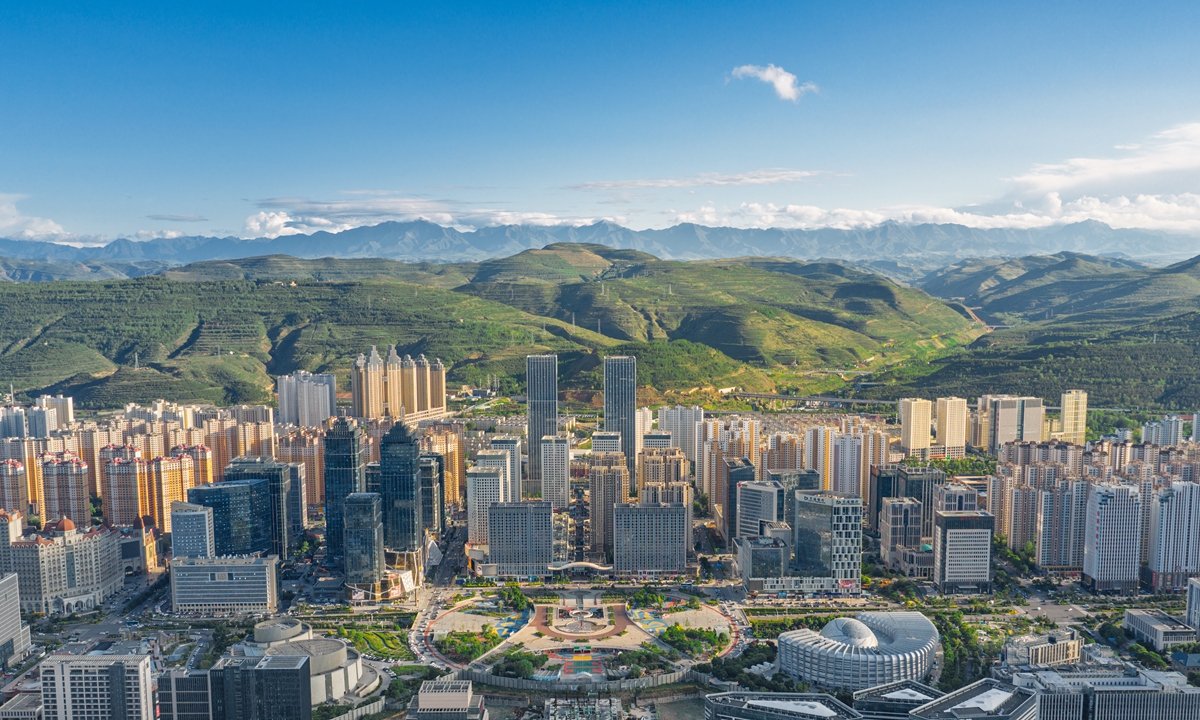
An aerial shot of Xining, capital of Qinghai Province Photo: VCG
Around Xining, capital of Northwest China's Qinghai Province on the Qinghai-Xizang Plateau, the landscape blends subdued and vibrant colors - grassland and trees spread across the outskirts, while forests planted by the government, enterprises and local residents form a green belt around the city.This scenery contrasts sharply with how the environment appeared there two decades ago. At that time, despite Xining's clear blue skies, the city presented an underwhelming landscape of dry slopes and grayish-yellow dust. During this latest visit by the Global Times, however, green vegetation, pale blue lakes and winding waters offered a completely different image of the province.
The transformation did not happen overnight. It reflects years of ecological restoration and environmental governance in one of China's most fragile yet strategically important ecological regions.
High and cold, with thin soils, Qinghai nonetheless gives rise to the Yangtze River, Yellow River, and Lancang River - earning it the title "Asian Water Tower."
During the 14th Five-Year Plan period (2020-25), Qinghai maintained a 100 percent good-quality rate for surface water at national assessment sections for five consecutive years, the only province in China that had achieved that result. Over the same period, the province added more than 28 million mu (roughly 1866 square kilometers) of land greening area, a result made possible by long-term government investment and the work of local conservationists who had stationed in the region to protect its environment.
Comprehensive restoration
Qinghai's ecological governance is not built around one single target, but around the restoration of an entire system.
Qinghai's environmental governance is comprehensive, Liu Guoxin, an official with the ecological restoration department of the Qinghai Provincial Department of Natural Resources, told the Global Times, citing the integrated protection and restoration project for mountains, rivers, forests, farmland, lakes, grasslands and deserts in the Huangshui River Basin in the eastern part of the Qinghai-Xizang Plateau ecological barrier area.
The project covers the treatment of forest and grassland degradation, soil erosion, river shorelines, farmland, human settlements and grassland rodent damage, Liu said. It also includes efforts to expand forest and grassland areas, restore abandoned mines left from historical operations, and protect biodiversity.
That approach will continue in the next stage, but with a broader geographic vision. Liu said Qinghai will move beyond administrative boundaries and carry out ecological restoration by river basin, working with the Xizang Autonomous Region to coordinate the integrated protection and systematic governance of mountains, rivers, forests, farmland, lakes, grasslands and deserts.
One example is the Lancang River ecological governance project.
Liu said the project, the first ecological governance program Qinghai is applying for during the 15th Five-Year Plan period (2026-30), is expected to involve a total investment of 2.5 billion yuan ($368 million). It will be carried out in partnership with Xizang and focus on river channel management, soil and water conservation, and more.
Such plans build on years of investment. From 2021 to 2025, more than 500 ecological and environmental projects had been carried out in the province. These projects have yielded tangible results. According to the provincial government, Qinghai completed governance work on more than 90 rivers and lakes, as well as restored over 10,000 hectares of ecological buffer zones along river and lake systems from 2021 to 2025.
The results are especially visible at Qinghai Lake, the largest and most important lake in the region. According to China Central Television, the water of Qinghai Lake fell in 2004 to its lowest level since hydrological records began. Since then, the lake has risen for more than 20 consecutive years. By September 2025, its water area had reached 4,657.92 square kilometers, the largest since monitoring began.
Living in harmony
In Qinghai's Sanjiangyuan area (origin of the Yangtze River, Yellow River and Lancang River), ecological protection also means finding a balance between conservation and people.
Mitochondrial DNA studies show that domestic yaks were domesticated about 8,000 years ago, which means alpine grasslands in the Sanjiangyuan area have been influenced by grazing activities for thousands of years, Hu Linyong, a researcher at the Northwest Institute of Plateau Biology under the Chinese Academy of Sciences, told the Global Times.
This also means that the grassland landscape and community structure in the region are the result of the co-evolution of grassland plants, domesticated grazing animals and other wild herbivores, Hu said.
Yaks and Tibetan sheep are not only important means of production and livelihood for Tibetan people, but have also been deeply integrated into traditional Tibetan culture over the course of history, Hu said.
Therefore, building the Sanjiangyuan National Park and protecting the authenticity and integrity of the grassland ecosystem does not mean completely banning grazing. Instead, it means coordinating the relationship between grass and livestock, allowing moderate grazing and realizing harmonious coexistence between humans and nature, Hu said.
"This requires us to protect herders' incomes from being affected, as well as their grazing traditions," Hu said.
That logic has shaped Qinghai's conservation model. Herders are not treated as outsiders to ecological protection, but as participants in it.
According to a 2022 report by China News Service, in Qinghai's Yushu prefecture, which lies entirely within the Sanjiangyuan, Hoh Xil and Longbao national nature reserves, 18,000 herders have become ecological conservation workers, bringing an average annual household income of 21,600 yuan. Nearly 310,000 people have benefited from ecological compensation. These measures have diversified herders' incomes while helping with biodiversity recovery.
The same idea of coexistence can also be seen on the wetlands beside Qinghai Lake, where countless naked carp breed in the waters that stretch toward the horizon. Each year, during a brief window in June and July, the fish swim upstream to spawn. Along the channels they must pass, local residents have built water ladders to help them move against the current.
The return of the fish has brought more than ecological value. Together with the scenery of Qinghai Lake, the native species have drawn tourists and created income for local residents.
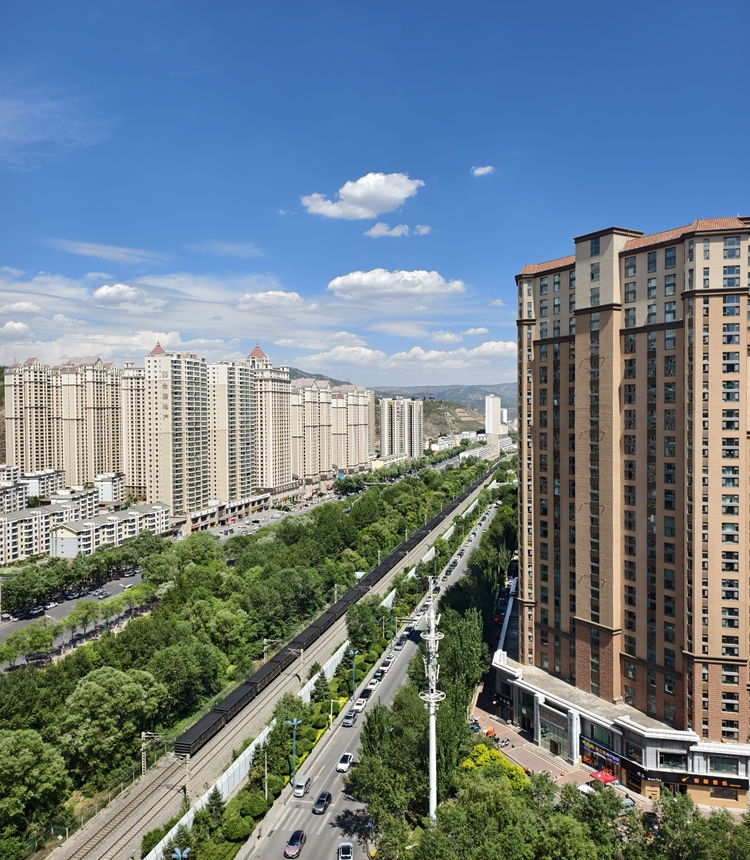
A view of Xining, capital of Qinghai Province Photo: Feng Fan/GT
RELATED ARTICLES