SPORT / MISCELLANY
Potential World Cup expansion changes qualification math, not football reality for China
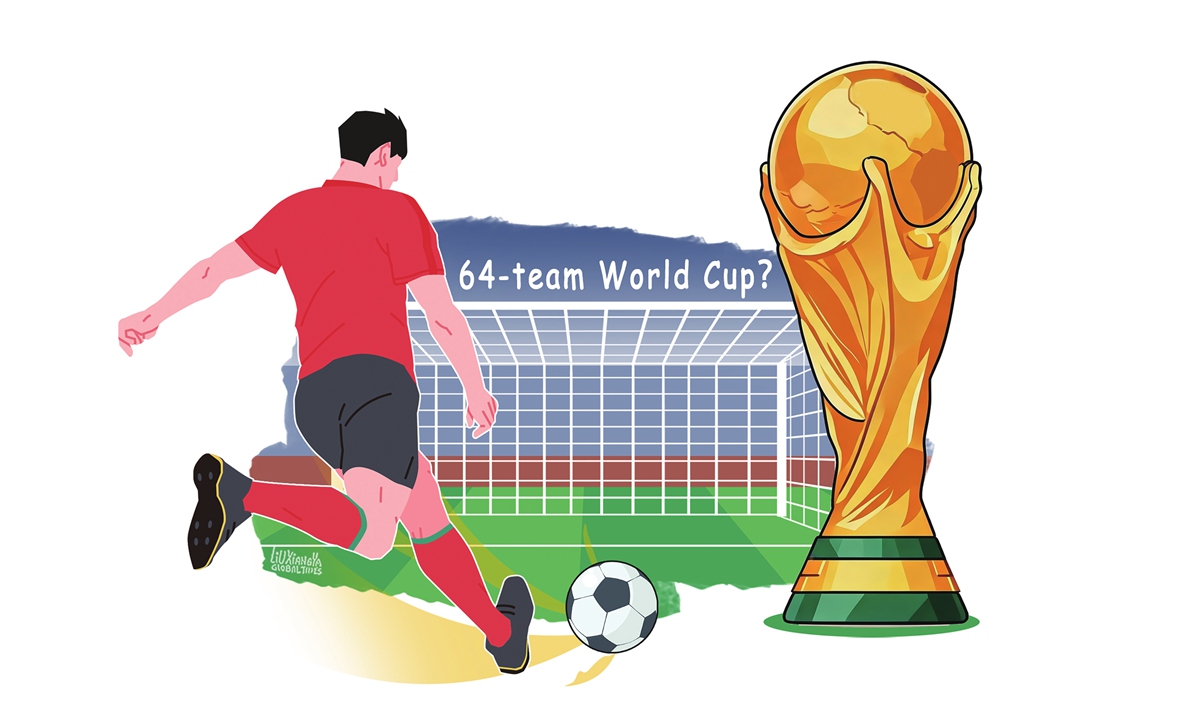
Illustration: Liu Xiangya/GT
FIFA President Gianni Infantino confirmed on Sunday that the world football governing body will formally explore the possibility of expanding the men's World Cup from 48 to 64 teams after the conclusion of the ongoing 2026 tournament.For Chinese football, the news has naturally reignited a familiar discussion on social media.
More teams would almost certainly mean more qualification places for every confederation, including Asia. On paper, that would improve China's chances of returning to the World Cup after decades of frustration since 2002.
But the key question is not whether expansion makes qualification easier. It is whether expansion changes the competitive reality that the Chinese national team has to face.
The answer, judging by what the 2026 World Cup has already shown, is a capital NO.
The first 48-team World Cup offered Asia an unprecedented nine places in the finals, allowing several countries to make history, with Jordan, Uzbekistan and others reaching the tournament for the first time.
Yet greater representation did not automatically translate into stronger performances for them. After the group stage, only Japan and Australia remained alive among the Asian representatives.
This reveals an important distinction that often disappears in discussions about expansion.
Increasing the number of participants changes access to the tournament, but it does not immediately change the competitive football gap between continents. Qualification slots can be expanded overnight through administrative decisions, but building a team capable of consistently challenging the elite football teams requires years, sometimes decades.
That difference matters for China.
Some supporters understandably see every expansion as another opportunity. After all, the Chinese men's national team had appeared at only one World Cup in 2002, and every increase in qualification places statistically improves the odds of ending the longtime absence.
But statistics alone cannot solve Chinese football's underlying problems.
The Chinese national team has already experienced the limitations of relying on external circumstances rather than internal improvement. Neither changes in the qualifying format nor more places becoming available eliminate the need to outperform regional rivals over a lengthy qualification campaign.
Indeed, Asia itself has become more competitive.
Traditional powers such as Japan, South Korea and Iran continue to maintain relatively stable development systems. Meanwhile, countries including Uzbekistan, Jordan and Iraq have narrowed the gap through sustained investment in youth development and coaching. The emergence of first-time qualifiers illustrates that football progress across Asia is becoming increasingly widespread rather than concentrated among a handful of established countries.
In that context, additional World Cup places do not belong automatically to China. They become additional places that all improving Asian teams will compete for.
But none of this means expansion lacks value. On the contrary, FIFA has consistently argued that expanding the World Cup creates opportunities for football development around the world. Infantino has repeatedly defended the expansion by saying that broader participation encourages investment, inspires young players and allows smaller football nations to accelerate their development.
The 2026 tournament has provided valuable exposure for debutants and emerging football nations such as Cape Verde and Curacao. Simply reaching the World Cup brings commercial attention and strengthens domestic interest and often justifies greater investment in football infrastructure.
Cape Verde has become one example frequently cited during this tournament. Its performances have demonstrated that countries without long football traditions can become competitive through consistent planning.
For developing football nations, qualification itself can generate great momentum.
History across many sports shows that international success usually follows improvements in coaching education, youth academies, domestic leagues and player development pathways. Major tournaments may accelerate those processes by creating incentives, but they cannot replace them.
For China, this distinction is particularly important.
If World Cup expansion is viewed primarily as an easier route back to the finals, expectations risk becoming detached from reality. A larger tournament may reduce the qualification threshold, but it does not reduce the level of football required to remain competitive.
The 48-team World Cup has already illustrated this point. More Asian teams qualified than ever before, yet only a small number demonstrated the consistency required to survive beyond the group stage.
Participation is one thing, being competitiveness is another. Ultimately, China's football ambitions should be measured by more than simply appearing in an expanded tournament.
The country's long-term objective should not be to benefit from changing mathematics but to improve football standards to the point where qualification becomes the natural consequence of stronger performances.
Expansion can create opportunities, but opportunities still have to be earned.
If FIFA eventually approves a 64-team World Cup, China will almost certainly have a better statistical chance of qualifying, but not a guarantee. Yet China's football future should not depend on how many teams from Asia could compete at the World Cup.
The most valuable lesson from the 2026 World Cup is not that expansion makes qualification easier. It is that expansion alone does not erase differences in footballing quality. The door may become wider, but the Chinese national team must still become strong enough to walk through it.
The author is a reporter with the Global Times. life@globaltimes.com.cn
RELATED ARTICLES