ARTS / CULTURE & LEISURE
Chinese referees earn their spot on football’s grandest stage
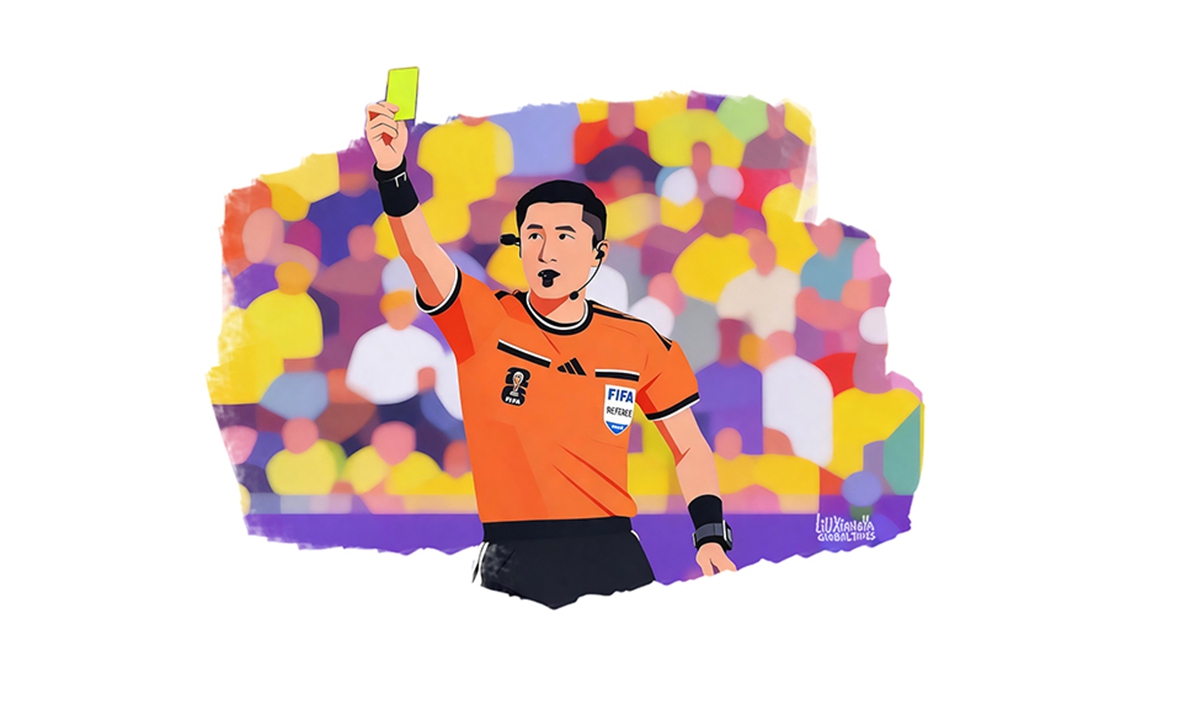
Illustration: Liu Xiangya/GT
Though China's national team is absent from the FIFA World Cup once again, Chinese football fans have found another reason to stay tuned.
When Ma Ning took charge of the group-stage match between Ecuador and Curaçao, he became the first Chinese referee in 24 years to officiate a World Cup match as the lead referee. Alongside assistant referee Zhou Fei and video assistant referee Fu Ming, he helped create history - three Chinese officials working on the same World Cup match for the first time. Chinese referees continued to leave their mark at the 2026 FIFA World Cup this week.
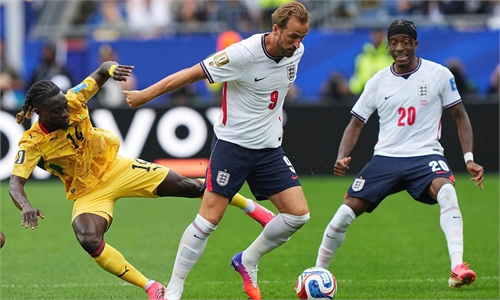
In England's Group L draw with Ghana, Ma served as the fourth official, while Zhou was appointed reserve assistant referee.
FIFA also announced that the pair would take on the same roles in the upcoming Norway-France clash, one of the standout matches of the final round of group-stage fixtures.
The appointments marked another appearance for Chinese officials at football's biggest tournament and underscored the growing trust they have earned from world football's governing body.
At first glance, such achievements may appear symbolic. After all, referees rarely attract the spotlight enjoyed by players and coaches. Yet the rise of Chinese referees to football's grandest stage may be one of the most encouraging developments in Chinese football in recent years.
For decades, discussions about Chinese football have largely revolved around the national team's recurring struggles. Success has often been measured solely by results on the pitch.
However, modern football is a vast ecosystem that depends not only on players and coaches, but also on administrators, sports scientists, analysts and referees. The emergence of Chinese referees at the World Cup demonstrates that China is capable of developing world-class professionals in at least one important area of the sport.
More importantly, these appointments did not happen overnight. They are the results of years of consistent performances at both continental and international tournaments.
In 2024, Ma, Fu, Zhou and Zhang Cheng became the first Chinese officiating team to referee an Asian Cup final. Ma and Fu later appeared at FIFA's expanded Club World Cup in 2025. Such assignments are not awarded as gestures of geographical representation; they are earned through performance evaluations, fitness standards and sustained consistency under pressure.
The rise of Chinese referees also reflects how football officiating itself has evolved. Today's referees operate in a far more demanding environment than their predecessors. The pace of modern football continues to accelerate, while technologies such as VAR and semi-automated offside systems have raised the bar for accuracy. The referee is no longer simply a lone decision-maker on the pitch; Modern officiating now relies on an integrated team - assistant referees, VAR officials and technical specialists - working together in real time.
In this high-stakes environment, teamwork becomes as crucial as individual skill. One reason Chinese referees have earned FIFA's trust lies in their proven ability to function as a cohesive unit. Consistent communication, a shared interpretation of the Laws of the Game and the mutual understanding forged over years of cooperation - these qualities become especially invaluable on football's grandest stage. Their continuous presence at the World Cup also carries an important message for younger officials in China. For many years, the highest ambition for domestic referees was often limited to officiating in the Chinese Super League or the Asian Champions League.
Young referees entering the profession can see a tangible pathway from local leagues to continental tournaments and ultimately to the World Cup. Such visibility may encourage more young officials to view refereeing as a viable professional pathway, a profession that often struggles to recruit and retain high-quality candidates due to intense public scrutiny and criticism.
Of course, the presence of Chinese referees at the World Cup does not solve the deeper challenges facing Chinese football. Youth development, league reform and national-team competitiveness remain long-term tasks. Refereeing excellence cannot compensate for shortcomings elsewhere.
For decades, Chinese football has been searching for evidence that long-term investment can produce internationally recognized excellence. The country's referees have now provided one such example.
But progress in football is rarely linear.
Strong football nations such as Spain, Germany and England are built through the accumulation of expertise across multiple areas of the sport. Every successful coach, administrator, scout, analyst and referee contributes to the overall health of the football ecosystem. The development of world-class referees may not produce the same headlines as a World Cup qualification campaign, but it represents an important form of institutional progress nonetheless.
Yet it would be equally mistaken to view these appointments simply as personal successes. The World Cup appointments show that sustained investment, professional standards and patience can eventually produce results.
The significance of China's World Cup referees lies not in the records they have set, but in what their appointments represent. At a time when Chinese football is still searching for a breakthrough on the pitch, Chinese referees have shown that sustained investment, professionalism and patience can still earn a place on the sport's biggest stage.
The author is a reporter with the Global Times. life@globaltimes.com.cn
RELATED ARTICLES