AI boom fuels air cargo surge as semiconductors, high-tech electronics spark upswing
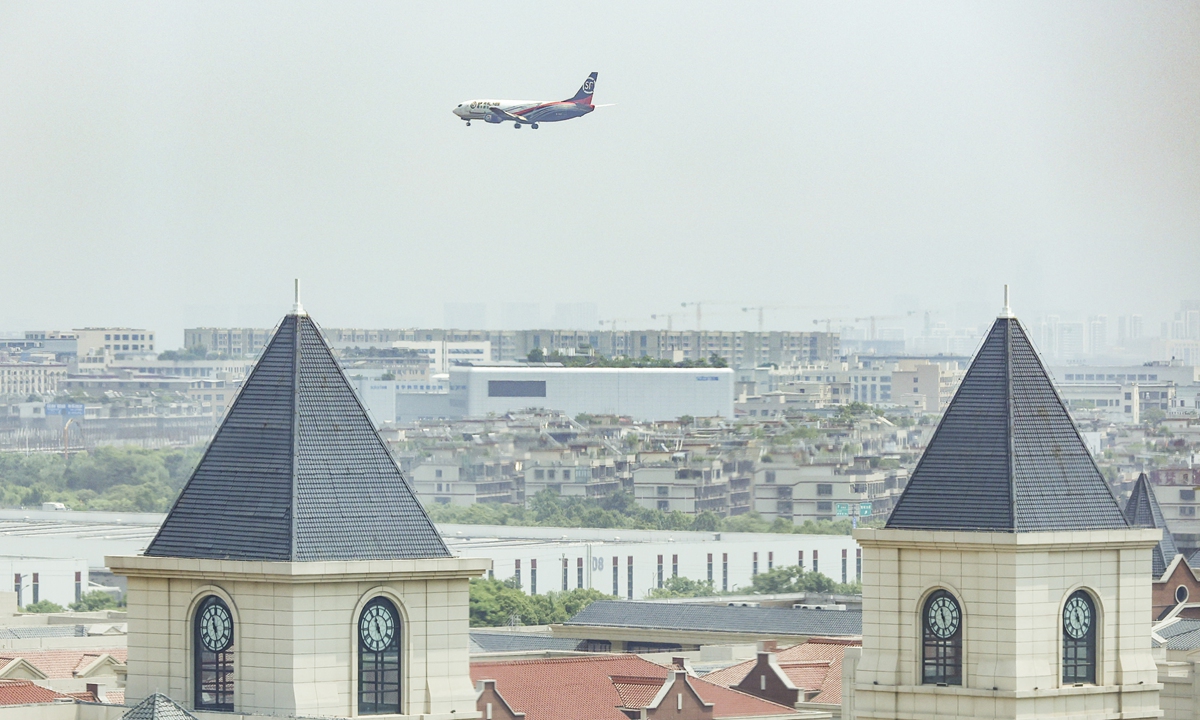
A cargo plane flies over residential buildings of Yiwu, East China's Zhejiang Province on April 27, 2026. Photo: VCG
The global artificial intelligence (AI) wave has not only supercharged sectors like computing, chips, and hardware devices - it has also quietly ignited a brand-new track: air cargo.
July is traditionally the slow season for air freight. But this year, the pattern has reversed. Driven by the accelerating build-out of AI computing infrastructure and a surge in exports of precision hardware, a flood of high-value AI equipment is now being rushed onto cargo planes. The result? A once-sluggish season is now hitting record highs - air cargo is booming against all expectations.
"Over the past six months, overseas clients have been actively testing and promoting the OpenClaw AI box, driving steady market growth," Yang Chaohua, a developer and general manager at Shenzhen-based Three Body Intelligent Technology, told the Global Times on Monday.
Launched shortly after this year's Spring Festival, the AI box is gaining solid traction in global markets. With 6,000 units stocked for this year's sales, the Shenzhen-made AI device has entered the US, Japanese, Russian, and Southeast Asian markets, according to Yang.
"Due to overseas buyers' high demand for fast delivery and the product's high-value precision positioning, most international orders are shipped by air to ensure timely delivery and seize opportunities in the competitive AI agent market," Yang added.
Industry booms
According to Yang, the compact mini hardware is specially built for local deployment of OpenClaw AI agents. Priced at only one-third of comparable international branded devices, it offers strong cost performance and practical advantages for global users.
As AI hardware devices see explosive order growth, the air freight demand for upstream infrastructure materials used in computing centers is also surging.
Jin Rui, vice president of air freight at BSI Global Logistics, told the Global Times on Monday that the company has recently taken on multiple large-scale supporting projects for computing centers. Core infrastructure materials such as fiber optics and cables must be delivered with full-cycle fulfillment within just one week.
For such massive orders, standard logistics simply cannot meet the requirements. Companies have been forced to charter entire aircraft for urgent shipments, and demand for high-end customized air freight services continues to soar, according to Jin.
Jin said that since the second half of last year, AI-related logistics orders have been steadily climbing. Entering 2026, the market has fully exploded - in just the first half of this year, his company's AI order volume has already surpassed the total for the entire previous year.
Industry data showed that from January to May this year, China's exports of cloud computing equipment surged by 114.4 percent year-on-year, and exports of semiconductor equipment surged by 91.5 percent year-on-year, reported news portal finance.cctv.com on Monday.
As computing power centers become increasingly integrated, server systems and large cabinets grow in size, not only substantially boosting overall cargo volume but also improving aircraft load factors and delivering a double benefit to the air freight industry, Guo Jia, an aviation industry market watcher, told the Global Times on Monday.
China launched 92 new international air cargo routes in the first half of this year, adding more than 210 weekly round-trip flights, the China Federation of Logistics & Purchasing said on July 6. The new routes include 41 serving Asia, 38 serving Europe, 11 serving North America, and one each for South America and Africa, with the primary cargo consisting of cross-border e-commerce goods, high-end manufactured products, high-value-added items, electronics, and auto parts.
Rising demand
Cross-border AI transport demand has continued to grow this year, creating new opportunities for the air cargo industry.
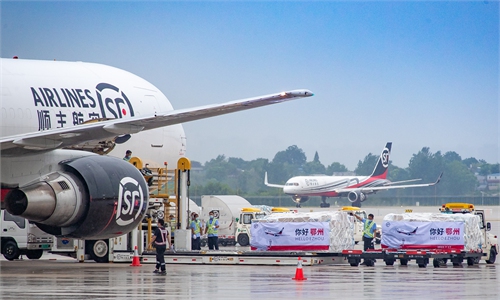
Xiang Xiwen, a manager from SF Airlines, told the Global Times on Monday that in the first half of 2026, the company's AI-related cargo volume surged by over 130 percent year-on-year.
Xiang noted that in the past, air freight was dominated by small, lightweight parcels. Now, the build-out of computing infrastructure is driving a sharp rise in demand for transporting oversized server racks and complete equipment units.
These precision devices cannot be squeezed or stacked, which has given rise to a surge in demand for premium air freight services, including full-charter flights, block space agreements, and palletized shipments. While the cost of shipping large AI equipment can increase by 20 percent to 30 percent, for technology companies, timeliness, safety, and reliability matter far more, said Xiang.
James Evans, general manager of Cargo Commercial, said in an earlier interview with the Global Times that AI will be one of the most important business highlights this year. Global investment in AI infrastructure is expected to see massive growth this year, with a large portion concentrated in hardware - and freight service providers play a crucial role in the global transport chain for these hardware products.
In March of this year, the International Air Transport Association (IATA) released a report, showing air cargo's vital role in sustaining global trade and supporting economic growth in 2025 amid severe trade policy uncertainty.
IATA said that as AI investment surged in 2025, air cargo efficiently and reliably delivered high-value, time-sensitive equipment such as servers, data storage units, and memory chips. The report said in 2025, more than two thirds of the value of AI-related trade was carried by air.
Air cargo consignments of AI-related goods grew 20 percent year-on-year, and AI-related goods accounted for 53.5 percent of the total value of air-transported trade, representing just 7 percent of its volume - highlighting the segment's high value density and strategic importance for the industry, according to the IATA.
Evans said that global investment in AI infrastructure is expected to see significant growth this year, with a large portion concentrated in the hardware sector. This type of transportation requires not only shipping capacity but also specialized solutions and cargo handling capabilities, including for cargos such as server racks, precision equipment, and hazardous materials including batteries.
These demands are expanding rapidly and will be a crucial driver of change and growth this year, he added.
RELATED ARTICLES