Merz's yuan undervaluation claim shows anxiety over Europe's declining competitiveness: experts
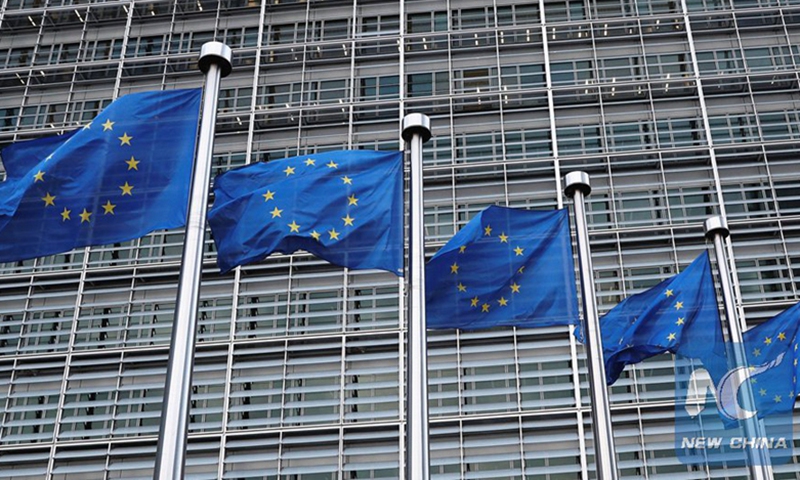
The European Union flags in front of EU headquarters in Brussels, Belgium. Photo: Xinhua
German Chancellor Friedrich Merz reportedly claimed that the yuan has been undervalued by 25 percent "for years," while calling for dialogue with China on monetary policy. Chinese experts said that Merz's remarks, which are unobjective and incorrect, reflect anxiety among some European leaders over Europe's declining competitiveness and that unilateral pressure on China is unacceptable and ineffective in resolving trade disputes.
As China-EU economic and trade cooperation continues to expand in scope and depth, it has delivered tangible benefits to both sides and contributed to global prosperity. The EU should seize the opportunities brought by China's development and enhance its own competitiveness rather than resorting to protectionism, experts said.
When asked about Chinese trade, Merz claimed in comments to students at Cologne University on Monday that the yuan has been undervalued by 25 percent "for years." The German leader delivered an address at the opening of the Adenauer School of Government, Bloomberg reported.
"We started an intensive discussion in the European Council," Merz said, adding that Europe had underestimated China's political and economic role in the world for too long. "We need a political currency dialogue with China," he said, according to Bloomberg.
This is not the first time the German leader has sought to pressure China over the yuan exchange rate. Following the recent EU summit, Merz stirred controversy over the yuan exchange rate, claiming that the currency was undervalued by as much as 30 percent and even citing the 1985 "Plaza Accord" - which plunged Japan into its "lost decades" - as a solution.
"Some European leaders have shifted their rhetoric from criticizing China's subsidies to alleging currency manipulation, persistently exerting pressure on China in an attempt to reduce the EU's dependency on China and address so-called trade imbalances. However, such perceptions are neither objective nor reasonable," Jian Junbo, director of the Center for China-Europe Relations at Fudan University's Institute of International Studies, told the Global Times on Tuesday.
Chinese central bank officials have on various occasions stressed that the country has no intention to gain foreign trade advantages through currency devaluation.
China has no need or intention to seek competitive edges in foreign trade through the depreciation of its currency, Pan Gongsheng, governor of the People's Bank of China, the country's central bank, made the remarks at a press conference on the sidelines of the fourth session of the 14th National People's Congress held in March 2026.
The PBC has always upheld the decisive role of market forces in exchange rate formation, maintained exchange rate flexibility, strengthened expectation management, and kept the yuan's exchange rate generally stable at an adaptive, balanced level, Pan said.
Recent remarks by certain EU officials revisiting the so-called "China-EU trade imbalance" and advocating for "trade-defensive instruments" regarding the trade deficit and industrial competition are, in essence, a reflection of the EU's profound anxiety over its own waning competitiveness, Jian said.
China has no need or intention to seek competitive edges in foreign trade through the depreciation of its currency, Pan Gongsheng, governor of the People's Bank of China, the country's central bank, said at a press conference on the sidelines of the fourth session of the 14th National People's Congress held in March 2026.
The EU should achieve better development by enhancing its own competitiveness rather than resorting to protectionism, Zhang Jian, a vice president of the China Institutes of Contemporary International Relations, told the Global Times on Tuesday.
China's development has prompted a growing number of European companies to expand their presence in the Chinese market. German investment in China surged by more than 55 percent last year compared with 2024, while Swiss investment jumped by 66.8 percent and British investment rose by 15.9 percent.
"That European businesses are choosing to double down on China speaks volumes about the openness and inclusiveness of the Chinese market, which offers tangible opportunities for companies worldwide, including those from Europe. Yet certain EU politicians, driven by ideological bias, choose to ignore these facts and bolster a series of trade-defense instruments. Such protectionist moves have led to a waste of China-EU economic and trade cooperation opportunities and ultimately harmed the interests of both businesses and consumers," Zhang said.
In nature, the China-EU economic and trade relationship is complementary and win-win. As bilateral cooperation continues to broaden in scope and deepen in substance, it has not only boosted the economies of both sides but also delivered tangible benefits to people on both sides, contributing to global prosperity. The EU should seize the opportunities brought about by China's development, Zhang said, noting that deepening economic and trade cooperation serves the common interests of both sides and aligns with the prevailing expectations of business communities and both people.
As the newly established China-EU trade and investment consultation mechanism progresses, China has invited European Commissioner for Trade and Economic Security and Interinstitutional Relations and Transparency Maros Šefčovič to visit China this autumn for the second meeting of the mechanism, He Yadong, spokesperson of China's Ministry of Commerce, said at a press conference on July 2.
China will continue to actively expand imports and promote the balanced development of imports and exports during the 15th Five-Year Plan (2026-30) period, Lü Daliang, spokesperson of the General Administration of Customs, said on Tuesday, in response to a question over the outlook for China's trade surplus for the rest of this year, as the country's trade surplus has raised concerns among its trading partners - most notably the EU.
"Regarding China's trade balance, I would like to point out that China's foreign trade is characterized by large-scale imports and exports. We are not only the world's largest exporter but also the second-largest importer. Data from the first half of this year shows that the growth rate of imports outpaced that of exports, resulting in a 4.7 percent narrowing of the trade surplus," Lü said.
RELATED ARTICLES