ARTS / CULTURE & LEISURE
Explore the legendary ‘wild tea’ in North China’s cold mountains
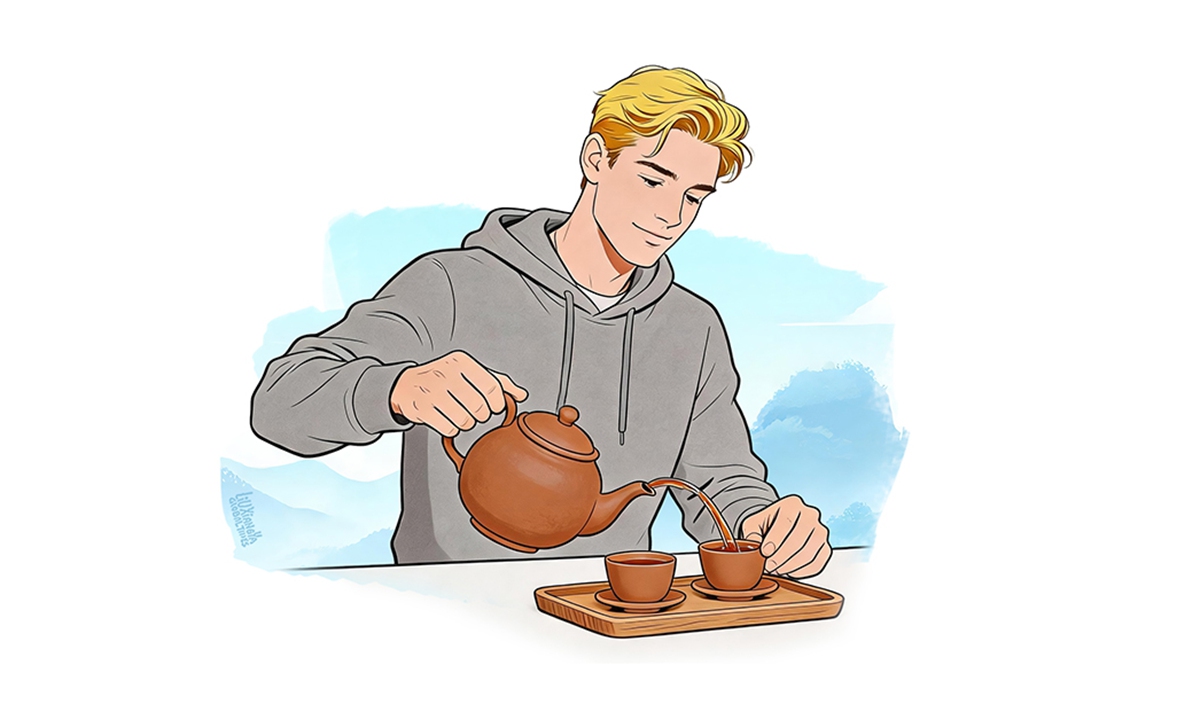
Illustration: Liu Xiangya/GT
Last I checked, there were over 400 registered local geo-indicated varieties of tea in China. From pungent raw Pu'er in the southernmost frontiers of Yunnan Province to the nutty green teas of the Shandong Peninsula, China is home to a greater variety of tea than any other country on the planet. China also produces some of the most enjoyable homegrown confusion one can ever have the pleasure of unraveling.I encountered one such case in 2025. On TikTok, I saw someone claim that Shanxi Province's Guye Mountain, located hundreds of miles north of Shaanxi and Henan's coldest tea growing areas, was somehow home to humanity's favorite little green leaf. Surely he was just confused, but his confusion appeared to be contagious. In the comments on this video, one local shared that their own grandparents used to travel up that mountain to pick tea, and at least two people claimed to have done so themselves. Are they all really lying? Some of them called it "big leaf tea;" others called it "green tea." If they are telling the truth, how could a brutally dry and cold area possibly have tea, growing in the wild nonetheless? This simply did not make sense to me. After a weekend visit to the area, I have a pretty good idea of what exactly this "tea" really is.
Convincing myself that these netizens may be not just confused, but on the verge of a major ethno-botanical discovery, I took the roughly four-hour train ride from Beijing to Huozhou station, just over an hour away from Guye Mountain.
My enthusiasm began to freeze with the first October sharp winds I felt as I got off the train. Walking up and down the central commercial street in Fenxi county, a 30-minute drive from Guye Mountain, one would never imagine that this was a place that could grow tea. Here you will see dusty streets covered in drying corn against the backdrop of barren yellow mountains and smokestacks. Two idle people on the street, both farmers around 60 years old who were born in the area, said they had heard the story of tea on Guye Mountain - but neither man had even seen it or tasted it. Visiting six tea shops in Fenxi county, I found not one that had the mystery tea on offer. Luckily, some of these tea shop owners had at least heard of what I was looking for.
From these tea shop owners, I learned of two different local "teas" that are associated with the mountain: Chiguoyou (Elaeagnus mollis) and Liusucha (Chinese fringe tree). Neither of these teas are true Camellia sinensis, but these tisanes do brew up a pleasantly bitter yellowish broth that tastes something like tea.
Chiguoyou refers to a semi-endangered tree whose leaves, bark, and fruit can all be brewed up as a tea, and more critically, can be refined into an oil of alleged medical properties. There are now some 300 mu (50 acres) of wild and cultivated trees of this species growing on one mountain slope in Zhushengou (Assembled Gods Village), at an elevation of around 1,200 meters. Boss Guo, who has now rented virtually all the land where these trees grow, speaks of the tea as a prehistoric anti-aging miracle of botany that only he, alone in the village, could see the value in. "A rare treasure in the Lüliang Mountain range - you cannot find it anywhere else, and the cost of production is next to nothing, only I could see the opportunity here." However savvy a business move it may have been for him to corner this market, no one drinks the tea locally. Dust-covered, untouched boxes of it can be found in the homes of some local farmers and tea shops who received it as a gift.
Liusucha, the tea made from the Chinese fringe tree, is a different story entirely. Although far fewer in number than the Chiguoyou trees, these were the tea trees that I was really after. It was scattered trees of these species in a patch of forest over 1,500 meters high that some locals drank as tea in past generations. In the more remote Shandicun (Bottom-Mountain Village), Zhang Jinlong, a beekeeper and corn farmer in other seasons, still spends a few days every May "picking tea." In the same wood-fired wok where he and his wife prepare their meals, they cook and shape flowers and leaves of the fringe tree into something that some locals call "green tea." The husband and wife duo can turn out around 7 kilograms of finished product during the narrow picking season. About a decade ago, a trader from the south had visited, asking for seeds from these wild trees. Since then, the farmer in question has become convinced that the tea has a special medicinal property, drinking it daily to prevent stroke and heart attacks, or at least so he claims. Regardless, he and some other local old timers in the village do still continue to drink this tisane.
There are probably many other tisanes out there in China that local people, living thousands of miles away from tea-producing areas, invented to meet the unbroken appetite for tea in hard times when the real deal was unaffordable or even unobtainable. Mulberry leaf and willow leaf tea are two further such examples. Now, however, with good quality Camellia sinensis available in such abundance and the purchasing power of Chinese farmers so improved, these tisanes can perhaps only be curiosities for the health-conscious and historically-minded.
I will never, however, tire of such a quintessential case of Chinese confusion. Almost every village and mountain has half-forgotten stories, almost every agricultural product has some ancient historical pedigree, and with every comment section, shop-keeper, and bored pedestrian, you can find a willing informant, eager to share both their insights and confusion. Millennia of historical development mean that the shared cultural memory of common people, even when it is wrong, will always lead you to interesting places.
The author is a US PhD student from Beijing Foreign Studies University. life@globaltimes.com.cn
RELATED ARTICLES