A fresh 'appetite' for the Chinese market: US restaurant chains return to China's growth story as market appeal grows
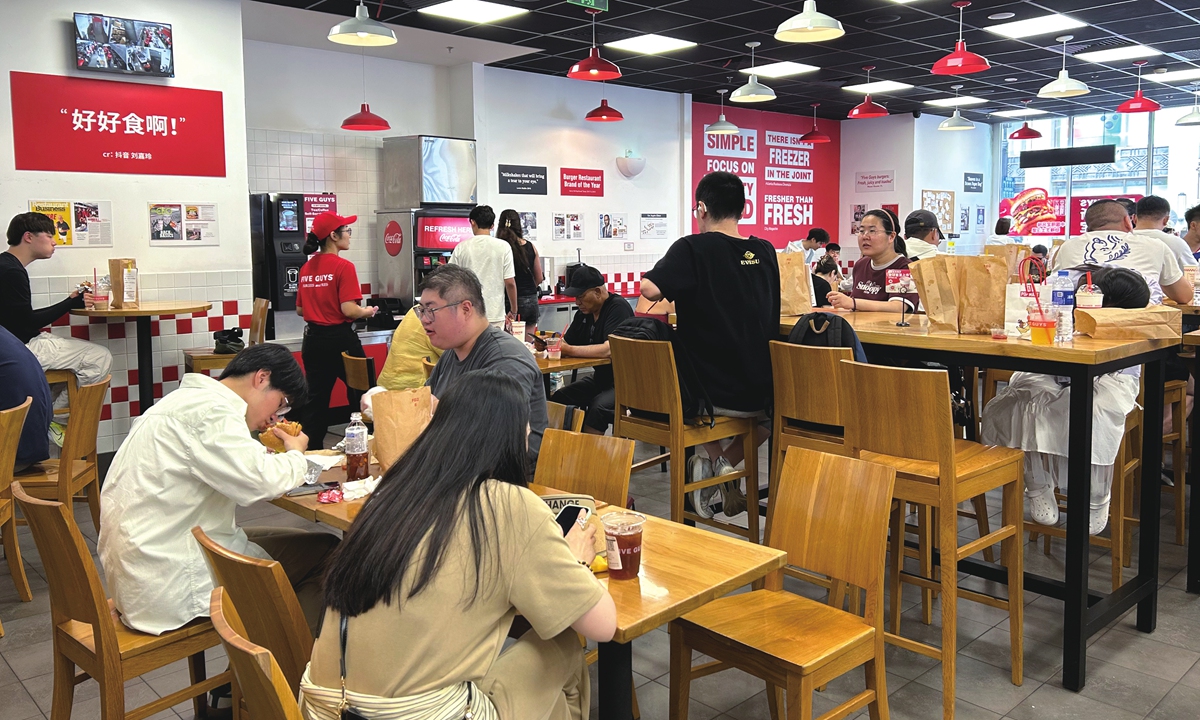
Customers dine at a Five Guys restaurant in a shopping mall in Shanghai on July 14, 2026. Photo: Qi Xijia/GT
At a Five Guys restaurant on Shanghai's bustling Nanjing Road East, the lunchtime rush had passed, but the dining room remained nearly full. More than 90 percent of the seats were still occupied when a Global Times reporter visited the restaurant after peak hours. Young Chinese diners sat alongside foreign visitors, while staff shifted easily between Chinese and English as they took orders and answered questions.
The scene reflects a broader trend. A growing number of US restaurant chains are increasing their presence in China as they seek new growth opportunities beyond increasingly competitive home markets.
Five Guys, the US burger chain, is set to open its first Beijing store in August, five years after having made its Chinese mainland debut in Shanghai in 2021. The chain plans to open three restaurants in Beijing, according to media reports citing the company.
During a recent visit to Chaoyang Joy City in Beijing, a Global Times reporter saw Five Guys construction barriers at the site, indicating that preparations for the opening are underway.
Expanding US fast food brands
Five Guys is one of several US restaurant brands that have recently stepped up their focus on China.
According to Wendy's 2026 first-quarter earnings report, the US burger chain signed a franchise agreement with an experienced restaurant operator to develop as many as 1,000 restaurants in China over the next decade.
Texas Chicken, the international sister brand of Church's Texas Chicken, announced plans to enter China with its first restaurant expected to open in Shanghai. The company said its agreement with Chinese operator Deke Shengtang would support the development of at least 600 restaurants nationwide over the coming years.
Meanwhile, Louisiana-based fried chicken chain Popeyes is accelerating its China expansion after re-entering the Chinese market in 2020 following its 2003 exit. The brand reopened in Beijing in April with a flagship store and later opened a new outlet in Hangzhou on Friday, with more stores in Shanghai, Nanjing and Beijing set to open later this month, according to its WeChat account.
During the recent visit to Chaoyang Joy City, a Beijing-based office worker surnamed Zhang told the Global Times that he was looking forward to Five Guys' opening, saying the arrival of more international brands would give consumers, especially younger diners, more choices.
"I have tried Popeyes before, and I'm looking forward to seeing Five Guys come to Beijing," Zhang said. "Chinese young consumers today are more willing to explore different cuisines and pay attention to taste, quality and dining experiences. The arrival of more international brands shows that Beijing's dining market is becoming more diverse and vibrant."
"The renewed investment by US restaurant brands in China shows that international companies remain optimistic about the prospects of the Chinese consumer market," Su Jian, a professor at Peking University's National School of Development, told the Global Times on Thursday.
"China's consumption market is undergoing a transition toward higher-quality growth, while the potential of Chinese consumers remains significant. As economic restructuring advances and the economy continues to recover, consumption potential is expected to be further released over the long term," Su said.
The renewed focus on China comes as US restaurant brands face a more challenging operating environment at home.
The US restaurant industry remains one of the world's largest, but years of expansion have left many chains competing in a challenging business environment amid "persistent cost pressures," "uneven traffic" and higher operating costs, according to an industry report from the US National Restaurant Association.
Wendy's latest financial performance illustrates the pressure. In its 2026 first-quarter earnings report, Wendy's said its US same-restaurant sales fell 7.8 percent year-on-year, while international systemwide sales increased 6 percent.
Attractive dining market
Zhu Danpeng, a Chinese food industry analyst, told the Global Times on Thursday that many international restaurant brands view China as one of their most important overseas markets.
"The development of brands such as KFC, McDonald's and Starbucks in China has demonstrated the feasibility of this market model," he said.
China's large consumer base, the growing role of younger generations as a major consumption force, and rising demand for fast food, delivery services and convenient dining have created continued room for international restaurant brands to expand, Zhu said.
China's catering sector has remained resilient amid evolving consumption patterns. Official data released on Wednesday showed that the sector's value added rose 5.0 percent year-on-year in the first half of 2026, faster than the 4.7 percent GDP growth during the same period.
The continued expansion of established global brands also highlights the depth of China's dining market. Starbucks has described China as "its largest overseas market," while Yum China, which operates KFC and Pizza Hut in China, had over 18,000 restaurants as of the end of 2025 and continues to see room for further growth.
"International restaurant brands have developed relatively mature operating systems in China after years of expansion," Zhu said. He noted that Chinese consumers have shown strong acceptance of international brands, while years of market development have helped these companies build operational experience in China.
Compared with other markets, China's advanced supply chains, digital capabilities and operational infrastructure provide international brands with advantages in improving efficiency and further expanding their presence, he said.
China has continued to roll out policies aimed at expanding consumption and developing services industries.
In its latest effort to boost consumption, China on Monday released its first five-year plan dedicated exclusively to expanding consumption, calling for a stronger role for consumption in driving economic growth, higher-quality services consumption and broader benefits for consumers.
In June, China unveiled an action plan to stabilize and improve foreign investment, with measures aimed at expanding market access, improving services for foreign-invested companies and enhancing the business environment for overseas investors.
Expanding services consumption could create new demand and provide greater growth potential for firms operating in areas like catering, Su said.
"Opening-up measures could support foreign companies by reducing operating costs and providing greater confidence in long-term investment," Su noted.
RELATED ARTICLES