ARTS / CULTURE & LEISURE
China and Russia dig together for ancient treasures in Altai region
By Published: Jul 16, 2026 08:23 PM

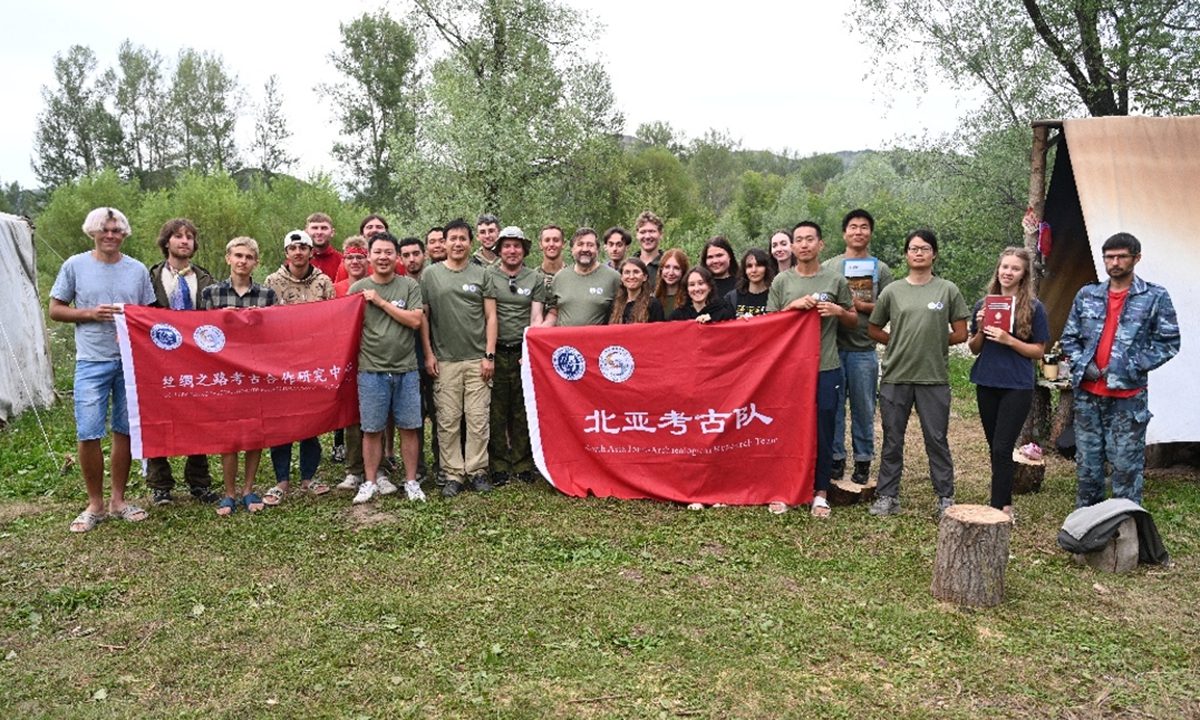
The China-Russia joint archaeological team pose for a photo. Photo: Courtesy of Shao Huiqiu
The Collaborative Research Center for Archaeology of the Silk Roads and Altai State University in Russia have launched their 2026 joint archaeological project. The joint team, made up of students and scholars from both institutions, has arrived at the Chileta Cemetery cluster in Altai Krai, Russia, to begin excavation work. This field project continues their past cooperation and also marks the first initiative of the newly opened Altai Branch of the Collaborative Research Center for Archaeology of the Silk Roads, signaling a new stage of stable, institutionalized collaboration between the two sides.This year's excavations focus on the No.1 and No.2 cemeteries along the Chileta River. The teams plan to excavate three Early Iron Age tombs (dating from around the 6th to 3rd centuries BC), including one medium-to-large tomb and two smaller ones. According to the research center, the main goals of the dig are to clarify the structure of these burials, examine the grave goods and their relation to social status, and use systematic sampling to reconstruct the environmental background, resource use, and subsistence strategies of the period.
Shao Huiqiu, the Chinese team leader, told the Global Times that the Altai region, which spans China, Russia, Mongolia, and Kazakhstan, is a key area for studying early nomadic civilizations and cultural exchanges between the East and West. The current China-Russia archaeological work is mainly taking place in Russian territory. In 2025, the joint team began special excavation work at Chileta village, where four ancient tombs were investigated, three of which dated to the Early Iron Age.
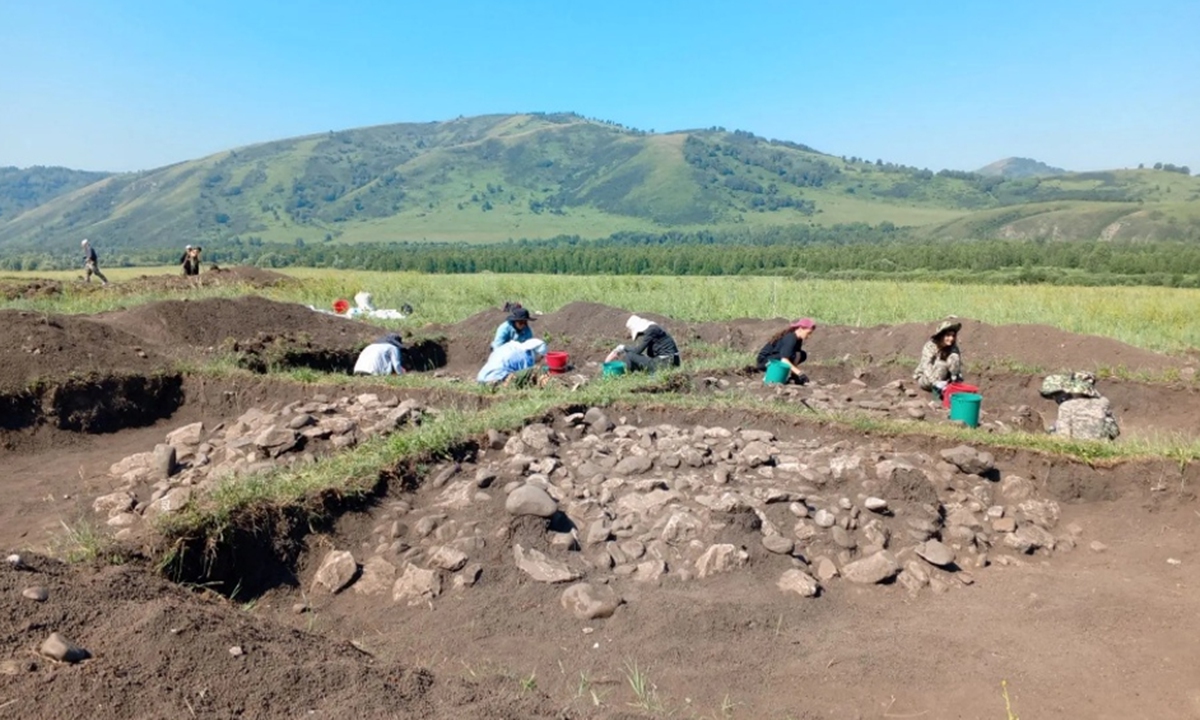
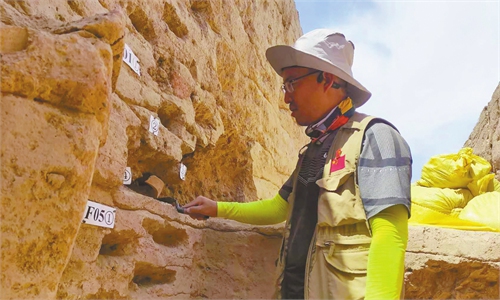
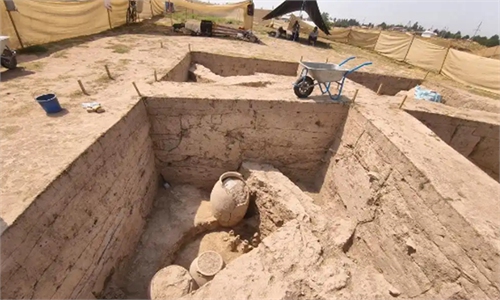
The team works at the archaeological excavation site in the Altai region. Photo: Courtesy of Shao Huiqiu
During these excavations, experts from both countries discovered valuable evidence of cultural interaction. For example, the stone coffin burials show clear connections with ancient burial customs in Northwest China's Xinjiang Uygur Autonomous Region. The "skull and hoof" burial tradition may have originated with nomadic people in northern China, providing concrete evidence that the Altai region served as a corridor for cultural exchange across the steppe. The "skull and hoof" custom refers to placing the skulls and hoof bones of livestock such as cattle, horses, or sheep within the tomb.Shao noted that the excavation area is remote and has long suffered from limited electricity supply and material supplies. The Chinese team draws on mature technology from archaeological science, using high-precision RTK (Real-Time Kinematic) surveying and drone-based 3D modeling to digitally archive field remains and conduct spatial visualizations of the entire area.
The Chinese and Russian teams have developed a cooperative model that leverages strengths of both sides. Russian experts are experienced in local field archaeology and have deep knowledge of the cultural sequence and distribution of archaeological sites in the Altai region. The Chinese side has accumulated extensive expertise in nomadic archaeology and cross-civilization studies of the steppe region of the Silk Road, with strong experience in multidisciplinary research and advantages in transregional comparative studies.
To further promote archaeological collaboration in the Altai Mountains, the center recently established the Altai Branch through cooperation with other institutions at Altai State University, with Shao named as its Chinese director. He noted that currently, archaeological cooperation among China, Russia, Mongolia, and Kazakhstan in the Altai area is still mainly conducted bilaterally. The goal of the new branch is to build a mechanism for four-party joint archaeology, creating a regular academic exchange platform that will enable institutions from multiple countries to work together on joint archaeological surveys, excavations, cultural heritage protection, and the training of young scholars in the Altai region.
RELATED ARTICLES