Y-9 anti-submarine aircraft debuts with upgrades in S.China Sea exercise following 2025 military parade display
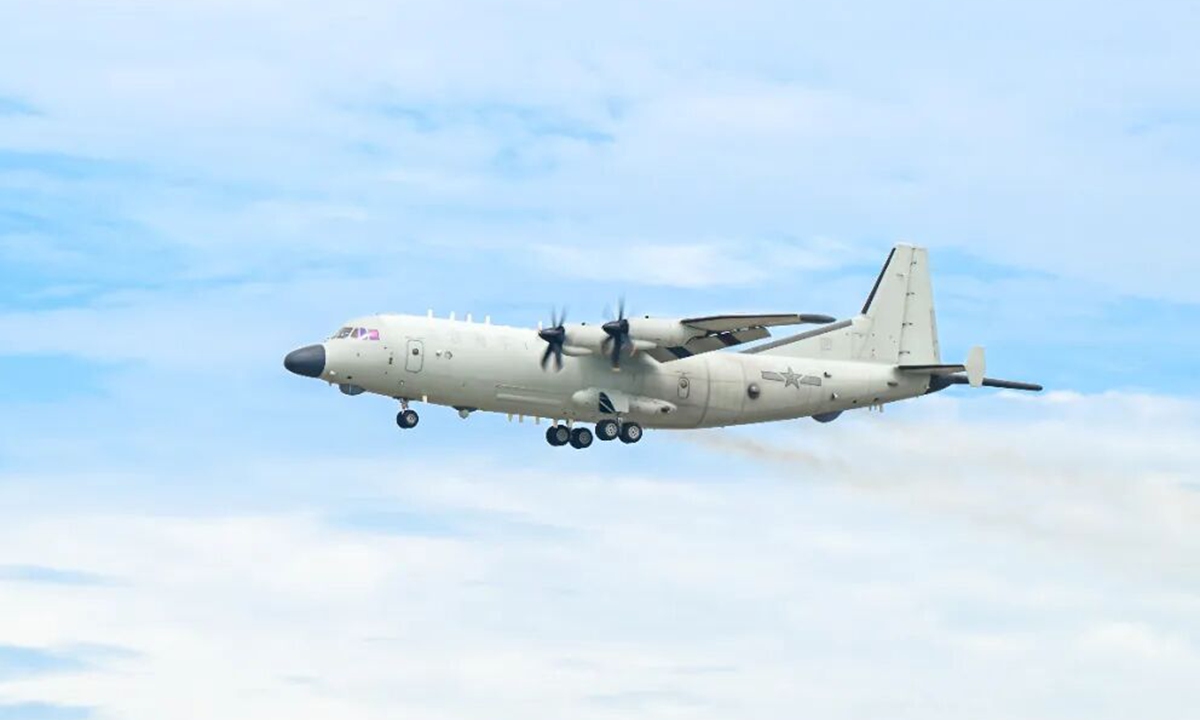
A Y-9 anti-submarine patrol aircraft affiliated with a naval aviation unit of the Chinese People's Liberation Army Southern Theater Command participates in a submarine search and attack training exercises in the summer of 2026. Photo: screenshot from South Sea Fleet WeChat account
Official Chinese People's Liberation Army (PLA) media consecutively released photos showing that the Y-9 anti-submarine patrol aircraft - following its debut during the 2025 V-Day military parade - has now appeared in military exercises for the first time, with an upgraded variant also making its first official public appearance. A military affairs expert said that this indicates that the new anti-submarine aircraft has been put into operational training and achieved initial combat capability, with upgraded radar and magnetic anomaly detector (MAD) enhancing its search, attack and survivability.
China Military Online released pictures on Tuesday evening of a Y-9 anti-submarine patrol aircraft - the version that debuted in the V-Day parade on September 3, 2025 - attached to a naval aviation regiment soaring in the sky during a flight training exercise.
Another set of photos released by the official WeChat account of the South Sea Fleet on Wednesday showed an upgraded version of the Y-9 compared to the 2025 V-Day military parade debut model.
Visually, the aircraft appears to have a new active phased-array radar mounted under the nose, which can offer wider coverage, broader scanning range and longer detection distance than the version that debuted at the V-Day military parade, Zhang Junshe, a Chinese military affairs expert, told the Global Times on Thursday.
Compared with the Y-8 anti-submarine patrol aircraft, the Y-9 anti-submarine patrol aircraft's range and combat radius have been further extended, with increased takeoff weight and longer endurance, further enhancing its comprehensive anti-submarine warfare capabilities, according to Zhang.
A new MAD appears to have been installed at the aircraft's tail. The new MAD is smaller in size, reducing magnetic field interference generated by the metal itself, making maintenance easier and further increasing detection range, said Zhang.
In addition, a large number of sonobuoys are arranged along both sides of the midsection of the fuselage, capable of deploying up to a hundred buoys of various types in a single mission, forming an underwater listening network covering dozens kilometers and significantly improving detection capability against submerged targets, the expert explained.
According to the South Sea Fleet, recently, a naval aviation unit under the PLA Southern Theater Command organized multiple anti-submarine patrol aircraft to conduct targeted search-and-attack submarine training. The exercise was conducted without preset scripts or fixed tactics, and involved coordinated confrontational drills with other units, covering maritime patrol and anti-submarine warfare.
Instructors set up emergent scenarios including electromagnetic interference and equipment malfunctions. The pilots were required to make independent judgments, decisions and responses, creating a combat-mimicking training environment covering all elements, processes and scenarios. Through multiple sorties of targeted search-and-attack submarine training, the unit is accelerating its enhancement of situational awareness, coordinated confrontation capabilities, and day-and-night search-and-attack submarine combat proficiency, said the article.
Both Y-8 and Y-9 anti-submarine patrol aircraft participated in the drills, photos released by the South Sea Fleet show.
Zhang said that the new variant of the Y-9 anti-submarine patrol aircraft has now appeared in the exercise, indicating that it has been put into operational training and has achieved initial combat capability, with preliminary submarine search and submarine attack operational capabilities.
Zhang noted that the South China Sea is more than 1,000 meters deep and has far more complex sea conditions compared to the East China Sea and the Yellow Sea, making submarines harder to detect. Therefore, the South China Sea imposes higher requirements on anti-submarine patrol aircraft. The new Y-9 variant should have significantly improved submarine search capability, attack capability and battlefield survivability.
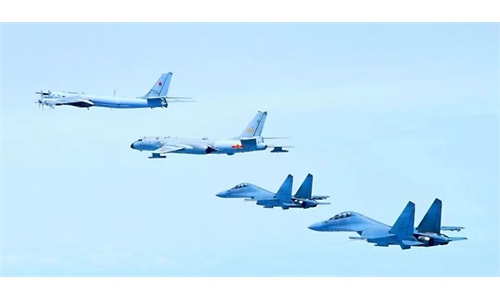
On September 3, 2025, the Y-9 anti-submarine patrol aircraft, Y-9 electronic reconnaissance aircraft and Y-9 radar jamming aircraft made their first debut as new types of special mission aircraft for the PLA Navy and Air Force, forming a special mission aircraft formation with six J-16 fighters to be reviewed, according to the Xinhua News Agency.
The Y-9 anti-submarine patrol aircraft is a domestically developed new type of anti-submarine patrol aircraft equipped with multiple search means, serving as a critical force for handling and responding to maritime and aerial situations, said Xinhua.
"The Y-9 platform has already matured as a special mission aircraft platform in China. Multiple special mission aircraft variants have been developed based on the Y-9 platform, with their operational performance better suited to modern warfare requirements," Jiang Tianhao, a member of the special mission aircraft formation, was quoted then by CCTV News.
RELATED ARTICLES