Chinese, Kazakh companies launch new container hub in Aktau to boost trans-Caspian trade
By Published: Jul 16, 2026 10:29 PM

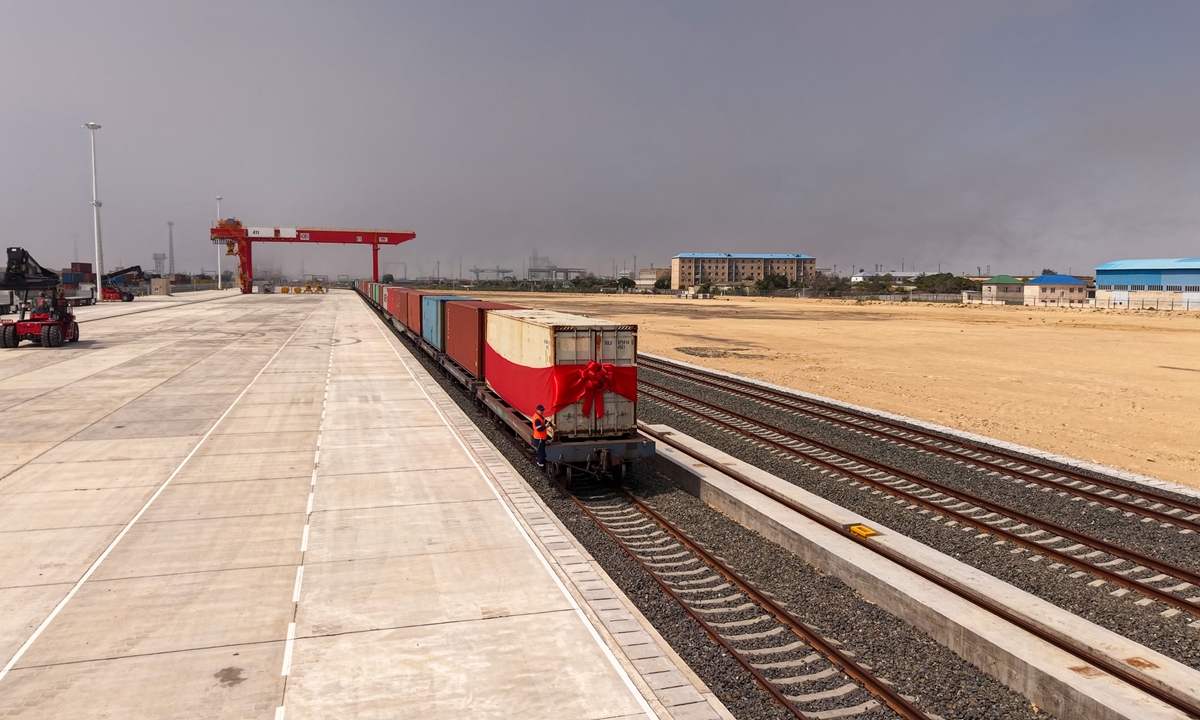
The first freight train, carrying 55 standard containers from East China's Zhejiang Province, arrives at phase I operation area of the Aktau Container Hub at the Port of Aktau, Kazakhstan on July 14, 2026. Photo: Courtesy of Port of Lianyungang
A China-Kazakhstan joint venture container hub at the Port of Aktau officially went into operation on Tuesday, marking a milestone in the development of the Trans-Caspian International Transport Route (TITR), the Port of Lianyungang in East China's Zhejiang Province said in a statement sent to the Global Times on Thursday.
The first freight train, carrying 55 standard containers from Zhejiang, arrived at the hub's Phase I operation area. The shipment included industrial raw materials such as steel coils, as well as Chinese-made light industrial and electromechanical products including home appliances, clothing, electric scooters, toys, and sporting goods. The goods will be transshipped via Aktau and transported across the Caspian Sea to Azerbaijan, reflecting strong market demand for Chinese products in Central Asia and the Caucasus, the statement said.
The port of Lianyungang, which sits at the eastern terminal of the New Eurasian Land Bridge, has emerged in recent years as the gateway to seaborne trade to landlocked Central Asian countries. Investment in the port of Aktau has been one of the moves to boost the resilience of the cross-continent trade artery.
The Aktau Container Hub is a flagship logistics project under high-quality Belt and Road cooperation between China and Kazakhstan, and serves as a key transit node along the TITR. It connects China-Europe railway networks with Caspian Sea shipping, creating an efficient multi-modal transport corridor linking China, Kazakhstan and Europe.
Phase I of the project covers 9.1 hectares, with three railway loading lines, approximately 690 flatbed slots, and advanced handling equipment capable of supporting container transshipment, inspection, and hazardous materials processing, the port said.
In a related development, the Lianyungang Port Holding Group signed on Wednesday a quadripartite cooperation agreement in Shanghai during a Kazakhstan-China logistics and e-commerce forum. The agreement was signed with Kazakhstan Railways (KTZ), China Railway Container Transport Co, and COSCO Shipping Container Lines Co, aimed at promoting the integrated development of "three hubs" along the TITR — the Aktau Container Hub, the Khorgos-Eastern Gate dry port, and the Lianyungang railway container terminal.
Wang Guochao, chairperson of Lianyungang Port Holding Group, said that the port is accelerating the construction of a new Asia-Europe land-sea multimodal data corridor and deploying a synchronized terminal operating system across the three hubs to enable full-chain data exchange among ports, railways, and customs. He added that Lianyungang Port will continue to deepen cooperation with KTZ and other partners to contribute to bilateral economic and trade ties.
China-Kazakhstan economic and trade cooperation has accelerated in recent years, with improving connectivity and growing strategic trust, Zhang Hong, a research fellow at the Institute of Russian, Eastern European and Central Asian Studies at the Chinese Academy of Social Sciences, told the Global Times on Thursday.
Kazakhstan is rich in energy, raw materials and mineral resources, while China has a large market, investment capacity and experience in industrial and infrastructure development. This has supported rapid growth in bilateral trade, expanded Chinese purchases of Kazakh oil and encouraged Chinese participation in local energy and industrial projects, Zhang noted.
Freight delivery via the Trans-Caspian International Transport Route, or the Middle Corridor, has risen fivefold over the past seven years, the Xinhua News Agency reported in March, citing the Kazakh Ministry of Transport.
In a May interview with Bloomberg, KTZ CEO Talgat Aldybergenov said that the company is spending $10 billion expanding rail lines, ports and cargo capacity as companies seek more reliable land routes between China and Europe amid escalating tensions in the Middle East.
"Chinese clients have become more interested in shipping by land rather than by sea because of reliability and predictable delivery times," Aldybergenov said.
Zhang emphasized that transport and logistics have become major areas of cooperation. The expansion of China-Europe freight services and routes through Central Asia has strengthened Kazakhstan's role as a transit hub between China and Europe.
The launch of the Aktau Port container hub is a concrete example of this trend, showing how infrastructure cooperation can turn Kazakhstan's geographic advantages into logistics capacity, investment and new growth opportunities. Recent new projects can improve multimodal transport efficiency, reduce logistics costs and attract more investment and cargo flows, Zhang said.
At the same time, closer strategic coordination through bilateral ties, the Shanghai Cooperation Organisation and the China-Central Asia mechanism has created a stable environment for economic cooperation. Overall, the trend shows that China-Kazakhstan cooperation is becoming broader, more practical and more mutually beneficial, moving beyond resource trade toward logistics, infrastructure and regional development, said the expert.
RELATED ARTICLES