Illustration: Chen Xia/Global Times
US Trade Representative Jamieson Greer said in a Bloomberg TV interview on Thursday that the US wants Vietnam to take more action on non-tariff barriers, economic security cooperation and intellectual property as the two sides continue to wrangle over a trade deal after months of negotiations, Bloomberg reported.
"If we're going to be shipping them some of our high-tech equipment, they need to align with us on export controls and other things," he claimed.
Beneath this technical-sounding trade rhetoric lies Washington's geopolitical calculus: to employ economic leverage to draw Vietnam into its technology-restriction orbit, with the evident aim of tightening the net around China's access to advanced technologies. But Vietnam does not need to pick sides to pursue its economic and trade interests.
The US pressure on Vietnam comes at a time when unilateral US containment of China's technological development has become increasingly futile. Over the past few years, despite successive rounds of US export restrictions on advanced semiconductors, manufacturing equipment and other technologies, China's domestic tech sectors have achieved remarkable progress, and its industrial resilience has continued to strengthen.
Washington's standalone measures have proven insufficient to isolate China's high-tech sector. In response, the US has turned to key supply-chain nodes across the Asia-Pacific, seeking to extend the reach of its export-control regime by coercing regional manufacturing hubs like Vietnam into regulatory alignment.
However, such a geopolitically driven demand is fundamentally incompatible with Vietnam's economic realities and sustainable development interests. After years of deep integration, China and Vietnam have forged a highly complementary and mutually dependent industrial and supply chain partnership. China serves as one of Vietnam's largest trading partners and the primary supplier of raw materials, spare parts and intermediate goods that underpin Vietnam's industrial operations.
Most general mechanical equipment, electronic components and light industrial materials supporting Vietnam's booming manufacturing sector rely on stable and cost-effective supplies from Chinese industrial chains. Vietnam's manufacturing upgrading, export expansion and overall industrial competitiveness are largely built on the smooth operation of this cross-border industrial collaboration ecosystem.
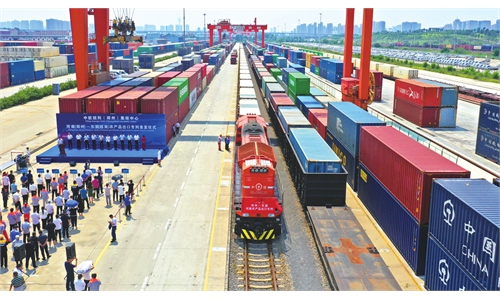
Chinese customs data shows that in the first half of this year, trade between China and Vietnam jumped 30.7 percent year-on-year, with China's exports to Vietnam up by 26.1 percent and imports up by 40.5 percent.
Though the US demands are framed as regulatory alignment, their essence is to impose Washington's unilateral technology restrictions on Vietnam, thereby curtailing Hanoi's policy space in sensitive sectors. For a country seeking to upgrade its industrial base, surrendering this policy flexibility in exchange for conditional market access is a poor bargain. There is no reason for Vietnam to tie its trade and economic development to geopolitical strings, especially in exchange for Washington's capricious promises of market access or something else.
From a broader perspective, the US approach of embedding its export-control rules into bilateral trade talks sets a troubling precedent and also lacks legitimacy. No country should abuse its economic dominance to force others to apply its domestic unilateral rules into global trade practices and coerce other economies into serving its geopolitical agenda.
In addition, China's Ministry of Commerce has repeatedly made its position clear that China firmly opposes any deal reached at the expense of China's interests, and it will resolutely take countermeasures to safeguard its legitimate rights and interests if such a situation arises. Any transaction built on undermining the legitimate rights and interests of a third party is unsustainable from the very beginning.
In today's world of deeply intertwined global supply chains, no country can arbitrarily change the global economic landscape through unilateral will and hegemonic power. If Washington continues elevating its domestic statutes above international norms, it will not consolidate its technological hegemony; instead, it will only erode its own credibility and shrink the space for regional economic cooperation - a loss for all parties involved.
RELATED ARTICLES