China’s humanoid robot makers eye global expansion as 2026 WAIC highlights industry’s rapid rise
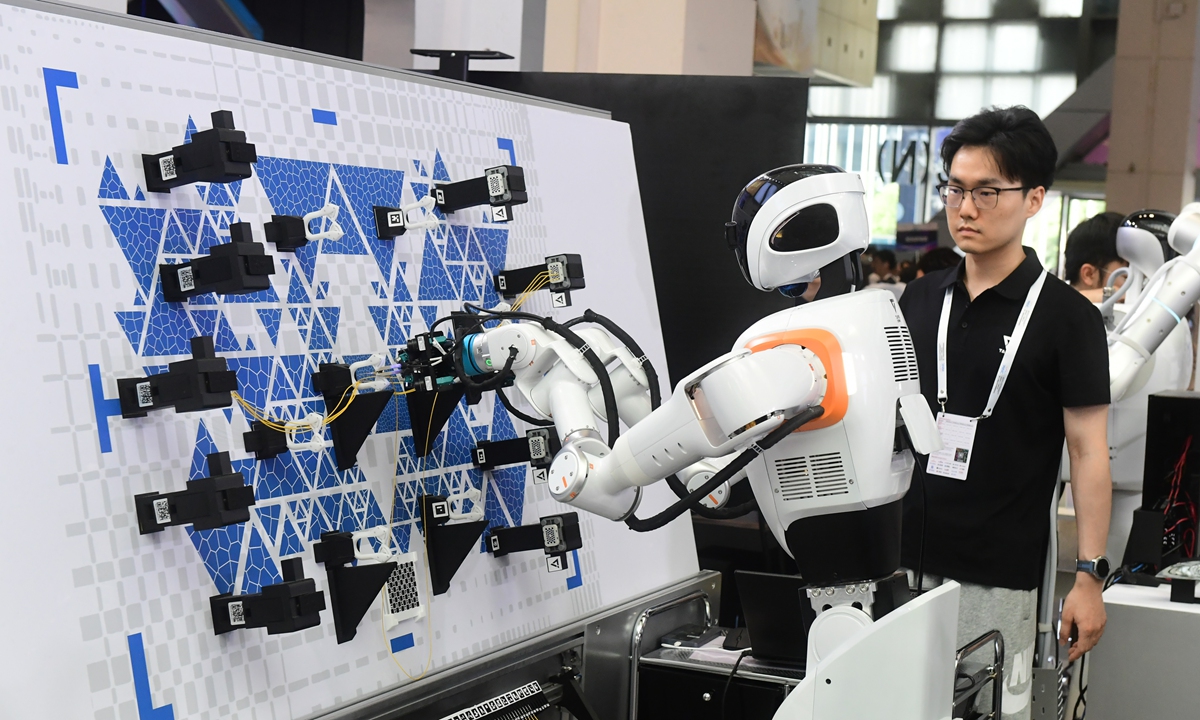 A high-precision robot performs a wiring task at the 2026 World Artificial Intelligence Conference in Shanghai on July 17, 2026. Photo: VCG
At the ongoing World Artificial Intelligence Conference (WAIC) and High-Level Meeting on Global AI Governance, industry leaders discussed China's technical strengths embodied in AI, export plans and the path toward commercial deployment.
"China has already taken the lead in several core areas of embodied intelligence, particularly manufacturing, datasets and training environments," Jiang Lei, chief scientist of the Shanghai-based National and Local Co-Built Humanoid Robotics Innovation Center, told the Global Times on Friday.
He described humanoid robot development as comprising four major pillars: hardware and software manufacturing, embodied AI models, datasets and training facilities. "In embodied intelligence, China is already ahead of the US in smart manufacturing, datasets and training grounds," Jiang said, adding that the gap in the broader technology landscape is narrowing in some areas, though the US still holds advantages in large-scale foundation models and computing.
Peng Zhihui, co-founder and CTO of humanoid robot start-up AgiBot, shared a similar view.
Peng told the Global Times on the sidelines of the WAIC on Friday that only China and the US currently have the full combination of capabilities needed to compete in embodied AI: strong AI "brain" models, robot body development and large-scale manufacturing.
According to the Ministry of Industry and Information Technology, China produced about 20,000 humanoid robots last year. That figure had already surpassed 40,000 in the first half of this year and is expected to exceed 100,000 for the full year, the Securities Times reported.
"In terms of manufacturing, engineering talent density and application scenarios, China has significant advantages," Peng said. "China should take on the responsibility of a major country and export its technologies and products globally."
More than 30 AgiBot robots are on display across WAIC venues, including AGIBOT A3 Ultra, X2 Edu, G2 Max, OmniHand 3 Ultra-M, according to the company's website.
Jiang stated that China's role in the sector is increasingly global rather than domestic-only, saying that many overseas research institutions and manufacturers are buying Chinese humanoid robots for data collection, experimentation and system testing. He said the open-source and open-access approach adopted by many Chinese companies is helping drive international adoption.
He also pointed to growing regional collaboration, including AI partnerships with Southeast Asian countries such as Malaysia, as well as promotional efforts in Thailand, South Korea and other Asian markets.
According to AgiBot, the company has already begun expanding abroad. Overseas business now accounts for more than 30 percent of the company's business this year.
Commenting on foreign concerns that Chinese open-source AI may be a "trap," Jiang dismissed such claims as reflecting lingering ideological bias. He said China's manufacturing strength is becoming a global asset, and that the country is shifting from importing standards to helping shape them.
China is also moving quickly to establish such standards for humanoid robot applications, Jiang said, noting that standards are essential for bringing order to a fast-evolving industry and ensuring that robots develop in ways aligned with human needs.
Industry leaders at WAIC also emphasized that humanoid robots should be seen as a complement to human labor rather than a replacement, arguing that the technology will help free workers to focus on jobs requiring creativity, judgment and empathy.
RELATED ARTICLES