SPORT / MISCELLANY
Lifetime bans on two players a necessary move to protect sports integrity

Football Photo: VCG
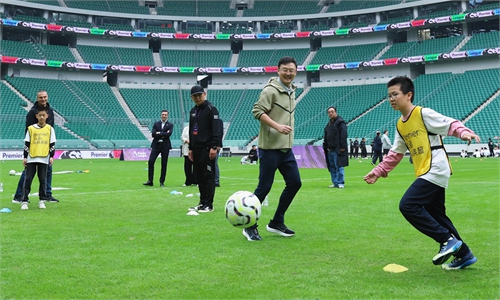
The Chinese Football Association (CFA) on Saturday reiterated that former China internationals Shen Si and Qi Hong remain permanently banned from engaging in any football-related activities, reigniting the debate over how the association should deal with those who have seriously damaged the integrity of the sport in China.The renewed attention came after a video showing Shen slapping an adolescent player at a youth football training activity held in Shanghai last week began making the rounds on social media.
The episode prompted questions over whether local football authorities had effectively implemented the CFA's previous disciplinary decision as Shen was banned for life from football in 2013.
In 2012, Shen and Qi, both former Chinese national team players and members of the generation that helped China qualify for its first FIFA World Cup in 2002, were convicted by a court for accepting bribes to fix a match in 2003. Following the court ruling, the CFA imposed a lifetime ban on the duo in 2013, preventing them from taking part in any football-related activities.
Some may argue that after serving criminal sentences - Shen served six years in prison, Qi five years and six months - individuals should be allowed to rebuild their lives. Modern legal systems emphasize rehabilitation, and society should provide opportunities for those who have genuinely reflected on their mistakes to return to normal life. But there is an important distinction between returning to society and returning to a particular profession.
A lifetime football ban is not a second criminal sentence; it is an industry disciplinary measure designed to protect the credibility and future development of the sport in China. Football is built on one fundamental principle: fair competition. Once that principle is compromised, the consequences go far beyond one match or one player. They damage the trust between clubs, players, fans and the entire football community.
Chinese football has experienced painful lessons from corruption, match-fixing and gambling scandals. These problems not only affected professional competitions but also weakened public confidence in the sport. Years of poor results by the national team have often attracted attention, but the deeper challenge has been rebuilding a football culture based on professionalism, transparency and trust.
That is why serious violations of sports integrity require serious consequences.
The CFA's disciplinary actions against football corruption have also shown that lifetime bans remain a major tool in its effort to restore order in the industry. In the latest anti-corruption storm that started in 2023, dozens of individuals, including former CFA leaderships and coaches, have received lifetime bans following investigations into corruption and match-fixing cases.
Critics of lifetime bans often raise a valid question: Should a person's mistake permanently define their future? In many areas of society, rehabilitation is an essential value. However, professional football carries special responsibilities because its survival depends on public trust. A person who was found to have directly harmed competitive fairness may regain the right to participate in society, but that does not automatically mean they should regain the privilege of holding a position within the same industry.
Of course, punishment alone cannot solve all of Chinese football's problems. Stronger youth development systems, better governance, improved league management and a healthier football culture are all necessary. But none of those reforms can succeed without a clear boundary between acceptable and unacceptable behavior.
Rules lose their meaning when they are not consistently enforced. A punishment that disappears quietly after public attention fades sends the wrong message: That violations of sports integrity may eventually be forgiven without consequences.
For Chinese football, rebuilding credibility requires patience and consistency. The goal should not only be to produce better players or achieve better results, but also to create an environment where every participant understands that fairness is non-negotiable.
The principle behind lifetime bans is not about refusing to forgive; it is about protecting the foundation on which football depends.
A sport cannot inspire trust if those who once undermined its fairness can easily return to positions of influence. Before discussing second chances within football, the game must first ensure that its most basic rule remains intact: The integrity of competition comes first.
The author is a reporter with the Global Times. life@globaltimes.com.cn
RELATED ARTICLES