Tourism Authority of Thailand signs new tourism partnerships with Chinese companies during PM's visit, eyes expansion in China's vast tourism market
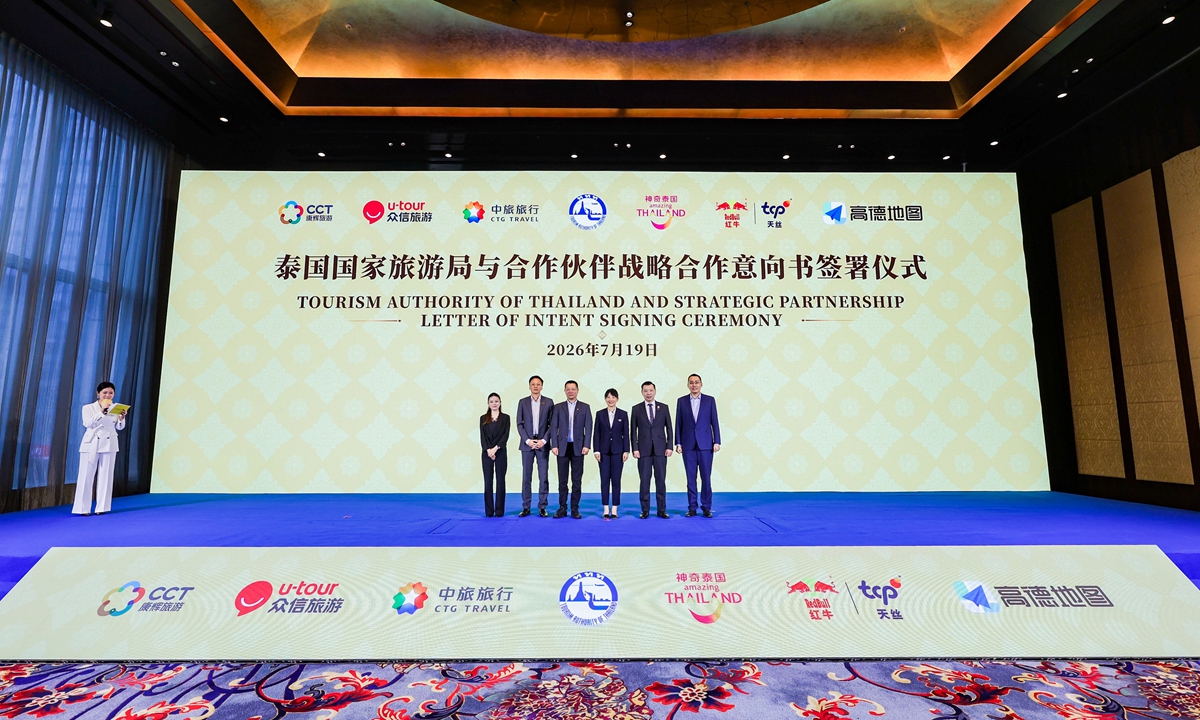
A signing ceremony between the Tourism Authority of Thailand (TAT) and Chinese and Thai businesses is held in Beijing on July 19, 2026. Photo: Courtesy of TAT
The Thai tourism authority signed a score of letters of intent with several Chinese tourism and technology companies at an event in Beijing on Sunday, underscoring the Southeast Asian country's commitment to further tapping the vast Chinese market, which has long played a vital role in Thailand's tourism sector.
The signing came on the sidelines of Thai Prime Minister Anutin Charnvirakul's ongoing visit to China from Thursday to Monday, marking his first official visit to China since taking office, Xinhua News Agency reported.
At Sunday's signing ceremony, China Tourism Group Travel Services Co, Utour Group, China Comfort Tourism Group Co and Amap, as well as Thailand-based company TCP Group, signed letters of intent with the Tourism Authority of Thailand (TAT).
The cooperation spans multiple areas, including tourism product development, group tour organization, smart mobility, brand marketing, and destination consumption experiences. It aims to further deepen Thailand-China tourism cooperation, enhance the confidence of Chinese tourists traveling to Thailand, and promote the sustained development of Thailand's high-quality tourism market, according to the TAT.
Speaking at the signing ceremony, Pattaraanong Na Chiangmai, Deputy Governor for International Marketing Asia and South Pacific at the TAT, said that the Thai prime minister's visit to China, accompanied by a delegation of representatives from the government and business community, has led to the signing of letters of intent between the TAT and five key Chinese partners. The signing marks not only an important milestone in elevating tourism cooperation between Thailand and China, but also demonstrates the strong commitment of the two countries to further deepen the comprehensive strategic cooperative partnership, she said.
As a well-known saying cherished by the peoples of both countries goes, "China and Thailand are as close as one family," this phrase not only vividly reflects the profound friendship between our two peoples, but also serves as an important bond that continues to strengthen cooperation across a wide range of fields, said Na Chiangmai.
Tourism, in particular, plays a vital role in this regard. It not only promotes people-to-people exchanges, but also enhances cultural exchanges and fosters mutual understanding between our peoples, serving as an important bridge for deepening friendship and mutual trust, the TAT deputy governor further noted.
Meanwhile, the share of independent travelers has continued to rise. Beyond first-tier cities such as Bangkok and Chiang Mai, tourists are gradually expanding their travel destinations to second-tier cities such as Rayong, said Na Chiangmai.
Talking about the plan for drawing more Chinese tourists to Thailand, Cao Jian, Vice President of Utour Group, and General Manager of U-Partner, who participated in Sunday's signing ceremony, said in a group interview with the Global Times that they will not only continue to promote Thailand's traditional tourist destinations such as Phuket, Chiang Mai and Pattaya, but also work to bring more Chinese visitors to the country's many second-tier cities while developing a wider range of themed tourism products.
At the same time, tourism is a two-way flow. Cao said that it is not only Chinese tourists traveling to Thailand, there is a growing number of Thai tourists have also visited China, with cities such as Southwest China's Chongqing and Chengdu proving particularly attractive destinations for Thai travelers.
China has now become a key outbound travel destination for people from Southeast Asia, said Cao, noting that as bilateral relations continue to deepen, tourism exchanges between the two countries are expected to enjoy even stronger growth.
RELATED ARTICLES