China’s H1 economic growth remains within reasonable range as nation has solid conditions to achieve full-year goal
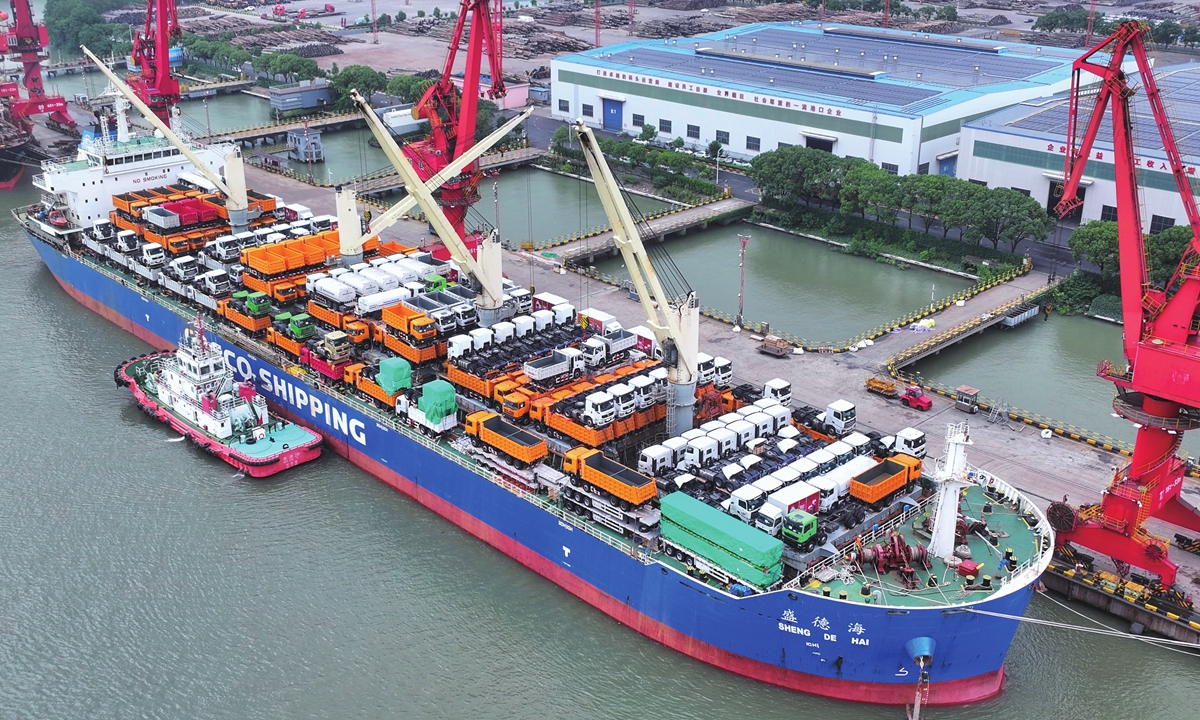
A cargo vessel carrying engineering vehicles for export is seen at a port in Zhangjiagang, East China's Jiangsu Province, on July 21, 2026. Photo: VCG
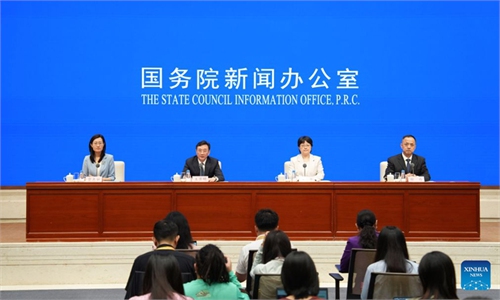
China's GDP expanded by 4.7 percent year-on-year in the first half of 2026, firmly anchoring the growth within a reasonable range. Following a strong start, the Chinese economy has transitioned into a phase of periodic consolidation and calibrated adjustment in the second quarter. Crucially, new growth drivers are sustaining robust momentum, while the transformation and upgrading of traditional industries are accelerating. Coupled with the steady unleashing of policy effectiveness, these factors provide solid conditions and strong support for achieving the full-year growth target.
Industrial production maintained solid growth, with most industries and products registering increases. In the first half of the year, the value-added of industrial enterprises above designated size rose by 5.4 percent year-on-year. In June alone, it grew by 5.3 percent year-on-year, up 0.8 percentage points from the previous month and marking the second consecutive month of acceleration.
New growth drivers continue to expand and strengthen, leading high-quality industrial development. In recent years, the contribution of new growth drivers to industrial growth has kept rising. Preliminary estimates show that in the first half of the year, new-driver sectors represented by high-tech manufacturing and digital product manufacturing contributed 47.9 percent to the growth of value-added of industrial enterprises above designated size, up 12.0 percentage points from the full-year level of the previous year.
Notably, consumer prices are showing a moderate recovery, preliminarily fulfilling the goal set out in this year's Government Work Report to move the general price level from negative to positive. Such progress will further improve corporate profitability, thereby boosting market expectations and strengthening investment confidence.
Between January and June, national total retail sales of consumer goods reached 24.87 trillion yuan ($3.68 trillion), a year-on-year increase of 1.3 percent. Over the period, the country's retail sales expanded by nearly 330 billion yuan compared with the same period last year, and the advantage of the country's ultra-large market continued to manifest.
In June, the total retail sales of consumer goods turned from a 0.6 percent decline recorded in the previous month to 1.0 percent year-on-year growth. The better-than-expected retail growth rate is a result of a combination of factors, including the "618" shopping festival and a low base caused by the shifted timing of the Dragon Boat Festival holidays, which fell between June 19 and 21.
Recently, the State Council, China's cabinet, has approved a plan to expand consumption during the 15th Five-Year Plan period (2026-30). According to the plan, by 2030, the total retail sales of consumer goods will reach approximately 60 trillion yuan ($8.85 trillion), and consumption will play an even stronger role in driving economic growth. It's expected that the authorities will step up efforts to boost consumption in the second half this year.
Investment structure continues to optimize. Driven by the steady advancement of major strategic and security capacity-building projects and the rollout of policies backing large-scale equipment upgrades and consumer goods trade-ins, investment in emerging fields such as R&D has maintained robust growth.

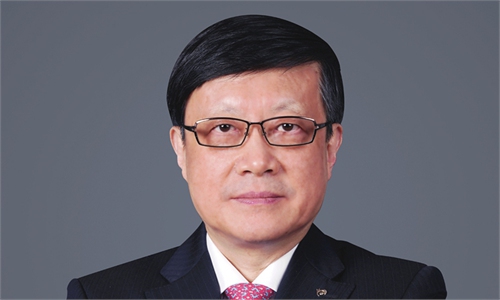
Wen Bin Photo: Courtesy of Wen Bin
Amid a complex external environment, China has leveraged its complete industrial chain to accelerate trade structure upgrading, driving brisk growth in both imports and exports. Although recurring Middle East developments may delay the global economic recovery, the fundamentals underpinning China's export rebound remain unchanged: the ongoing AI investment cycle, competitiveness of China's new-energy products, plus a raft of domestic risk-mitigation policies covering forex, fiscal and customs affairs. China's export sector is projected to hold onto double-digit growth in the second half of the year.
On July 13, a high-level symposium was held, bringing together experts and entrepreneurs to hear their views on the current economic situation and economic work in the next stage. This symposium serves as a key window to gauge China's policy direction in the second half.
The meeting stressed the need to intensify counter-cyclical adjustment, make full and effective use of existing policies, and study and prepare incremental policies in advance to consolidate and expand the momentum of steady and improving economic performance. It's expected that the authorities will step up policy measures for the rest of the year, especially that the implementation of existing policies will gather pace and that efforts will also be made to study and prepare incremental policies for release at an appropriate time.
As for specific tasks, the priority may be boosting consumption. Service consumption is more resilient than commercial goods consumption, with more growth potential and a significant role in supporting employment. The meeting also stressed combining investment in physical assets with investment in human capital. Looking ahead, in addition to investment in crucial infrastructure more investment is expected to be made in the public service sector, which will contribute to both improving people's livelihood and expanding domestic demand.
Industrial policies are also expected to stabilize jobs and enterprises. The meeting also called for a smooth transition between old and new growth drivers, faster digital and intelligent transformation of manufacturing, deeper integration of advanced manufacturing and modern services, and the large-scale commercial applications of new technologies such as artificial intelligence. Policy priorities are pivoting further from technological breakthroughs and proof-of-concept toward application scenarios, commercial deployment, and upgrading industrial organization capacity.
This article was compiled based on an interview with Wen Bin, chief economist at China Minsheng Bank. bizopinion@globaltimes.com.cn
RELATED ARTICLES