Japan hypes China-Russia naval drills in London, but ‘attempt to seek support for military buildup doomed to fail’: expert
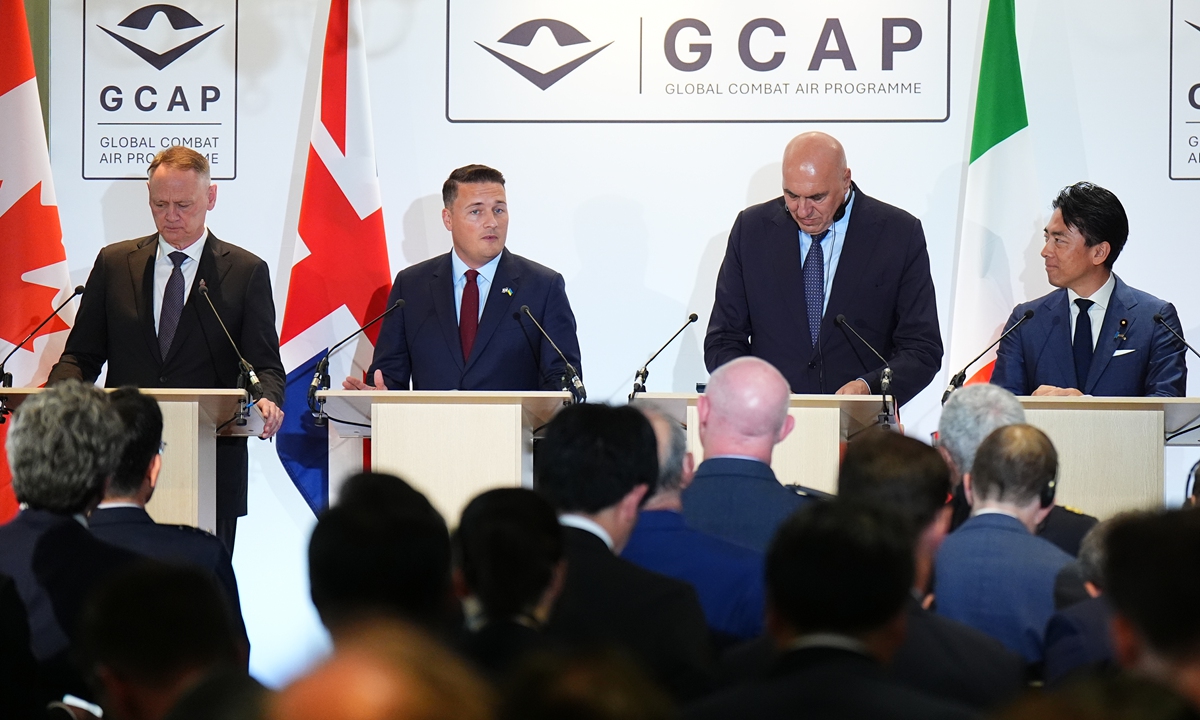
Japanese Defense Minister Shinjiro Koizumi (far right) speaks alongside counterparts from Canada, the UK and Italy during a meeting on the Global Combat Air Programme (GCAP) at Wellington Barracks in London, England, on July 21, 2026. Photo: VCG
Japanese Defense Minister Shinjiro Koizumi on Tuesday played up claims that Chinese naval vessels conduct drills in Japan's so-called "exclusive economic zone" during a meeting with defense chiefs from Italy, Japan, the UK and Canada in London, vowing to continue monitoring Chinese and Russian naval activities around Japan and strengthen surveillance in surrounding air and sea areas, Japan's NHK reported on Wednesday. The meeting also discussed Canada's participation in the Global Combat Air Programme (GCAP), according to Canada's Department of National Defence.
The Asahi Shimbun, a Japanese newspaper, reported on Wednesday that amid China's continued criticism of Japan's neo-militarism, Koizumi's move was aimed at "informing" the international community of the activities of the Chinese and Russian militaries. In response to Japan's hype and smears, Chinese Foreign Ministry spokesperson Lin Jian responded on Tuesday that China's activities in relevant high seas areas are consistent with international law and practice.
Chinese military expert Song Zhongping told the Global Times on Wednesday the GCAP is facing significant obstacles, with its overall research and development progress continuing to fall behind schedule.
According to Song, Japan, Italy and the UK remain divided over issues including cost-sharing, ownership of core technologies and the allocation of industrial responsibilities, resulting in persistent internal disputes. Against this backdrop, Canada appears unwilling to commit funding to the program at this stage, opting instead to participate as an observer while assessing the project's overall progress as well as its potential risks and benefits before making a final decision, which Song described as a pragmatic approach.
Song said Koizumi's remarks hyping the so-called "China-Russia military threat" were aimed at rallying Western countries to pressure China. But such accusations are "groundless," he said.
Song argued that Tokyo is using the narrative to justify its military buildup while seeking support from Western allies for its maritime claims and expansion. He cited Japan's moves including increase in military budget, revision of the pacifist constitution and development of long-range assaulting weapons, as well as occupation of the high seas, plundering seabed resources and maritime expansion.
Within the Western bloc, interests and aspirations vary drastically and every country has its own calculations. They appear united yet remain divided and "Japan's attempt to use the Western bloc to advance its security agenda will end up in vain," Song said. "It should abandon its Cold War mentality and zero-sum thinking, stop hyping so-called external threats, and contribute to regional peace and stability through concrete actions."
RELATED ARTICLES