ARTS / CULTURE & LEISURE
Two decades of conservation are redefining how communities engage with China’s ancient frontier heritage
Echoes of the Great Wall endure
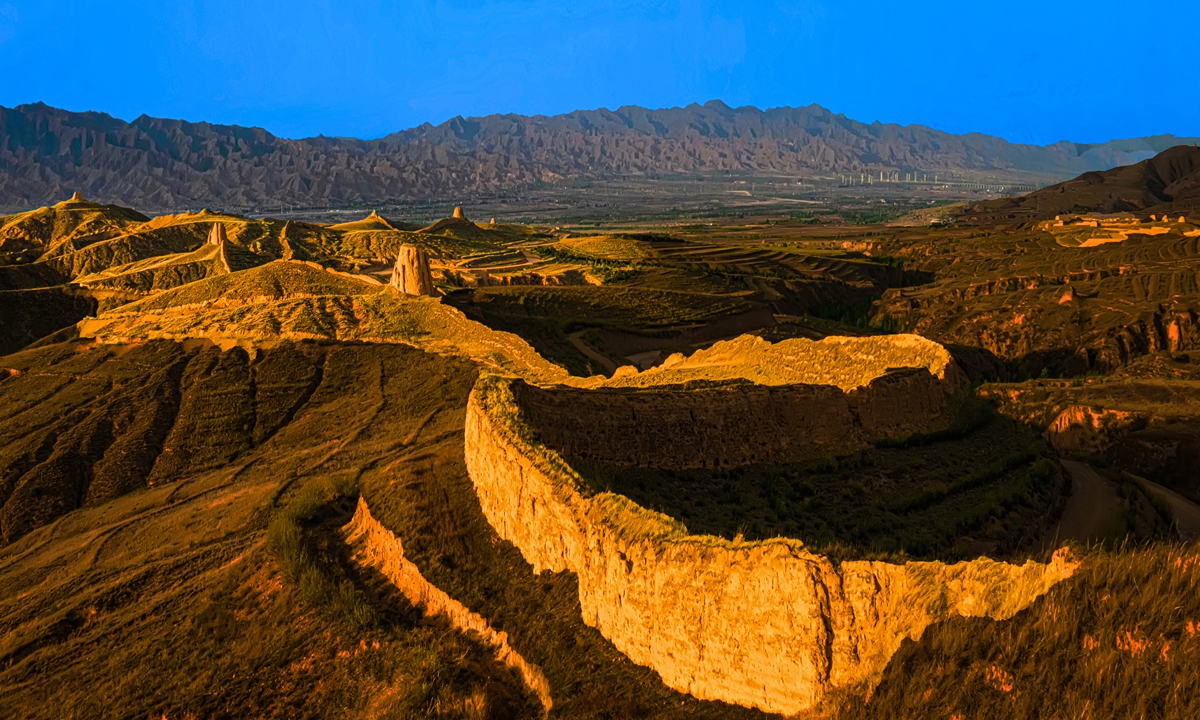
A view of the Great Wall ruins in Xinghe county, North China's Inner Mongolia Autonomous Region Photo: Liu Yongsheng
In the height of summer, the grasslands of Xinghe county in North China's Inner Mongolia Autonomous Region stretch vast and clear beneath the bright sky. At the tri-provincial border of Inner Mongolia, Shanxi, and Hebei provinces, the vast plains of Xinghe are scattered with Great Wall relics spanning the Warring States Period (475BC-221BC), the Han Dynasty (206BC-AD220), and the Ming Dynasty (1368-1644). Layer upon layer of rammed earth stands in silent succession, worn by more than two millennia of wind and rain. No longer the towering rampart of legend, these weathered earthen walls - fissured, grass-covered and half-consumed by brush - endure as a ledger of history, bearing witness to the rise and fall of dynasties, the ebb and flow of frontier trade, and the mingling of cultures.
2026 marks the 20th anniversary of China's national regulation on the Great Wall protection. A Global Times reporter traveled with specialists in cultural relic preservation, digital tourism and artistic creation to survey Xinghe's mountainous frontier, conducting field studies of Great Wall sites. Two decades of sustained conservation have recast the Great Wall from an age-old military boundary into something more expansive. Amid the weathered remains, a balance of heritage conservation and innovative cultural tourism is transforming this once-divisive border wall into a living thread - one that connects cultural memory, brings communities together and helps drive rural revitalization.
From barrier to bond
The Great Wall is a spiritual emblem of the Chinese nation and the largest, most widely distributed heritage site in the country. Built and rebuilt over a span of more than 2,000 years, it stretches across 15 provincial-level regions, bearing witness to the continuity of Chinese civilization.
Xinghe is often called an "open-air museum of the Great Wall," boasting fortifications from five distinct eras: the Warring States Period, Qin (221BC-206BC), Han, Northern Wei (386-534), and Ming. At 83 survey sites scattered across the hills, the rammed earth walls glow a soft ochre under the afternoon sun.
"The Great Wall was essentially a fence between brothers," Zhao Chen, director of the Institute of World Cultural Heritage at Chengdu University, told the Global Times. "It is a monument jointly forged by all Chinese ethnic groups, and a historic tool to sustain peace and cross-border commerce. By enabling goods exchange instead of armed conflict, it laid solid groundwork for a unified multi-ethnic nation."
Evidence of this integration can be seen in local archaeological finds. Bai Xiangdong, an expert with the Inner Mongolia Great Wall Protection Association, said that the coins and everyday artifacts unearthed in Xinghe reflect centuries of exchange among Mongol, Han, and Hui communities.
"By the Ming Dynasty, places like Mashikou had shifted from military strongholds to bustling trading hubs for grain, cloth, and horses," Bai explained. "The Wall transformed from a divider into a connector."
"From ancient times to the present, the Great Wall has served as a vivid symbol of forging a strong sense of community for the Chinese nation," Gao Xiaomei, president of the Inner Mongolia Great Wall Protection Association, told the Global Times.
Citing the 20th anniversary of the protection regulations, Gao said that across China, efforts are intensifying to build an increasingly robust protection network for the Great Wall, combining professional stewardship with broad public participation. From installing markers and conducting routine patrols to strengthening institutions and expanding public education, a systematic protection framework has begun to take shape, effectively advancing the preservation and inheritance of the Great Wall. Such targeted conservation efforts are fully underway in Xinghe.
The county has tailored this standardized protection model to safeguard its multi-dynastic Great Wall relics on local terrain.
From preservation to innovation
Located just over an hour from Beijing by high-speed rail, Xinghe is seeing a surge in cultural tourism. The narrative of the Wall is being rewritten through modern infrastructure and technology.
"In ancient times, the Wall kept invaders out; today, it brings prosperity in," Zhao Chen observed. Across the region, local governments are linking heritage with economic development.
Shanxi Province has launched "Highway No.1," a scenic route connecting Ming Dynasty fortifications across three cities. Neighboring Inner Mongolia recently hosted its sixth annual Great Wall cultural festival in Xinghe, focusing on sustainable tourism.
Discussions among experts increasingly focus on avoiding homogenized development. Wang Xiaodong, vice president of the Inner Mongolia Animation Association, advocates for building a localized AI database for Xinghe's Wall. This would enable smart tours and immersive digital experiences, ensuring the history reaches a wider audience. Zhao Dun, vice president of the Yanqing District Cultural Relics Protection Association in Beijing, suggested comprehensive visual documentation to create a "Xinghe Model" for preserving earthen ruins.
The most promising sign, locals say, is the rise of educational travel. "Kids don't just snap photos anymore," Gao said, smiling. "They touch the rammed earth and listen to the stories buried in the dust. The Wall is no longer just a relic of the past; it's becoming an immersive epic that people can actually read and feel."
RELATED ARTICLES