ARTS / CULTURE & LEISURE
Chinese-Uzbek team uncovers 3,000-year-old city in Central Asia
Findings shed light on evolution of urban layouts
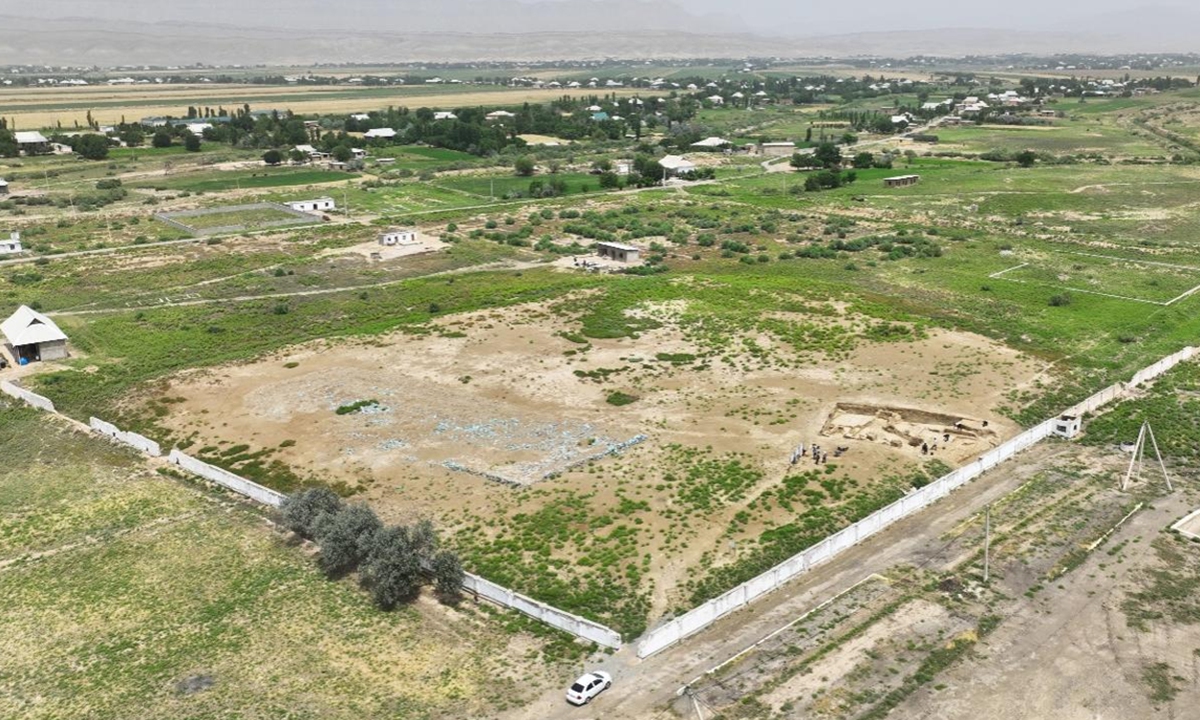
The Bandikhan II site, located in Uzbekistan's Surxondaryo Region Photo: Courtesy of China's Northwest University
A 3,000-year-old city in Uzbekistan has been discovered by a joint Chinese-Uzbek archaeological team, shedding new light on the ancient city's layout and construction during the early Iron Age.The discoveries were made at the Bandikhan II site, located in Uzbekistan's Surxondaryo Region. The settlement, roughly square in shape, was built in the 10th century BC and used until the 8th century BC.
The excavation has, for the first time, revealed the city's layout, construction methods, functions, and how it was built and used during the early Iron Age, Zhu Jiangsong, a member of the joint archaeological team from the School of Cultural Heritage, Northwest University, told the Global Times on Sunday.
The site was originally discovered in 1969, but joint excavations didn't begin until 2023, when the archaeological team was formed by Northwest University of China, Termez State University, and the Termez Archaeological Museum.
Archaeologists excavated the eastern section of the site and confirmed that its lowest layer dates to the early Iron Age, making it the largest and best-preserved settlement identified in the Bandikhan oasis. They also uncovered the eastern city wall, a storage space within the wall, and five rooms, along with interior partitions, support pillars and evidence of fire use.
Among the most significant findings is a well-preserved eastern wall, with a trapezoidal cross-section measuring 6.15 meters wide at the base and 4.3 meters at the top, and standing to a height of 2.1 meters. The wall was not built with a foundation trench. Instead, builders first leveled the ground, laid a 0.1-meter layer of clean yellow soil, and then constructed the wall using compacted mud.
A storage space measuring 3.69 meters by 1.33 meters was also discovered within the eastern wall.
Inside the city, archaeologists uncovered a series of structures, including five interconnected rooms aligned along a northwest-southeast axis. They also found multiple traces of fire use inside the rooms and a bed in one of them. A lamp niche was set into the middle of the north wall beside the bed, with a flat base and arched top. Its interior had been hardened into red, fired clay by repeated burning, and soot marks were visible along the upper surface.
The site also yielded a large and diverse assemblage of artifacts, dominated by pottery and stone tools, with a smaller number of bronze objects. Pottery finds include carinated jars, bowls and flat-bottomed dishes. Stone tools, such as grinding slabs, mullers, pestles and mortars, indicate grain processing, while bronze items include knives and arrowheads. Seashells were also recovered.
In terms of form, decoration and manufacturing techniques, the pottery closely resembles material found at the sites of Kuchuktepa and Yaztepa, placing it within the early Iron Age's Yaz cultural tradition.
Based on radiocarbon dating, archaeologists determined that the lower layer of the Bandikhan II site was founded in the 10th century BC and remained in use until the 8th century BC. "The site is a well-preserved and structurally intact urban center from the ancient Bactrian kingdom, dating to the period after the decline of the region's Bronze Age culture and before the expansion of the Persian Achaemenid Empire," noted Zhu.
Its wall construction and the inclusion of storage spaces within the fortifications are similar to the layout of the Bronze Age site at Sapalitepa. However, they differ markedly from the contemporary site at Talashkantepa, where semicircular defensive towers were built along the exterior of the walls.
"The findings provide key evidence for understanding the form of early Iron Age city-states in southern Central Asia and the evolution of urban layouts from the Bronze Age to the early Iron Age," said Zhu.
Only a small portion of the site has been excavated so far. The total area of the ancient city is estimated at around 10,000 square meters, but just 300 square meters have been explored to date. Researchers plan to expand excavations in future seasons to gain a more comprehensive understanding of the settlement, according to Zhu.
In parallel with the fieldwork, the collaboration has also extended into education and cultural exchanges. On March 22, a two-week training program on Silk Road archaeology, cultural heritage protection, and scientific techniques was launched at Termez State University, according to Northwest University.
The program includes classroom instruction, laboratory training and fieldwork, covering topics such as Chinese and Silk Road archaeology, cultural relics conservation, heritage management and archaeological science. It brings together scholars from China and Uzbekistan, and includes classroom instruction, laboratory work, and field visits.
As a specialized training program in Silk Road archaeology, it is expected to inject new momentum into the protection and transmission of Silk Road cultural heritage and to promote cultural exchange, according to Zhu.
RELATED ARTICLES