ARTS / CULTURE & LEISURE
‘Pastry Poet’ Wu Yang creates with inspiration from books
Recipe for creativity
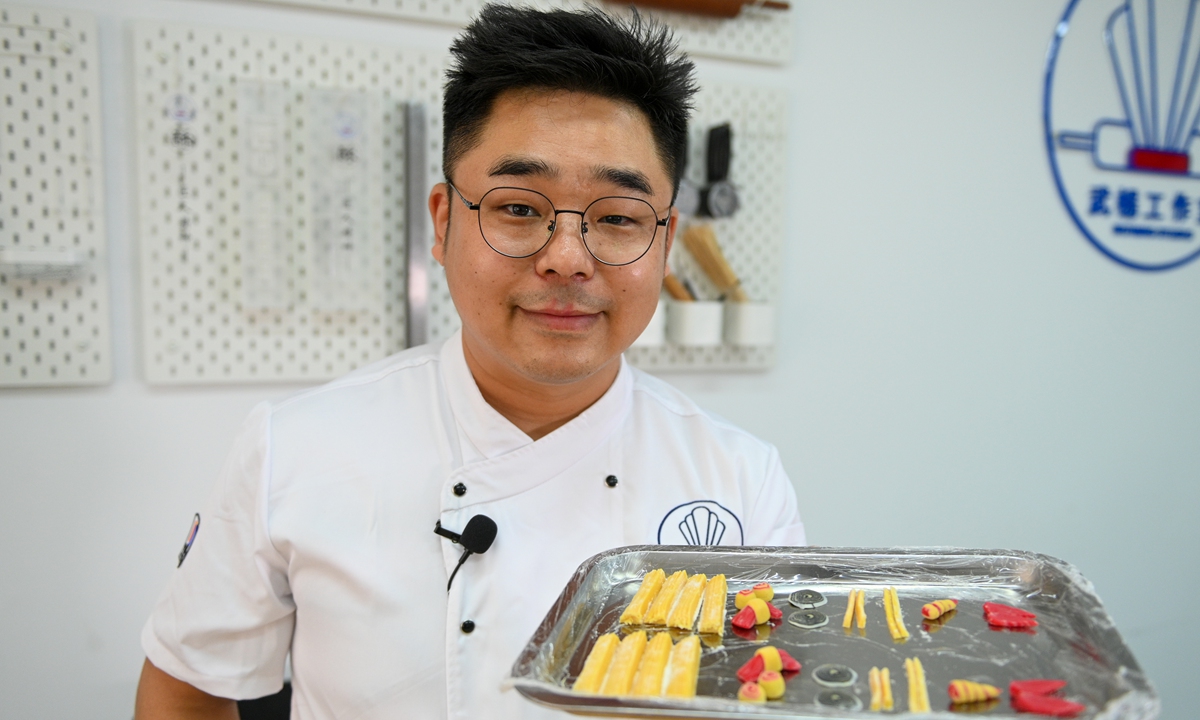
Chinese pastry artist Wu Yang Photo: VCG
In Wu Yang's workshop, a small pastry shaped like a traditional Chinese lion rests beside his other creations. With delicate layers forming the lion's mane and facial details, the piece reflects the craftsmanship behind what has made Wu, a Chinese pastry artist known online as the "poet of pastries," widely recognized.
Over the past two decades, Wu has transformed cultural symbols such as lion dances, Beijing's Tu'er Ye (Lord Rabbit), fish lanterns and Peking Opera headdresses into intricate pastry designs, creating more than 100 original works. But behind these eye-catching creations lies a process that goes beyond technique - one shaped by years of reading.
"People often focus on the finished piece, but a work of art is shaped long before it takes its final form - through years of learning, reflection and countless attempts behind the scenes," Wu told the Global Times.
Sources of inspiration
Wu's love for reading started to deepen when he was 15, after he left home to become a pastry apprentice. Between 2002 and 2006, as he moved between different cities for work, he developed the habit of visiting bookstores and newspaper stands wherever he went.
At a time when smartphones and short-video platforms had not yet become part of daily life, books and magazines were among his main ways of learning about the world.
"I mainly read two types of books back then. One was related to pastry making, and the other was magazines, among the latter, one of my favorites was Stories," he recalled.
Over the years, his reading interests evolved alongside his career. What began as a way to solve technical problems gradually expanded into books on personal growth, time management, traditional culture and philosophy.
"Books including The Evolving Self, Deliberate Practice and The Biography of Zeng Guofan have all shaped the way I think about my work, teaching me to slow down, stay focused and keep working at something long after the initial excitement has faded," he noted.
That mindset has also found its way into his pastry making. Many of Wu's creations begin with a question: How can a piece of traditional culture be distilled into something as small and delicate as a pastry, without losing the meaning behind it?
His widely recognized work "Lion Dance Pastry," for example, was not created simply by copying the appearance of a lion dance figure.
Before starting the project, Wu learned about lion dance culture, and explored the history and symbolism behind the tradition. Only after understanding its cultural meaning, he began experimenting with a variety of ways to transform those elements into pastry.
The process was far from easy.
From the initial idea to the final product, Wu went through countless trials and adjustments. He needed to find a balance between preserving the cultural identity of the subject and adapting it to the techniques of pastry making.
During this process, he often found himself completely absorbed in his work, losing track of time.
It was only after reading The Evolving Self that Wu found a word to describe that experience.
"When someone is fully engaged in what they are doing, time seems to pass quickly, and they can find a sense of meaning, value and happiness," he said.
This realization also changed the way he viewed craftsmanship. For Wu, reading is not simply about gaining knowledge. It helps creators understand the deeper connections between their work, culture and themselves.
Today, from lion dance pastries to rabbit figurines and fish lantern-inspired creations, Wu hopes his works can convey more than just aesthetics. "Through pastry, I want to express the cultural stories and emotions behind traditional symbols," he said.
Creating a unique style
Wu often says that creativity requires artists to "step into others' works, and then step out of them." Years of reading have helped him gradually develop his own approach to creation.
This year, Wu published his second book on pastry making, hoping to document his understanding of pastry techniques and aesthetics. Beyond sharing his own experience, he also added a list of books that have helped shape his thinking, hoping to pass on the inspiration he once received to more readers.
The book includes 20 pastry-making techniques and 100 pastry designs. Wu spent nearly seven months producing and photographing the works, taking more than 5,000 pictures himself. Including editing, layout and revisions, the entire process lasted almost a year.
During that period, one book offered him particular guidance: Eat That Frog.
"The book's approach to time management inspired me to focus on the most important tasks each day and make steady progress," he said. "I spent 80 percent of my energy every day on 'eating that frog.'" Reading, Wu believes, has changed not only how he works, but also how he sees himself. The Biography of Zeng Guofan had a particularly deep influence on him.
Wu considered himself introverted and slow compared to others. He often lacked confidence. But Zeng Guofan's philosophy of "winning through persistence rather than cleverness" changed his perspective.
"The greatest persistence can overcome the greatest cleverness," Wu said, quoting a line that inspired him.
The idea encouraged him to embrace his own pace: working patiently, improving continuously and focusing on long-term accumulation.
In today's world, where short videos have become a major way for young people to discover traditional culture, Wu believes they can serve as an entry point, but deeper understanding still requires reading.
"Short videos pass by quickly, but reading reaches deeper," he said.
For Wu, preserving a traditional craft is not only about passing down techniques. It is also about helping the next generation understand the culture behind those techniques and find their own way of expressing it. And reading, he believes, is what gives that journey lasting depth.
RELATED ARTICLES