Geely to build EVs at Ford Spain plant, as US automakers tap China’s EV capabilities in Europe: expert
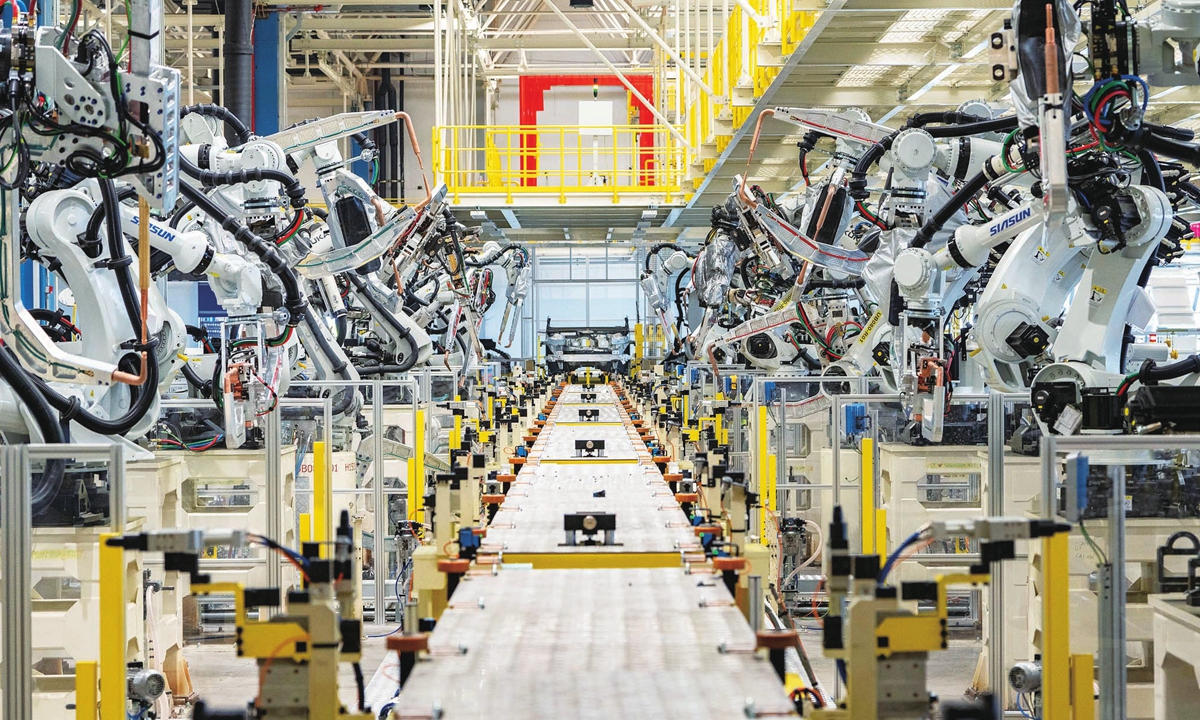
Robots work at the welding assembly line of Geely Auto's Lynk electric vehicle plant in Yiwu city, East China's Zhejiang Province, on February 25, 2026.
Geely Auto will build two electric SUVs at Ford's factory in Spain and the two firms will jointly develop a new model, Reuters reported on Thursday. A Chinese industry expert said the cooperation between Chinese and US automakers reflects the growing role of China's new-energy vehicle (NEV) companies in supporting Europe's green transition while expanding in the European market with the advanced NEV technologies and production capacity together with the US counterpart.
This will be Geely Auto's first production facility in Europe. According to the report, under a joint venture that will be 66 percent owned by Ford and 34 percent by the Chinese firm, the first Geely brand electric SUVs will roll off the Valencia plant's production line in 2028.
The first electric SUV to be made in Valencia is the EX5, which is already sold in Europe, and the other vehicle the Chinese automaker will make at the plant is still in development, Reuters reported, citing Geely's Senior Vice President Victor Yang.
This move serves as an example of how the global automotive industry is undergoing changes in its competitive landscape, and that competition in the NEV sector is not only about technological capabilities, but also relies on global supply chains and industrial cooperation, Cui Dongshu, secretary-general of the China Passenger Car Association, told the Global Times on Friday.
The latest cooperation also reflects a broader shift in the global automotive industry, where partnerships across markets and supply chains are becoming increasingly important in driving the development of NEVs, the expert noted.
Chinese automakers have seen growing sales in the European market, a monthly report on new car registrations released by the European Automobile Manufacturers' Association (ACEA) showed.
The demand for EV continued to grow. By June 2026, battery-electric cars held a 20.7 percent share of the EU market, up from 15.6 percent a year earlier. In the first half of 2026, 1,220,890 new battery-electric cars were registered, capturing 20.7 percent of the EU market, latest data from ACEA shows.
Amid the EU's green transition, Chinese automakers have been expanding their presence in the European market, supported by growing demand for EVs.
According to the ACEA, in the first half of the year, Chinese automaker Leapmotor saw its registrations jump 526.7 percent year-on-year, leading the growth, followed by Chery Automobile with a 268.7 percent increase and BYD with a 168.2 percent rise. Geely also recorded positive year-on-year growth. By comparison, Ford saw a 20.2 percent decline.
Europe's auto industry is at a critical stage of its transition toward electrification, while Chinese NEV companies have developed strong competitive advantages in battery supply chains, intelligent technologies and large-scale manufacturing, Cui said, noting that the participation of Chinese companies can help optimize the industrial resources, improve manufacturing efficiency and accelerate the adoption of NEVs in the European market.
The cooperation came as the US intensified its unilateral measures against Chinese EVs out of political motivations. According to the Reuters' report, such cooperation with an automaker like Geely would likely be "impossible" in Ford's home market, where a US Senate committee on Wednesday approved legislation to toughen a ban on Chinese automakers entering the US.
Hu Qimu, a professor at the Maritime Silk Road Institute of Huaqiao University, told the Global Times on Friday that cooperation between the Chinese and US automotive industries presents greater opportunities than competition. By expanding collaboration with Chinese NEV companies in third markets, US automakers can better leverage the supply chain resources, reduce production and innovation costs, and strengthen their competitiveness in the global market amid rapid changes in the industry, the expert said.
"More importantly, the future development of the global automotive industry will increasingly depend not only on individual companies' technological capabilities, but also on their ability to build efficient industrial ecosystems and participate in global collaboration together," Hu said, noting that there is much more to cooperate in the fields such as battery supply chains, intelligent vehicle technologies, charging infrastructure and the joint development of EV models for global markets.
RELATED ARTICLES