C-beauty goes global
From Vietnam to S.Korea: How Chinese cosmetic brands reshape beauty industry
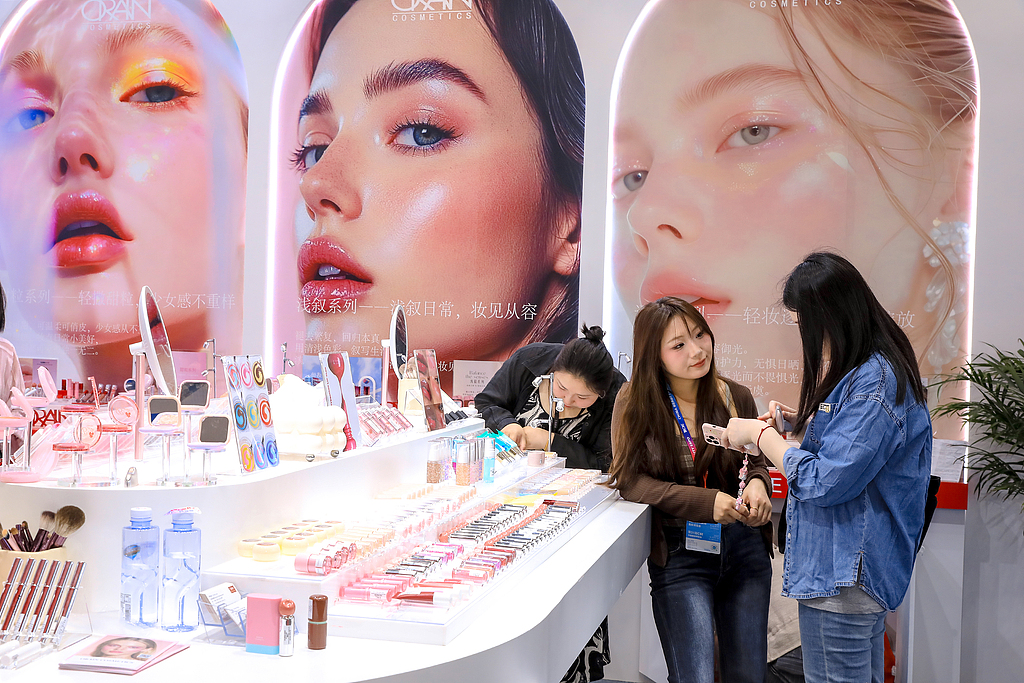
Visitors try out cosmetics at the 2026 China Beauty Expo in Shanghai on May 13, 2026. Photo: VCG
From a 100-fold sales surge in Vietnam to a 14-fold exports jump to South Korea, C-beauty is no longer a niche player — it is redefining cosmetics competition.
After tweaking its makeup shades to match Vietnamese consumers' preference for bolder colors, Chinese brand Little Ondine saw sales on e-commerce platform Lazada surge over 100-fold in the past six months — a microcosm of a collective international push as Chinese cosmetics brands expand their overseas market share.
That shift is most visible in South Korea, where Chinese cosmetics exports skyrocketed to 112.7 million yuan ($16.58 billion) in May, up nearly 14-fold year-on-year.
"The defining question for global beauty brands is no longer how much they can sell in China, but how they can compete with China on a global scale," South Korean beauty industry media outlet thebk.co.kr said.
For decades, the global beauty market was dominated by Western luxury houses and K-beauty. Yet today, Chinese cosmetics brands are rewriting the market narrative through a combination of industrial scale, R&D power, and cultural distinctiveness. Official customs data shows China's cosmetics exports reached $7.82 billion in 2025, up 9.2 percent year-on-year, with more than 50 domestic brands now operating in international markets, Xinhua News Agency reported.
Accelerating global push
Some Chinese brands tap overseas markets via cross-border e-commerce platforms, while others roll out brick-and-mortar stores, underscoring the sector's accelerating push in overseas markets.
When Little Ondine entered the Vietnamese market on Southeast Asian e-commerce platform Lazada, it quickly discovered a crucial insight: local consumers favored high-pigment, vivid makeup shades over the pale pinks that worked well elsewhere.
The brand responded swiftly, replacing its popular pale pink tone with a wild rose shade tailored to Vietnamese tastes. Within six months, the brand rocketed from a cold start to explosive growth, with sales surging more than 100-fold, generating more than $300,000 in sales in Vietnam, the Global Times learned from Lazada.
Brands such as Florasis and Flower Knows have entered mainstream chains, including Ulta Beauty in the US, while others have expanded into Watsons stores overseas. In 2025, several labels, including Judydoll, Joocyee and Florasis, opened their standalone shops abroad.
Behind this momentum lies a fundamental shift in the industry's value chain.
Zhang Yi, CEO of the iiMedia Research Institute, told the Global Times that Chinese manufacturers have evolved from taking low-margin original equipment manufacturer orders to orchestrating full-chain global operations — covering self-developed raw materials, brand ownership, distribution, and localized marketing in one integrated system.
"The transformation is underpinned by China's massive domestic market, as its supply-chain depth, speed and cost efficiency give it a structural advantage," Zhang said.
In 2025, China boasted the world's largest cosmetics market, valued at 1.1 trillion yuan, with homegrown brands capturing 57.37 percent of the domestic market share, according to Xinhua.
On average, a Chinese brand can move from trend identification to product launch in under three months, a cycle that typically takes six to twelve months elsewhere, according to data from cross-border e-commerce platform Alibaba.com.
R&D investment has been equally critical. Such investment has enabled Chinese brands to break away from the outdated stereotype of cheap substitutes, Zhang said.
By mid-2025, Chinese companies had filed 80 new cosmetic ingredient patents, 70 percent of them domestically sourced, marking a year-on-year leap of around 80 percent. Hyaluronic acid alone, a staple in moisturizers and serums, sees 80 percent of its global production coming from China, giving brands both quality and cost leverage, per Xinhua.
Chinese beauty brand Florasis told the Global Times that, since 2019, it has formulated internal quality benchmarks drawing regulations from China, the EU, Japan and the US to facilitate market access. Since 2020, it has focused on developing new materials based on Chinese botanicals, mineral powders and traditional Chinese medicine theories tailored to Asian skin types. Today, Florasis sells products in more than 110 countries and regions.
Yatsen Group, the Chinese beauty group behind Little Ondine, disclosed on its website that the group has poured over 700 million yuan into R&D since 2020 and set up dedicated research hubs in Shanghai, Guangzhou, South China's Guangdong Province and Toulouse in France. As of the end of 2025, the group had filed a total of 269 patents worldwide.
Another major domestic beauty player Proya Cosmetics revealed in its 2025 annual financial report that its R&D expense ratio reached 2.05 percent last year.
Cultural storytelling
In addition to sustained investment in R&D, what distinguishes Chinese beauty players from global competitors lies in their well-calibrated dual-track internationalization strategy: fine-tuned localized product adaptation that caters to regional consumer demands, paired with authentic, culturally rooted story-telling that amplifies the aesthetic heritage of China, Zhang noted.
For instance, Florasis blends Chinese intangible heritage crafts such as ceramic carving, Miao ethnic silverwork and Suzhou embroidery into modern cosmetics to deliver understated oriental aesthetics without heavy marketing.
The brand told the Global Times that its March launch at Dubai Mall's Ulta Beauty sparked organic social media coverage from local beauty creators drawn to its traditional craft designs, signaling strong early demand among many Middle Eastern shoppers.
Supportive customs policies have smoothed the path for C-beauty's overseas expansion. The General Administration of Customs (GAC) in May released a revision of cosmetic inspection rules effective on December 1, scrapping filing requirements for export manufacturers and rolling out remote inspection and market purchase location declaration pilots. Meanwhile, early trials in Yiwu enabled one-stop clearance, cutting clearance times by three to five working days and reducing costs by roughly 5,000 yuan per shipment, according to the GAC.
"This is essentially a journey from zero to one. Global brand-building cannot be accomplished overnight — it requires long-term cultivation. But all these industrial strengths together have made overseas markets a definite, sustainable new growth driver for Chinese beauty firms," Zhang said.
RELATED ARTICLES