US senator’s threat to‘seal off’ US car market from Chinese hardware, software, and partnerships would be extremely difficult to implement: expert
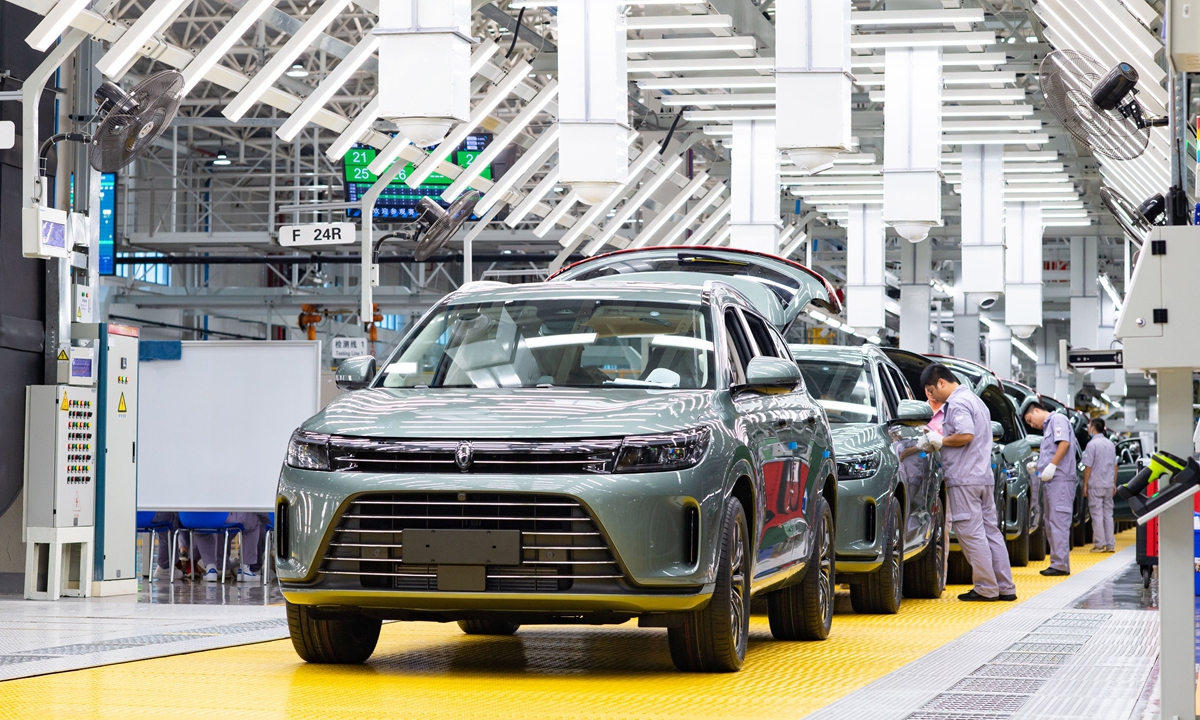
An NEV manufacturing line in Southwest China's Chongqing Municipality Photo: VCG
The US Republican Senator Bernie Moreno claimed on Tuesday that he will introduce legislation next month to expand an existing US government ban on Chinese automakers to more strictly forbid Chinese hardware, software and even partnerships from entering the American market, according to Reuters' report. A Chinese expert said the move reflects a broader tendency among some US officials to stretch the concept of so-called national security as a political maneuver. The proposal would be extremely difficult to implement in practice, as today's global automotive supply chain is deeply interconnected, the experts said.
Previously, the Biden administration imposed a sweeping regulation that effectively bans all Chinese automakers from selling passenger vehicles in the US in January 2025, citing "national security" concerns about the ability of vehicles to collect sensitive data on American owners, said the report.
Speaking at an Automotive Forum event ahead of the New York Auto Show, Moreno claimed his proposed legislation would go further than the ban on imports, and would seal off the US so "there's never a scenario where a Chinese automobile will enter our market, that's hardware, that's software, that's partnerships."
On a further note, the US senator urged the Latin America, Mexico, Canada and Europe, to follow suit.
The latest move by the US senator has drawn attention from some Chinese trade analysts, warning that such a politically motivated proposal runs counter to market principles and would be very difficult to implement.
"By citing so-called national security concerns, the US is essentially overstretching the concept of security and instrumentalizing economic and trade issues... Such an approach lacks sufficient evidence and deviates from the fundamental principles of market competition," Zhou Mi, a senior research fellow at the Chinese Academy of International Trade and Economic Cooperation, told the Global Times on Wednesday.
As for the proposal to go "further than the existing ban," Zhou said that this could take several forms, including extending restrictions to third-party companies that have partnerships with Chinese firms, such as joint ventures, technology collaborations, or supply chain partners.
However, the proposal of "seal off the US" from Chinese automobile, hardware, software, and partnerships, would be extremely difficult to implement in practice, experts said.
Today's global automotive supply chain is deeply interconnected. Zhou said that even US domestic automakers maintain varying degrees of linkage with Chinese supply chains in areas ranging from batteries and electronic control systems to in-vehicle software and components.
Despite the Biden administration's previous ban, a recent survey underscores the continued appeal of Chinese cars among US consumers. The Cox survey polled 802 US consumers who expect to buy a car in the next two years. Nearly half - 49 percent - rated Chinese cars as having very good or excellent value, and 40 percent say they support the idea of Chinese auto brands in the US market, according to separate report by Reuters in March.
The report quoted Rich Benoit, a car enthusiast whose YouTube videos reviewing Chinese models garner millions of views, said the most compelling feature is the price. "That's what a lot of people are looking for: efficient, quiet and low cost," he said.
Zhou said that if a "full decoupling" were pursued as suggested by the US lawmaker, it would not only impose restrictions on Chinese companies, but also force US firms to undertake costly and less efficient supply chain restructuring. That policies of this kind may appear to target China, but in reality they primarily drive up costs for US industries and consumers themselves, the expert noted.
Meanwhile, regarding the US lawmaker's call to "encourage other countries to follow suit," experts said it is more of a political rhetoric than a policy path with real binding force.
"While the US may seek to advance its position through diplomatic, trade pressure, or coordination within certain alliances, significant differences remain across economies in terms of industrial structure, market demand, and their economic and trade ties with China," Gao Lingyun, a research fellow at the Chinese Academy of Social Sciences, told the Global Times on Wednesday.
For instance, demand for Chinese new energy vehicles is rising in markets such as Europe, Southeast Asia and Latin America, Gao said, noting that "simply following such restrictions would mean giving up access to cost-effective and quality products as well as new investment opportunities, which does not align with the interests of those economies."
Moreover, if the US lawmaker was to push allies to adopt similar measures, it could further fragment global industrial chains and undermine the stability of the multilateral trading system, Gao said.
Previously, the Chinese government officials have also made clear stances in responding to the similar US moves. In September, 2024, a spokesperson of the Ministry of Commerce said China strongly objects to the US proposal to restrict the use of Chinese connected vehicles, as well as their software and hardware, in the US, the Xinhua News Agency reported. The remarks were made in response to a media inquiry, emphasizing that the US proposal smears Chinese connected vehicles under the pretext of national security.
The proposal has no factual basis, violates the principles of the market economy and fair competition, and is a typical act of protectionism, the spokesperson said.
RELATED ARTICLES