The answer to ‘the Qian Xuesen Question’ is gradually becoming clear: Global Times editorial
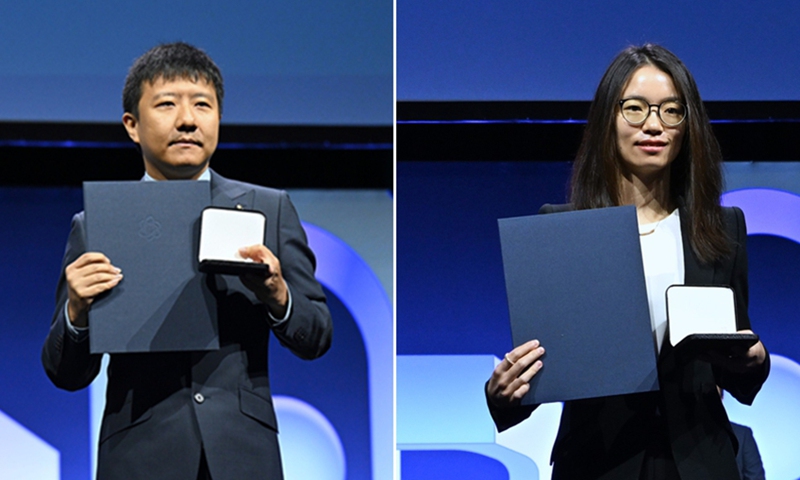
Photo: Xinhua
A younger generation of Chinese is entering the global frontiers of science and technology with growing density and standing with greater composure at the center of the international academic stage. From Liang Wenfeng, who has driven innovation in AI development paradigms, to Yang Zhilin, who has led his team into the global front ranks of large models, to the growing numbers of young researchers emerging in mathematics, physics, life sciences, materials science, aerospace, and advanced manufacturing, the era of a "surge" of young Chinese talent is coming.
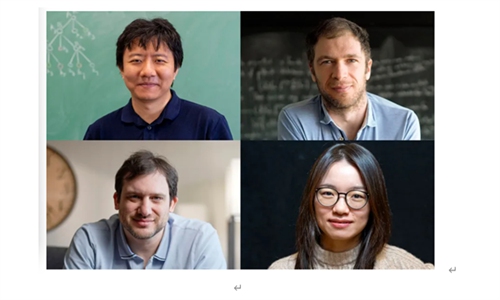
Good news came from the 2026 International Congress of Mathematicians: Chinese mathematicians Wang Hong and Deng Yu both received the Fields Medal, widely regarded as the top honor in mathematics - the "Nobel Prize of math." The news has filled Chinese society with pride.
Wang and Deng both winning the Fields Medal is a cause for celebration, yet the profound changes unfolding behind this achievement are even more striking. On the same day the two mathematicians stepped onto the podium, local time Thursday, Unitree Robotics founder and CEO Wang Xingxing appeared on the cover of Time magazine together with his humanoid robot product GD01 under the headline "The Robots Cometh." Meanwhile, the shockwaves that Yang Zhilin, the founder of Moonshot AI, an AI startup that created Kimi K3, sent through Western tech circles have yet to fully subside, and an internal recording by DeepSeek founder Liang Wenfeng's recent insightful comments on the industry have resonated widely both at home and abroad. These young Chinese scientific talents are now rising to prominence and shouldering major responsibilities.
No one can still dismiss these achievements as mere "coincidence." A younger generation of Chinese is entering the global frontiers of science and technology with growing density and standing with greater composure at the center of the international academic stage. It is like a long-rising curve that, on a certain day, suddenly crosses a coordinate of symbolic significance. From Liang, who has driven innovation in AI development paradigms, to Yang, who has led his team into the global front ranks of large models, to the growing numbers of young researchers emerging in mathematics, physics, life sciences, materials science, aerospace, and advanced manufacturing - Chinese youths are participating in cutting-edge scientific exploration at an unprecedented density. People now fully believe that the era of a "surge" of young Chinese talent is coming.
Today's rise of young Chinese tech talent to the center of the world stage is the cumulative result of decades of progress: the universalization of basic education, the expansion of higher education, the development of key disciplines, increased research funding, the improvement of industrial systems, and the overall rise of national strength. Among these factors, the importance of undergraduate education in China deserves particular attention. The undergraduate years determine whether a young person can build a complete knowledge structure, develop independent thinking, and cultivate a lasting interest in genuinely difficult problems. More and more young people trained by Chinese universities are now able to enter the world's most rigorous academic training systems. Through close exchange and competition with the finest peers from around the globe, they are growing rapidly and, in a number of fields, gradually evolving from participants and contributors into problem-solvers and trailblazers.
This demonstrates that the foundational strengths built by China's higher education system are increasingly translating into world-class talent with global impact.
That said, this momentum can only be sustained through a research environment that is open, stable, and patient. Fundamental science requires long-term commitment. Many landmark breakthroughs cannot be scheduled around annual performance evaluations, nor can their commercial returns be predicted in advance. Truly creative young researchers need the freedom to explore, the space to fail, fewer unnecessary administrative burdens, and greater opportunities for cross-institutional, interdisciplinary, and international collaboration.
The experiences of Wang and Deng make one point especially clear: openness and collaboration are essential to nurturing talent. Modern scientific research is built on a highly interconnected global knowledge network. A major breakthrough may begin with the foundations laid by China's education system, be further developed through training at universities in Europe or the US, and ultimately be achieved through collaboration among researchers from many countries. This also underscores a broader reality: while "small yard, high fence" strategy may create short-term barriers, they cannot produce lasting scientific leadership. Restricting the movement of researchers, curtailing academic exchanges, and politicizing scientific cooperation ultimately undermine the efficiency of innovation across the global knowledge system. The recent debate within the US tech community over why Yang Zhilin chose not to build his career in the US reflects growing concern about the increasingly unhealthy research environment of the country.
The defining factors in future technological competition is who can provide the most stable support for scientific research, who can respect the individuality and creativity of researchers, who can attract the world's brightest minds, and who can enable researchers from diverse cultural backgrounds to exchange ideas freely and inspire one another. China is becoming increasingly capable of participating in and initiating global knowledge creation with confidence, openness, and a spirit of equal partnership.
From grappling with the "Qian Xuesen Question" to seeing its young scholars rise one after another to the pinnacle of scientific research, China's answer of our times on the cultivation of innovative talent is gradually being written. The two Fields Medals reflect a China with a vast population, an increasingly strong educational foundation, and innovation that continues to gather momentum. The world will become ever more accustomed to seeing young Chinese scientists at the forefront of discovery, while China, with an even more open and inclusive approach, will work alongside researchers worldwide to push the boundaries of human knowledge and ensure that scientific progress benefits all humanity.
RELATED ARTICLES