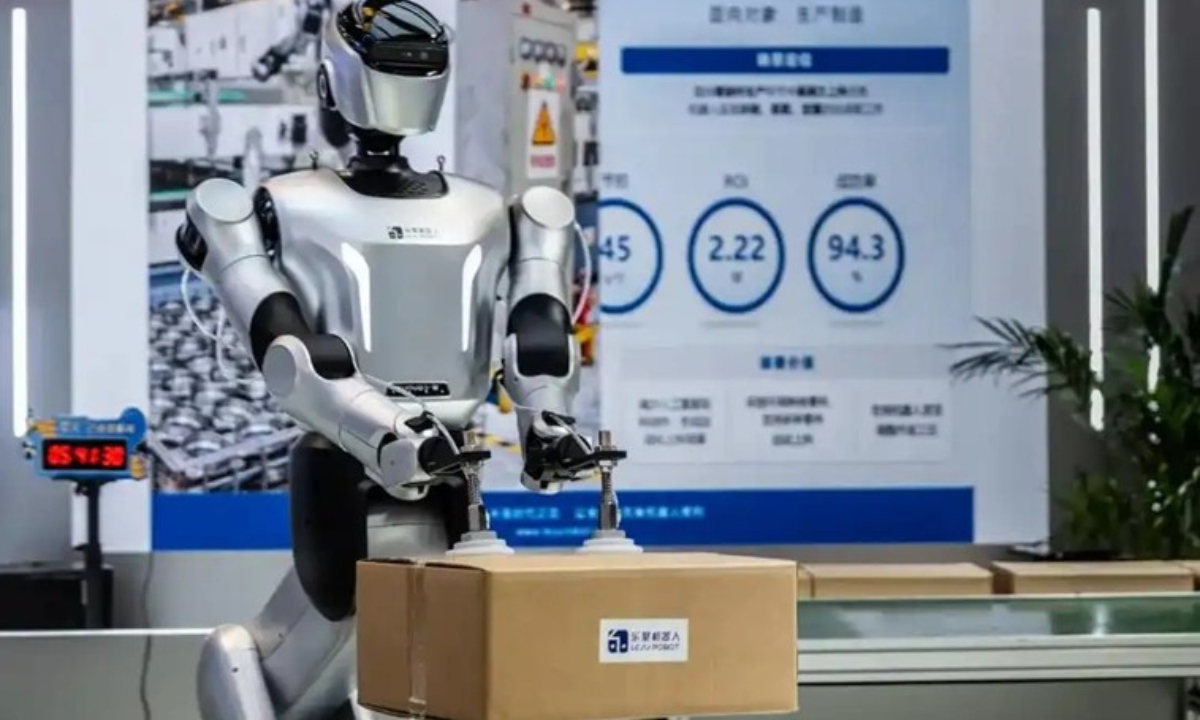
A robot is on display at the 2026 World Artificial Intelligence Conference. Photo: Wu Xue
China is fostering a new batch of core strategic industries – artificial intelligence (AI), robotics and innovative drugs, dubbed the "next new three," emerging as new growth drivers, Yin Hejun, minister of Science and Technology, told a recent policy briefing focused on bolstering public well-being amid high-quality development.
The rise of the "next new three" marks a major upgrade in China’s industrial and export landscape, following two pivotal development stages of the country’s manufacturing and foreign trade.
For decades, China established its global manufacturing foothold by leveraging its labor-cost advantages, with apparel, furniture and home appliances serving as the iconic "old three" of Chinese exports.
In recent years, the export portfolio has undergone a remarkable green and tech transformation. Electric vehicles (EVs), lithium batteries and photovoltaic products, known as the "new three", have become the backbone of China’s export growth.
Data shows the export scale of the "new three" approached 1.3 trillion yuan ($192 billion) in 2025, increasing 3.5-fold compared with 2020, successfully steering China’s outbound trade toward high-tech, high-value and low-carbon development.
Solid industry data also demonstrates the strong growth potential of the "next new three" tech sectors.
Statistics from global AI platform OpenRouter show that domestic large models registered 36.11 trillion token calls in the week of July 13 to 19, a month-on-month increase of 30.93 percent, with growth sustained for eight straight weeks. In the first half of the year, the country’s robotics exports reached 6.29 billion yuan, covering 141 countries and regions worldwide. The export volume of high-end surgical robots saw a striking 3.3-fold year-on-year surge. Meanwhile, China’s innovative pharmaceutical sector has gained strong global influence, with outbound technology licensing transactions hitting $110 billion in the first six months of the year. Chinese pharmaceutical enterprises accounted for eight of the world’s top 10 pharmaceutical licensing deals.
While both the "old three" and "new three" revolve around physical merchandise trade supported by China’s formidable manufacturing capacity, the "next new three" focuses on exporting integrated technological capabilities and services instead of basic commodity sales.
China’s innovative drug sector now exports capabilities across the entire value chain including target discovery, clinical transformation and global registration, beyond finished medicine products. Exported robotics solutions integrate hardware equipment with integrated support of data, algorithms and scenario-based application systems. The global expansion of Chinese AI further features intangible digital technology empowerment such as algorithm research and development and intelligent agent deployment, which cannot be fully measured by traditional trade statistical standards.
This industrial transformation mirrors a profound upgrade of China’s role in global trade and innovation. From January to May this year, China’s total services trade volume rose 6 percent year-on-year, with the services trade deficit narrowing by around 20 percent. Exports of knowledge-intensive services surged 12.2 percent, highlighting the continuous improvement of China’s services export competitiveness and the optimized structure of foreign trade. These figures highlight the growing global influence of China’s intelligent manufacturing and indigenous innovation.
China’s high-quality products and services exports have brought inclusive technological progress to the global market. In the Middle East, Chinese computing infrastructure enterprises have partnered with local players to deploy high-density liquid cooling AI infrastructure, supporting the region’s transformation from a traditional energy hub into a digital infrastructure center. In Europe, cooperation between Chinese tech firms and Serbian teams has integrated local languages into intelligent translation and service systems, breaking the monopoly of major languages in large model applications. In South America, Chinese mobility platforms have spurred new local service formats including motorcycle travel and online delivery.
These examples reflect Chinese enterprises’ core strengths in independent technological research, business model innovation and the ability to integrate global resources, as well as China’s commitment to driving global development and benefiting humanity through technological openness.
The booming "next new three" industries stem from China’s long-term strategic planning in emerging technologies and continuous industrial upgrading. Against a backdrop of rising trade frictions and volatile global geopolitics, the rapid growth of these emerging sectors vividly demonstrates the strong resilience and proactive adaptability of the Chinese economy.
As China advances from the "old three" and "new three" to the "next new three," it will further secure technological self-reliance and build a more open global innovation ecosystem. More new technologies, products and business forms will continue to emerge, providing sustained momentum for China’s high-quality modernization.
This was compiled and translated by the Global Times based on an article published by the People's Daily.
RELATED ARTICLES