Japanese side claims latest location of China-Russia joint naval patrol vessels; expert says route demonstrates two navies' ability to break through so-called island chain blockade
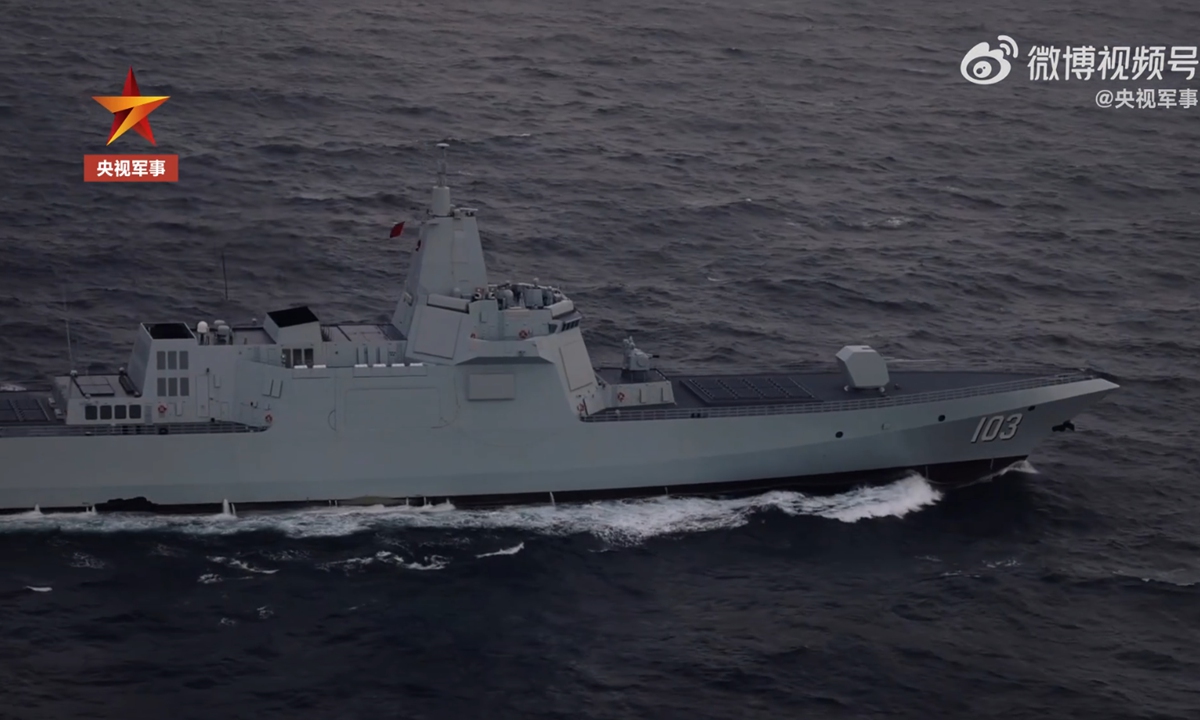
People's Liberation Army (PLA) Navy's Type 055 guided-missile destroyer Hull 103 Anshan participates in the China-Russia "Joint Sea-2026" exercise. Photo: CCTV
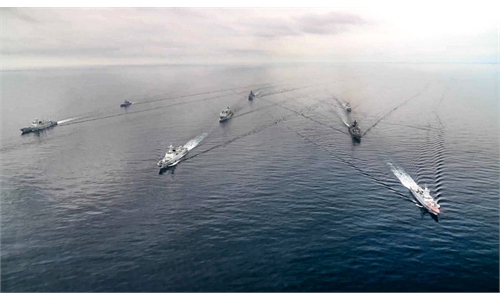
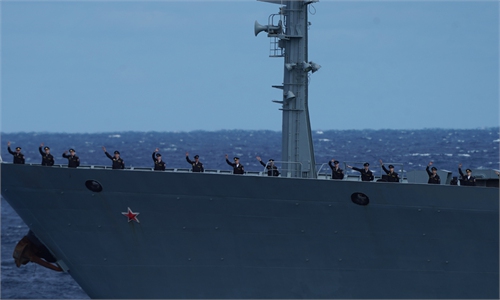
Japan's Ministry of Defense Joint Staff on Saturday again reported the latest location of the China-Russia joint naval task group, claiming that it had confirmed four Chinese and Russian naval vessels proceeding northeast through waters southeast of Cape Nosappu, Hokkaido. A Chinese expert said the joint patrol is likely to complete a circumnavigation of Japan, demonstrating the two navies' ability to break through the so-called island chain blockade while deterring Japan's right-wing forces.According to a release on its official website, Japan's Ministry of Defense Joint Staff claimed the flotilla, consisting of the People's Liberation Army (PLA) Navy's Type 055 guided-missile destroyer Hull 103, the Type 052D guided-missile destroyer Hull 124, the type 903A comprehensive supply ship Hull 903 and the Russian Navy's Steregushchiy-class frigate Hull 343, had been spotted continuously since mid-July.
It claimed the Type 055 destroyer was sighted about 220 kilometers northeast, and the other three vessels were sighted about 130 kilometers southeast, of Cape Inubo, Chiba Prefecture, on July 23. Then, the four ships were confirmed proceeding about 300 kilometers southeast of Cape Nosappu, Hokkaido, on July 25. According to the Japanese side, the vessels had transited south between Okinawa Island and Miyako Island on July 16 before sailing northeast southwest of Okinotori, on July 19, then proceeding northeast southeast of Minami Iwo Jima and north east of Iwo Jima on July 21.
According to China's Ministry of National Defense, following the conclusion of the "Joint Sea-2026" joint exercise in waters and airspace near Qingdao, East China's Shandong Province in July, some forces from China and Russia launched a joint maritime patrol in relevant waters of the Pacific Ocean. The patrol was arranged under the annual cooperation plan between the two militaries and aims to jointly respond to security challenges and safeguard regional peace and stability.
Song Zhongping, a Chinese military affairs expert, told the Global Times on Sunday that judged by sighting records claimed by the Japanese side, the China-Russia joint naval task group has already completed roughly two-thirds of a circuit around Japan and is likely to continue through either the Tsugaru Strait or the Soya Strait into the Sea of Japan before transiting the Tsushima Strait. Completing a full circumnavigation of Japan would demonstrate that the two navies are capable of rapidly deploying to relevant waters to conduct joint training and other military missions.
Previously in October 2021, a seven-day patrol saw the warships circumnavigate Japan by traversing the Sea of Japan, the West Pacific and the East China Sea, transiting several strategically important straits in the process.
Song said the latest joint patrol and exercises fully comply with international law. He further noted that Okinotori is a rock rather than an island.
Song's mention of Okinotori came after Japan's hyping and protest over the Chinese military's live-fire exercise in its so-called "Exclusive Economic Zone (EEZ)" during the China-Russia joint drill and maritime patrol. Over this question, Lin Jian, spokesperson for Chinese Foreign Ministry, said at a regular press conference on July 21 that China has firmly rejected Japan's baseless "protest." Chinese competent authorities have made the position clear on China-Russia joint drill and maritime patrol.
Lin stressed that by UNCLOS definition, Okinotori is a rock rather than an island, and thus unfit to claim EEZ or continental shelf. Japan's claim of an EEZ around the Okinotori violates international law. China's activities in the high seas are fully consistent with international law and international practice. By smearing other countries for their legitimate and lawful actions and peddling the so-called external threat, Japan is seeking excuses for accelerating remilitarization and challenging postwar international order. The international community must stay on high alert and jointly push back this dangerous pursuit.
Song said that the joint patrol also serves as a deterrent to Japan's right-wing forces. Japan has long acted as a destabilizing factor in the Asia-Pacific and has challenged the postwar international order established by the Cairo Declaration and the Potsdam Proclamation.
Another key objective of the China-Russia joint patrol is to strengthen the two navies' ability to break through island-chain blockades and operate in strategically important straits. The expert noted that the patrol demonstrates the capability of the Chinese and Russian navies to overcome strategic blockades and restrictions at maritime chokepoints.
With modernization of the two countries' defense capabilities, the so-called first island chain has become largely and genuinely ineffective, as shown by the joint patrol, Song said.
RELATED ARTICLES