IN-DEPTH / IN-DEPTH
Exclusive: At MAZU's 'birthplace,' exploring how China's intelligent meteorological solution delivers inclusive early warnings worldwide
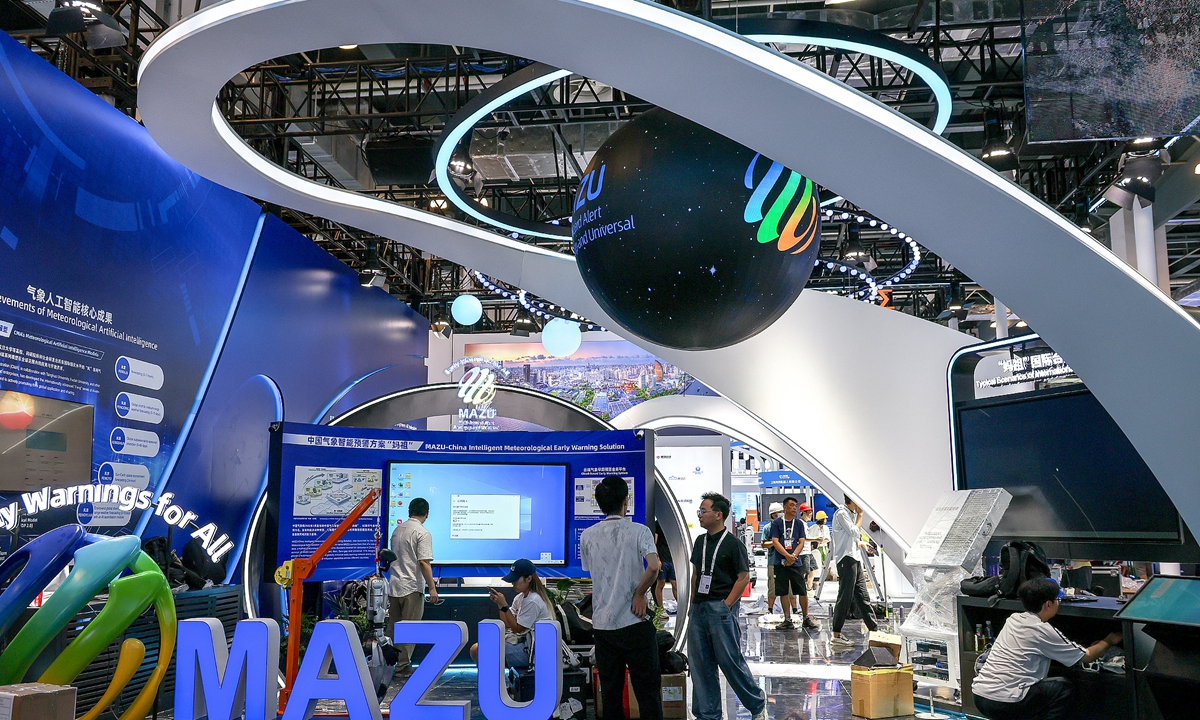
China intelligent meteorological solution MAZU is seen on display during the 2026 World Artificial Intelligence Conference in Shanghai. Photo: VCG
Editor's Note:As global challenges grow increasingly interconnected, technological solutions are rarely confined to a single country. Through research collaboration, open sharing of expertise and partnerships with international institutions, Chinese scientists, engineers and enterprises are engaging more deeply with the world, contributing tools and experience to problems that demand collective answers.
The Global Times launches a series of "Tech Seeds, Global Bloom," spotlighting China's achievements in advancing tech for good both domestically and internationally. By following these trajectories, the series invites readers to consider a different measure of progress: Not how advanced technology becomes, but whom it ultimately serves, and how widely its benefits can spread.
This article is the fifth installment. Global Times reporters visited the China Meteorological Administration (CMA) - the birthplace of "digital goddess" MAZU - tracing China intelligent meteorological early warning solution MAZU's evolution from a homegrown prototype to a global public good.
Imagine a crate of Russian chocolates, weeks out of Moscow, finally arriving at a warehouse in Southwest China's Chongqing Municipality - the box pristine, its fine confections reduced to brown residual indentations left by once-melted treats. For years, that was the invisible tax of cross-continental trade: perishables lost to temperature swings that no one could predict in time.
Today, however, a modern incarnation of "Mazu" eliminates such losses. Not, as people have long known, the ancient guardian of seafarers, but China intelligent meteorological solution MAZU (Multi-hazard, Alert, Zero-gap, Universal).
Before the train even departs Moscow, an operator can use the Impact-based Service module of MAZU's Cloud-Based Early Warning System (CEWS) to identify which goods will be vulnerable to weather impacts at each location along the China-Europe Railway Express network over at least the next two weeks.
Garnering global attention at the 2026 World Artificial Intelligence Conference (WAIC), MAZU stands as China's response to the UN's "Early Warnings for All" initiative. But unlike cumbersome, opaque traditional meteorological systems, it operates as a flexible high-tech buffet. Its Menu-to-Service Platform offers more than 100 customizable service items. Need a drone for weather modification? A FengYun Satellite AI Box? A malaria-risk monitor? Participating nations simply submit their requests, with the AI assembling bespoke, scenario-specific solutions.
Currently, over 40 national meteorological agencies are now using MAZU via cloud, while customized systems have been deployed in seven countries. China has recently committed to rolling out MAZU in 30 countries over the next five years, according to the Xinhua News Agency. That pledge, however, invites a wider curiosity: how does MAZU actually work around the clock, in the cloud, to strengthen disaster resilience and boost development across the Global South?
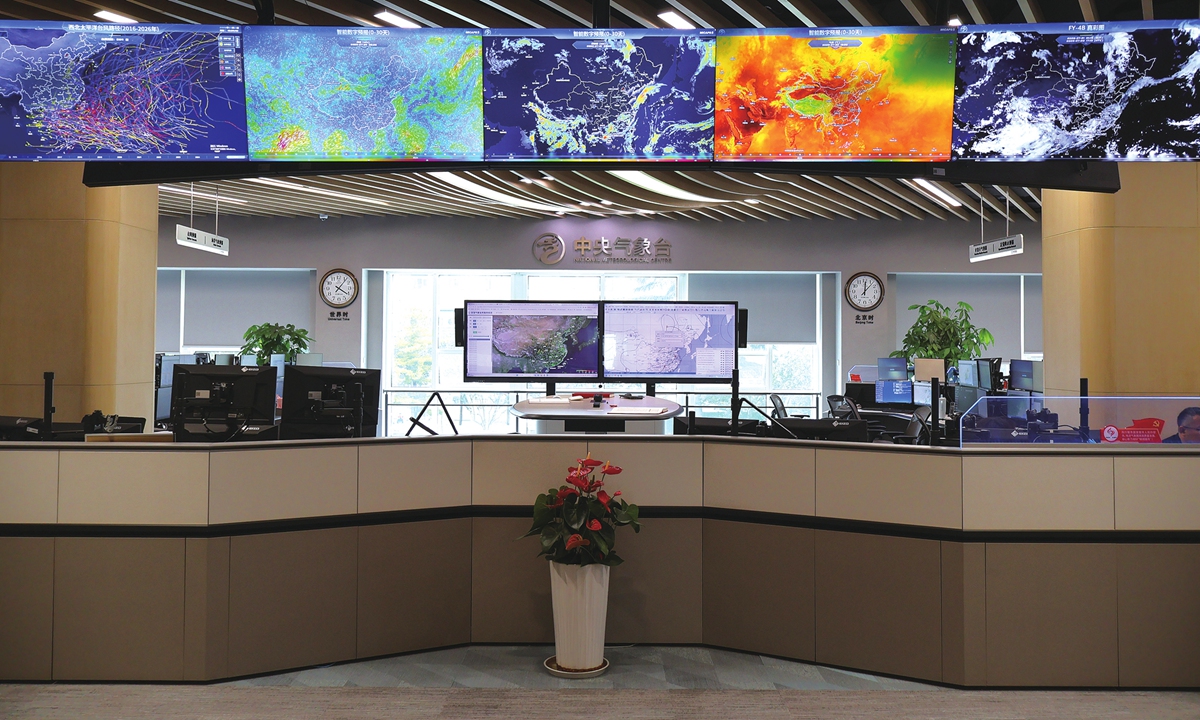
Real-time meteorological data is displayed on large screens at the National Meteorological Centre on July 21, 2026. Photo: Lin Xiaoyi/GT
Weather warnings reimaginedFor Pakistan's meteorological forecasters, an early disaster warning was once a fragmented, labor-intensive struggle. "Before the adoption of the MAZU early warning solution, Pakistan faced several critical challenges in meteorological disaster early warning and disaster reduction. Although a considerable volume of meteorological information was available to Pakistan Meteorological Department (PMD) forecasters, it remained scattered across separate workstations and formats. In addition, there were limited observation networks in remote mountainous regions, frequent communication disruptions," Furrukh Bashir, director of Research and Development Division of PMD, told the Global Times.
Bashir is something of a familiar name in the World Meteorological Centre Beijing (WMC-BJ) Office at the CMA - colleagues still fondly recall the Pakistani expert who wore the MAZU pin through every panel at WAIC, sharing its transformative value for global weather governance with international peers.
For Bashir, the appeal was straightforward: "CMA is readiness to share advanced AI-driven technology. And MAZU provided a unified, AI-empowered data integration platform that consolidates multi-source information into a single interface, thereby eliminating the time-intensive process of accessing each data source separately. It functions as a powerful decision-support tool for early warning and forecasting, with the potential to further enhance regional prediction accuracy through ensemble numerical weather prediction techniques."
When Global Times reporters visited the WMC Beijing, engineer Hua Wenli walked through MAZU's full operational framework. The platform opens with a real-time refreshing global map, feeding live data from China's Fengyun meteorological satellites to track weather shifts across every corner of the planet.
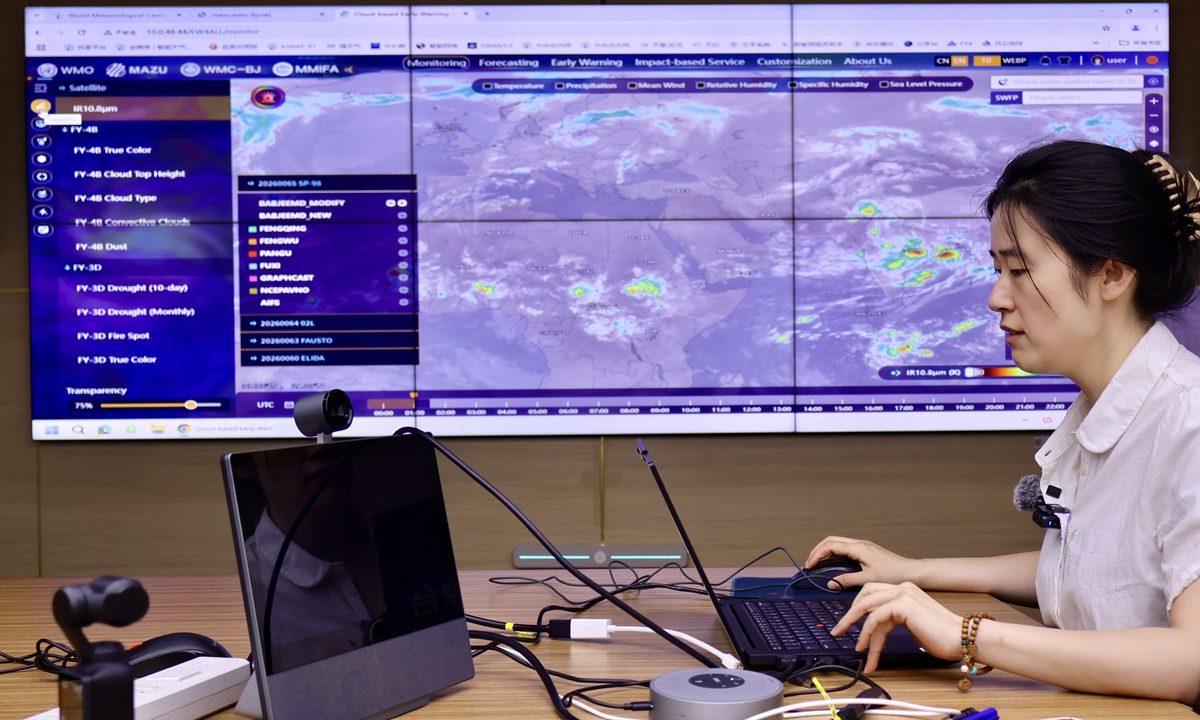
Hua Wenli, an engineer at the World Meteorological Centre Beijing, operates the Cloud-Based Early Warning System of MAZU at the China Meteorological Administration on July 21, 2026. Photo: Lin Xiaoyi/GT
Structured around five core modules - monitoring, forecasting, early warning, impact-based service and customization - the system lowers technical barriers drastically. Hua told the Global Times that MAZU's monitoring module displays vivid global cloud imagery, integrating data from China's homegrown Fengyun meteorological satellites and ground monitoring stations. For resource-limited developing countries, MAZU offers finished, ready-to-use meteorological products without requiring local computing or storage capacity.The Global Times learned that MAZU's forecasting module unifies numerical prediction results from leading global institutions in China, Europe, the US, Japan and Germany on a single interface, enabling forecasters to instantly cross-compare traditional and AI-driven models and efficiently spot forecasting deviations.
But for Bashir, one of MAZU's most groundbreaking strengths lies in its robust impact-based service - the module that translates abstract weather data into concrete risk scenarios. This was precisely Pakistan's weak spot in the past: the country had long struggled to bridge the gap between "what the weather will be" and "what the weather will do." MAZU has filled this critical gap with a comprehensive impact analysis system covering floods, agriculture, China-Europe Railway Express cargo routes, fishery vessels, public health and building infrastructure - each designed to turn raw data into actionable warnings.
Empowered by this upgraded tool, Bashir noted that during Pakistan's 2026 monsoon season, the locally adapted MAZU platform sharpened precipitation analysis and flash flood risk assessments, giving the Pakistan National Disaster Management Authority and provincial agencies precious extra days to coordinate evacuations.
'Meteorological supermarket'
In 2022, UN Secretary-General Antonio Guterres launched the "Early Warnings for All" initiative, aiming to ensure that "everyone, everywhere" is protected by an alert system by 2027. For Pakistan, that ambition is already taking shape. The country has come a long way from its fragmented forecasting past, but solving the fragmentation problem was only half the battle. The other half was sustainability.
"Sustainability issues arising from earlier donor-funded projects further constrained the effectiveness of the national early warning system," Bashir recalled.
Thankfully, unlike traditional one-off foreign aid that failed to empower local teams and sustain long-term capabilities, MAZU redefines international meteorological cooperation through equal collaboration and localized capacity building, overhauling Pakistan's outdated development model.
Zhang Tianhang, deputy director of the WMC-BJ Office, told the Global Times that MAZU never applies a one-size-fits-all solution worldwide. Instead, it advances clustered meteorological technology and service outreach via a tailored "one country, one policy" model, featuring mutual co-creation rather than unilateral donation.
During the interview, one word that Zhang repeatedly mentioned was "co-creation."
Nowhere is this more evident than in MAZU's customization module. It operates on a demand-driven model: countries articulate their specific needs, and the Chinese team designs tailored solutions. At the WMC Beijing, the Global Times found that the platform resembles a high-end "meteorological supermarket" packed with diverse tailored services and equipment.
Beyond ready-made products, China prioritizes core technology sharing, Zhang noted. For example, on July 17, CMA officially released the FengYun Satellite AI Box on the Menu-to-Service platform of MAZU. Unlike the ready-made forecasts already "served on the table" via the platform, the toolbox functions more like a recipe book and a set of kitchen utensils. "It contains open-source code that countries can modify and optimize according to their own needs," Hua explained. "They can produce the customized products they actually want."
Bashir also offered Pakistan's cooperation case. PMD meteorologists once received professional CEWS training at the CMA, yet they found the China-hosted cloud system sluggish for local operations due to latency constraints. Pakistani experts proactively communicated their demands, launching in-depth joint research with Chinese technicians to develop local deployment modules. The bilateral collaboration facilitated the delivery and on-site installation of a dedicated server in Islamabad, with both teams completing localized customization.
The joint effort eliminated latency issues and comprehensively upgraded PMD's professional capabilities. "In Pakistan's case, the successful indigenous development and customization of the system by PMD experts - working in close collaboration with CMA - further highlights that the solution can be adapted and owned by developing countries," Bashir said.
Zhang noted that the meteorological world used to run mostly on American and European products. Now, China has achieved a "corner overtaking" with AI. Yet the more important shift, he noted, is philosophical: "MAZU is designed to help developing countries establish their own early warning systems and shrink the alert capability gap with the developed world."
Sharing tech, sharing safety
According to CMA, at the recently concluded WAIC in Shanghai, Guterres said that implementing the "Early Warnings for All" initiative demands a qualitative leap in international cooperation and he believes MAZU could become "one of the most important instruments" to drive that collaboration.
Guterres noted that China co-develops meteorological tools with developing-country partners, grounding them in local data so that nations can issue their own alerts using domestic data, Xinhua reported.
That philosophy of capability transfer is already being put into practice. China has launched systematic global talent cultivation programs via MAZU. Data from the CMA reveal that, to date, nearly 1,000 professionals from over 100 developing countries and regions have received specialized training in meteorological early warning technologies in China.
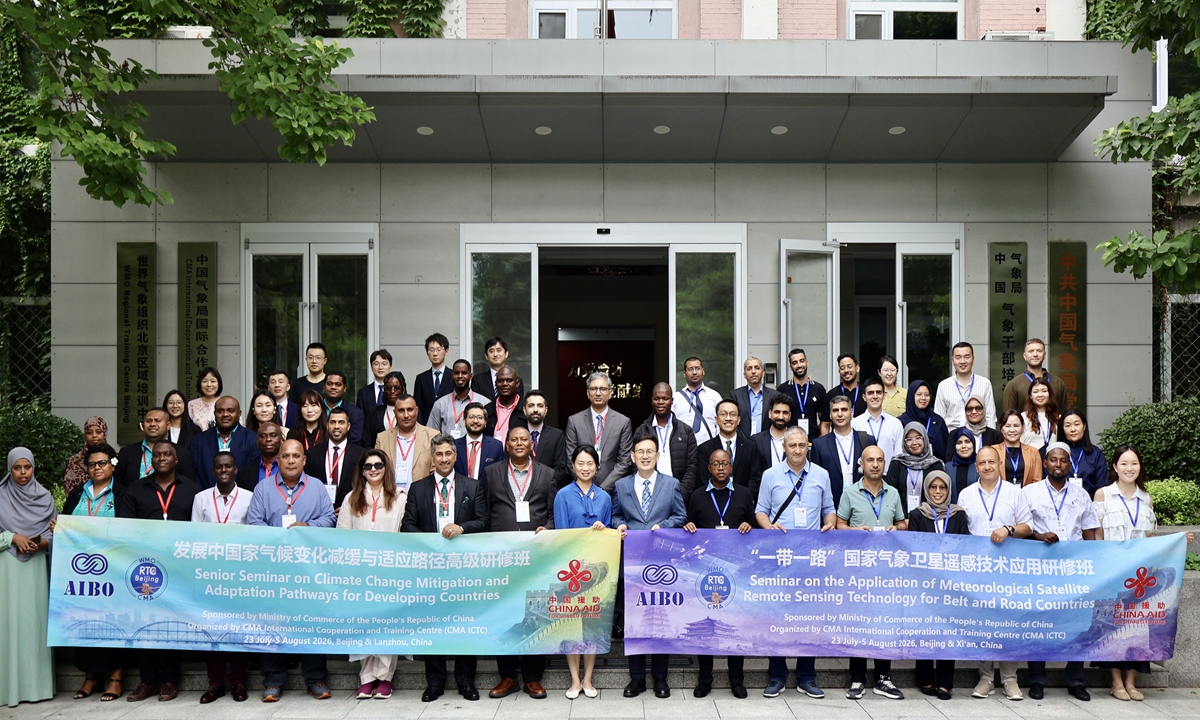
Two seminars targeting meteorological practitioners worldwide, hosted by the China Meteorological Administration, kick off in Beijing on July 23, 2026. Photo: Lin Xiaoyi/GT
A new round of capacity-building efforts kicked off in Beijing on July 23, targeting core meteorological practitioners worldwide. The two advanced training programs cover MAZU's global early warning service system, Fengyun satellite remote sensing applications, multi-disaster early warning AI tools and practical forecasting technologies, equipping foreign talents with full-chain operational skills."I admire how China converts weather forecasts and extreme weather event predictions into accessible, actionable information. Such information is easy for local communities, government departments and emergency response teams to understand and utilize, which can effectively reduce disaster losses and risks," Dita Fatria Andarini, a researcher from Indonesia's National Research and Innovation Agency, told the Global Times.
During her tour at the CMA, Andarini grasped MAZU's operational logic and learned to log into the system, access its products and conduct professional operations with Fengyun satellite data for the first time. "I have never encountered such an advanced system before," she said. "I believe these technologies will benefit both scientific research and Indonesia's national meteorological early warning system, greatly boosting its disaster prevention and mitigation capacity."
Leveni Duvuduvukula Rinavisa from Fiji's Ministry of Forestry echoed the sentiment. As a climate-vulnerable island nation, Fiji faces constant extreme weather threats. He emphasized that China's AI-driven meteorological innovations offer crucial references for global climate adaptation, and the training platform enables developing countries to learn tailored early warning and climate resilience strategies.
During the interview, Rinavisa also stressed that climate action cannot succeed in isolation. "It requires robust South-South cooperation, technology transfer and a genuine partnership between developed and developing countries," he said.
For those who have already joined the MAZU ecosystem, the conversation has moved beyond aspiration. Bashir noted that scaling MAZU's inclusive partnership model will accelerate the UN's early warning agenda and boost global climate resilience. In subsequent cooperation, he said, PMD hopes the Chinese side can provide capacity building on AI model deployment, assistance in multi-satellite data fusion and co-development of automated community-level early warning dissemination tools tailored to Pakistan's operational needs.
With deepening collaboration with China, Bashir is confident: Pakistan's early warning future is now in its own hands.
Chen Jinyang, Wang Yujing contributed to this story
RELATED ARTICLES