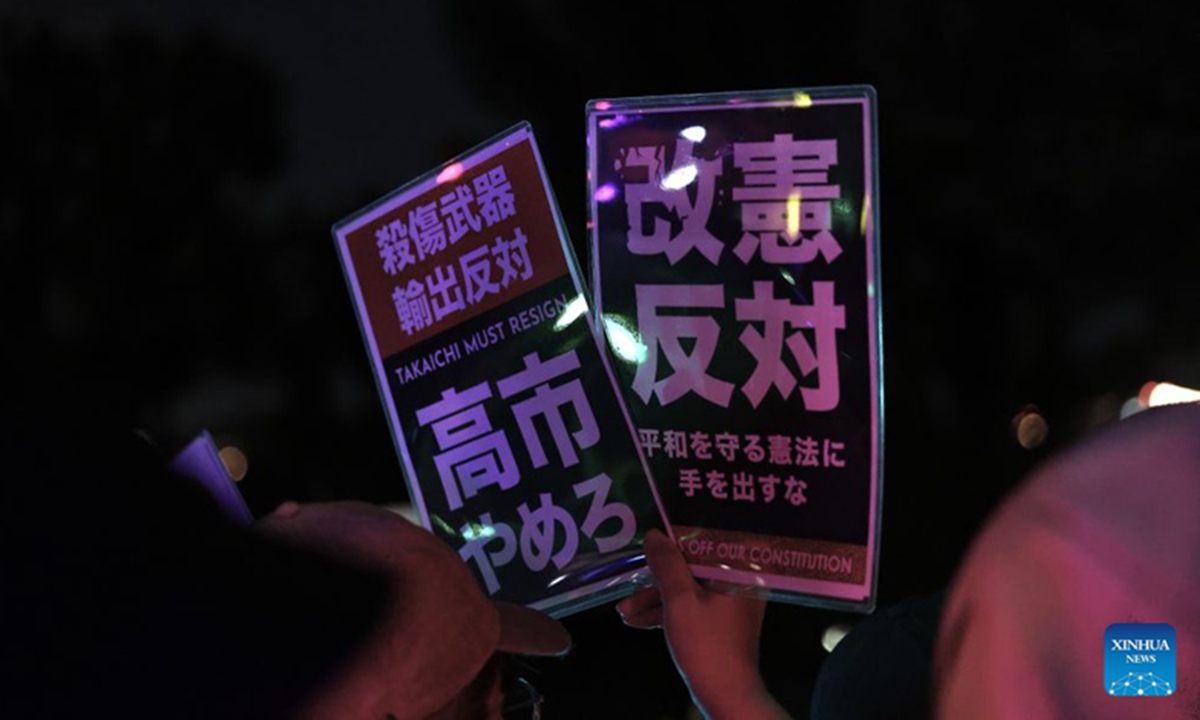
People holding signs attend a protest rally in front of the National Diet Building in Tokyo, Japan, July 10, 2026. A large number of Japanese citizens gathered in front of the National Diet Building in Tokyo on Friday evening to protest a series of dangerous policies and bills recently promoted by the government of Prime Minister Sanae Takaichi. Photo: Xinhua
Japanese Prime Minister Sanae Takaichi on Monday again stopped short of clearly ruling out any reconsideration of the principle of "not introducing" nuclear weapons at a House of Representatives Budget Committee session.
Facing questions about the government's response toward "moving toward the abolition of nuclear weapons" and calls for a clear commitment to uphold the Three Non-Nuclear Principles of not possessing, not producing and not introducing nuclear weapons, Takaichi claimed that the Three Non-Nuclear Principles remain the policy of the government, while failing to make a clear commitment on whether the principle of "not introducing" nuclear weapons would be completely excluded from discussion or whether she would explicitly reject any reconsideration of the principle.
Chinese observers noted that amid mounting livelihood concerns and a sluggish economic recovery, the Takaichi cabinet has focused instead on hyping security and nuclear deterrence issues to divert public attention from its domestic policy failures, exposing its prioritization of political maneuvering over people's well-being.
The ambiguous response is in line with Takaichi's previous vague stance on the Three Non-Nuclear Principles during discussions on revisions to Japan's three key security documents, experts noted.
Toward the end of Monday's deliberations, Tomoko Tamura, head of the Japanese Communist Party, questioned Takaichi for about nine minutes. Against the backdrop of the upcoming August anniversary marking Japan's defeat in World War II, she asked about the government's response toward "moving toward the abolition of nuclear weapons" and called on Takaichi to make a clear commitment to uphold the Three Non-Nuclear Principles of not possessing, not producing and not introducing nuclear weapons, and not to initiate any form of reconsideration of the principles.
Tamura noted that the logic of nuclear deterrence is premised on the "use of nuclear weapons when necessary," which would only intensify the arms race. As the only country in the world to have suffered atomic bombings, Japan's involvement in such a logic would amount to exposing its territory and people to the risk of nuclear war, she said. She also called on the Japanese government to join the Treaty on the Prohibition of Nuclear Weapons and fulfill its historical responsibility as a country that has suffered atomic bombings.
The concerns have not been limited to opposition parties. On the same day, Japanese media outlet Jiji Press noted in an article titled "Defense Minister Koizumi eager to speak out — concerns from LDP over 'nuclear weapons' and 'China'" that there are also voices of concern within the government and the Liberal Democratic Party over the diplomatic impact, citing Japanese Defense Minister Shinjiro Koizumi's recent increasingly unconventional remarks on nuclear policy and developments concerning China.
Koizumi has repeatedly raised the issue of nuclear weapons recently, claiming that Japan should have a discussion "without taboos", citing France's strengthening of its nuclear capabilities as an example and stressing the need for such a discussion, per report.
Jiji Press noted that a former Cabinet minister from the Liberal Democratic Party (LDP) said Koizumi may have his own considerations, but warned that "we also need to carefully consider the diplomatic repercussions."
The article noted that some observers see Koizumi's proactive remarks as reflecting an intention to appeal to conservatives with an eye on a future LDP presidential election. Jiji Press also quoted a Foreign Ministry official as saying, "It is us who will suffer the consequences if he makes remarks that provoke China."
"The ambiguous remarks by Takaichi and Koizumi's provocative nuclear rhetoric are typical of a 'salami-slicing' strategy by Japan's right-wing forces to gradually erode the Three Non-Nuclear Principles. It is highly deceptive and dangerous," Lü Chao, an expert at the Liaoning Academy of Social Sciences, told the Global Times on Monday.
Lü noted that as the only country in the world to have suffered atomic bombings, Japan should uphold its anti-nuclear commitment and fulfill its responsibility to oppose nuclear weapons. Instead, Japanese politicians are loosening the country's nuclear policy boundaries and opening the door to nuclear discussions, betraying Japan's historical commitments to peace.
Japan's nuclear rhetoric caters to right-wing conservatives, strengthening military ties with allies and pursuing so-called "military normalization." Amid low domestic support and mounting livelihood concerns, hyping nuclear deterrence and external confrontation also serves to divert domestic grievances and win conservative votes, putting political interests above national security and regional peace, the expert stressed.
With the August anniversary marking Japan's defeat in World War II approaching, the expert urged the international community to remain vigilant, pressure Japan to uphold the Three Non-Nuclear Principles and prevent political ambitions from dragging the region into instability.