Report of China mass-producing DUV tools triggers Western chip stock sell-off; reflecting expectations for Chinese breakthrough amid blockade: expert

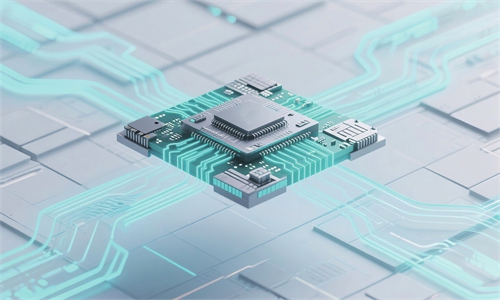
chip Photo:VCG
A media report claiming that China has started mass production of its homegrown deep ultraviolet (DUV) lithography machines, a key chipmaking tool, has sent shockwaves through Western media, technological and financial circles, triggering a major sell-off in Western chip stocks, including that of Dutch supplier ASML, the current dominant player.
While the report by The Information, which cited unnamed sources, remains unverified, the widespread reaction to the news reflects market expectations that China would eventually make such breakthroughs amid tight US-led blockades, a Chinese expert said.
Citing people familiar with the matter, The Information reported that an unidentified Chinese company has begun to mass-producing DUV lithography machines. The report further claimed that machines are expected to be delivered this year to leading Chinese chipmakers, including Semiconductor Manufacturing International Corp, Hua Hong Semiconductor, and ChangXin Memory Technologies. The report also suggested that five machines are expected to be delivered this year and about 20 in 2027.
Upon the news, shares of ASML plunged more than 7 percent, putting the stock on track for its worst day since June 8, according to Reuters. The news also brought down the shares of companies exposed to the global chip equipment supply chain, including BE Semiconductor Industries, which tumbled about 8.5 percent, and Soitec, which fell 5 percent, Reuters reported.
A Chinese expert said that the sharp drop in Western chip stocks also reflect that the industry has long been aware of — and even expected — an eventual Chinese breakthrough in the chip sector, as the US continues to tightening blockades in such a critical area.
Zhou Mi, a researcher at the Chinese Academy of International Trade and Economic Cooperation, told the Global Times on Tuesday that if the news is true, it would undoubtedly be an important breakthrough for China's semiconductor industry chain.
"If lithography machines can be partially replaced by domestic production, it would be a step from 0 to 1 in breaking external blockades and achieving independent innovation. This would effectively alleviate our dependence on overseas suppliers and provide more diversified options for domestic chip companies," he said.
Xiang Ligang, director-general of the Zhongguancun Modern Information Consumer Application Industry Technology Alliance, told the Global Times on Tuesday that if the report is true, it would provide further evidence that China has built strong, long-term capabilities in high-tech sectors and cannot be crushed by tariff wars, trade wars, or technology wars, or technology wars.
China's rise and technological progress are making a positive contribution to global development. China has supplied global markets with a wide range of high-quality, affordable products, helping drive technological progress and economic growth worldwide," Xiang said.
Zhou added that lithography remains one of the few areas where the US maintains a clear edge over China, and any credible Chinese self‑supply would erode its leverage over semiconductor controls. That, he said, explains the sharp US market reaction, which also reflects market expectations of a Chinese breakthrough amid tightening US blockades.
The US has continuously escalated its blockades against China. For example, in April, the US Department of Commerce ordered multiple chip equipment companies to halt certain tool shipments to a major Chinese chipmaker, Reuters reported at the time.
In response to that reported move, Lin Jian, a spokesperson for the Chinese Foreign Ministry, said on April 29 that "China has made clear more than once its principled position on US export of chips to China. We hope the US will take concrete actions to keep the global supply chains stable and unimpeded."
RELATED ARTICLES