ARTS / CULTURE & LEISURE
Open museum of architectural art
International artists draw inspiration from Shanxi ancient structures
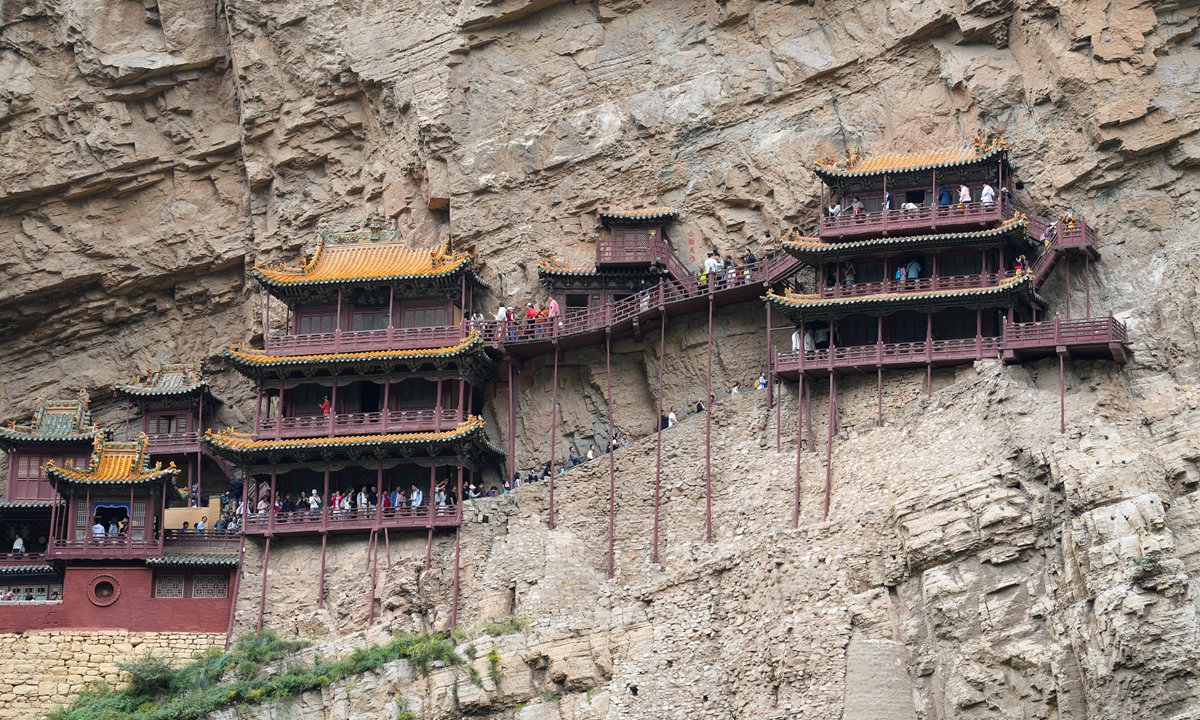
Tourists visit the Hanging Temple in Datong city, North China's Shanxi Province on June 29, 2026. Photo: VCG
When Colombian artist Rodrigo Escobar Vanegas recently stepped into Jinci Temple in North China's Shanxi Province, he was deeply awed by its remarkably well-preserved timber architecture and the intricate beam framework.
"What strikes me most is how the architecture clearly reflects the ancient perception of space in relation to the universe and nature," Vanegas told the Global Times.
Vanegas is one of the international artists who were invited to Shanxi in July to explore ancient Chinese architecture. Coming from countries including the UK, Germany, Italy, Russia and Colombia, the artists went to the cities of Xinzhou, Datong and Shuozhou in Shanxi to experience firsthand the millennia-old craftsmanship embodied in ancient architecture and offer their perspectives on bringing China's traditional heritage to a broader international audience.
Renowned for its sophisticated timber-frame construction, ancient Chinese architecture embodies the wisdom, craftsmanship and aesthetic ideals of generations of Chinese artisans. Shanxi is home to more than 80 percent of the country's surviving timber structures built before the Yuan Dynasty (1279-1368), earning it the reputation of a "museum of ancient Chinese architectural art."
For a long time, overseas perceptions of Shanxi have been largely associated with its rich energy resources and heavy industry. The recent tour, however, offered international guests a chance to discover the province's profound historical and cultural heritage.
Vanegas noted that his overall impression of Shanxi is that it is geographically very special, which allowed it to be the foundation on which Chinese civilization developed by the Yellow River.
"The ancient buildings in Shanxi are not merely structures; they represent a cultural dimension that reflects a cosmology founded on harmony and the relationship between humanity and the cosmos," he said.
Every town in Shanxi reflects, in its architecture and ornaments, a profound interaction between the sky, earth, and nature. Vanegas noted that it is almost impossible to fully understand the structure, as every brick and every element is connected to the others and carries its own meaning.

Colombian artist Rodrigo Vanegas Photo: Courtesy of Rodrigo Vanegas
Multi-temporal canvas
During the artists' first stop at Jinci Temple in Taiyuan city, they were impressed with the iconic Water Mirror Stage.
Jinci Temple, built as a shrine dedicated to the first feudal lord of the Jin State during the early Western Zhou Dynasty (1046BC-771BC), houses a wealth of cultural heritage that dates back to the Song Dynasty (960-1279).
Inside the temple, the Water Mirror Stage has long been regarded as one of Shanxi's most iconic architectural landmarks. Dating back more than four centuries, it has left its mark on generations of audiences through appearances in popular cultural works, from the classic 1986 television adaptation of Journey to the West to the hit video game Black Myth: Wukong and the recent animated blockbuster Nobody.
According to reports, Black Myth: Wukong features 36 locations across the country, with 27 of them located in Shanxi. The game has sparked a surge of interest in ancient Chinese architecture.
As a visual artist and poet, what attracted Vanegas most is the dynamic essence of the architecture across different dynasties.
"At Jinci Temple, you can find physical wooden structures from the Song Dynasty, while on the same walls you see paintings from the Ming Dynasty (1368-1644) and sculptures from the Song Dynasty. This layering allows you to see through the architecture the entire evolution of thought and the different ways of perceiving beauty and harmony over centuries. It's a living, multi-temporal canvas," said the Colombian.
From the Wooden Pagoda of Yingxian County to Huayan Temple, German artist and illustrator Anja Nolte captured the memorable moments of her journey through her illustrations.
"I love watching the swifts soaring around the Wooden Pagoda of Yingxian County, and I'm equally drawn to the lifelike details depicted in the murals," Nolte told the Shanxi Daily.
The pagoda was built in 1056 with tenon-and-mortise work. The 67.31-meter-high building is the tallest and oldest wooden multi-story structure in the world, according to UNESCO.
Each ancient structure, Nolte said, sparked new creative inspiration, and she hoped to continue telling the stories of China's architectural heritage through her artwork in the future.
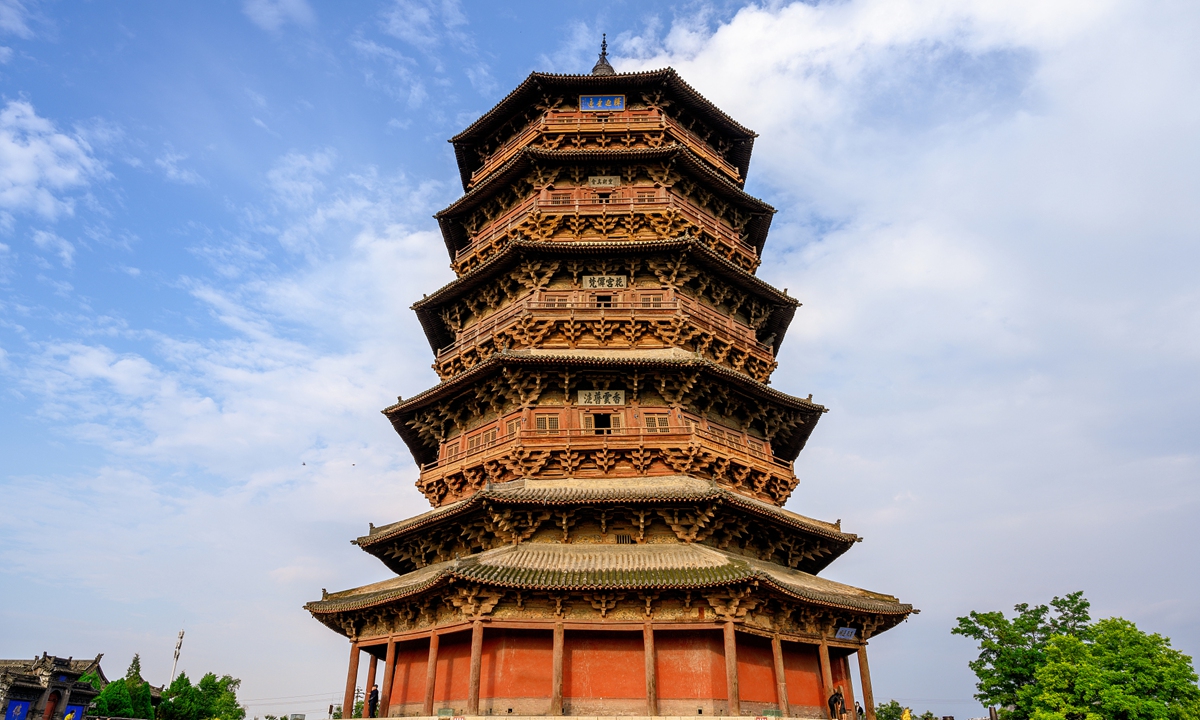
The Wooden Pagoda of Yingxian County in North China's Shanxi Province Photo: VCG
Reaching a broader audience
During the 2026 World Internet Conference (WIC) Digital Silk Road Development Forum held in Xi'an, Northwest China's Shaanxi Province, on July 22, 45 exemplary cultural heritage digitalization case studies from 13 countries and regions were released, showcasing the latest advances in the application of digital technology across cultural heritage protection, archaeology, exhibition and utilization.
Among the 45 exemplary cases, five are from Shanxi, demonstrating its efforts in applying cutting-edge technologies such as 3D scanning, hyperspectral imaging, digital twin technology and immersive interactive experiences, to tackle longstanding challenges in the conservation of grotto temples, painted sculptures and murals.
Talking of bringing China's traditional heritage to a wider audience, Russian video blogger Artem Usov noted that Shanxi's ancient architecture has tremendous potential to resonate with international audiences.
He pointed out that a video he filmed at the Hanging Temple in Datong city has garnered more than 10.16 million views.
"In Russia, it's rare to see buildings that are both so well preserved and so old," he told the Shanxi Daily. Looking ahead, he plans to continue showcasing Shanxi through social media, hoping to help more people around the world discover the province and fall in love with it.
Cultural events such as the Pingyao International Film Festival, an annual event held in the UNESCO World Heritage ancient town of Pingyao, will allow people to understand that observing time through heritage is also a way to explore the future, Vanegas said.
RELATED ARTICLES