ARTS / CULTURE & LEISURE
South China’s largest natural history museum opens
Exhibits showcase evolution of the Earth, life and local ecosystems
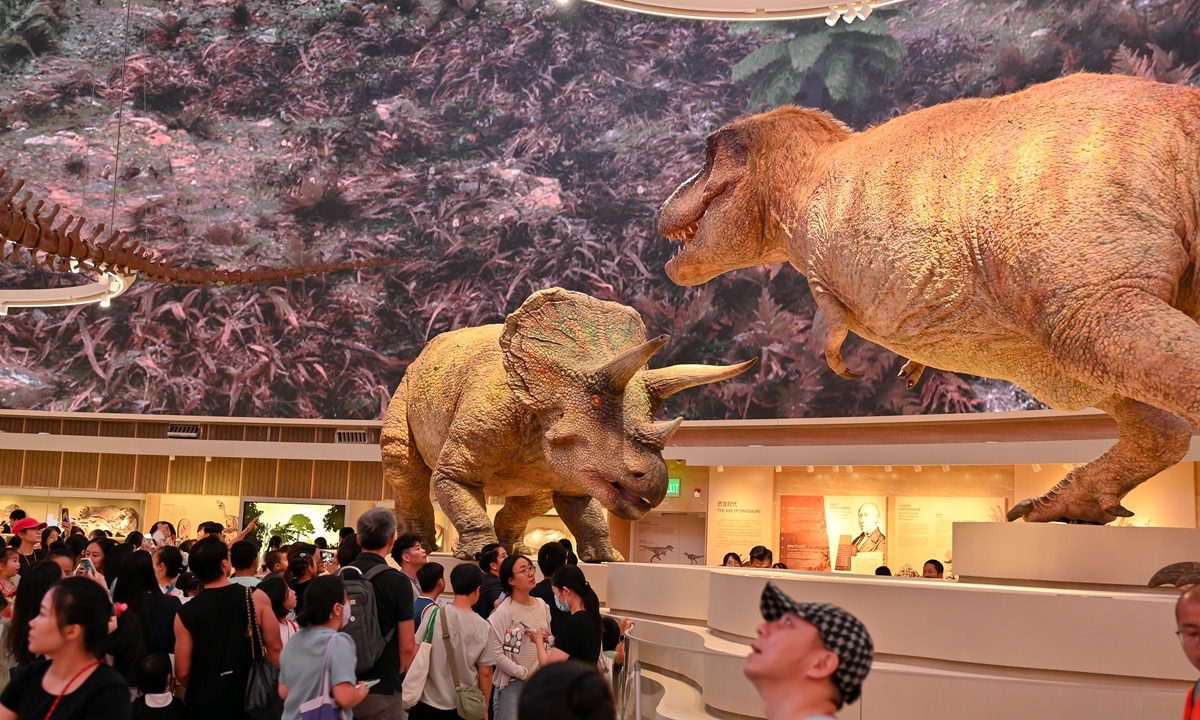
Visitors explore the Dinosaur Hall at the Shenzhen Natural History Museum in Shenzhen, South China's Guangdong Province. Photo: VCG
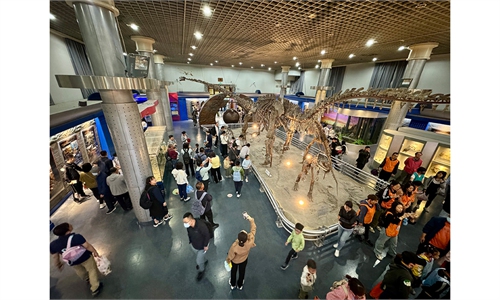
The Shenzhen Natural History Museum opened on Tuesday, marking the launch of the largest comprehensive natural history museum in South China, with more than 7,400 authentic specimens and exhibits showcasing the evolution of the Earth, life and local ecosystems.Located in Shenzhen's Pingshan district, the museum features eight themed exhibition halls: Universe, Earth, Evolution, Dinosaurs, Humans, Biology, Ecology and Homeland. Through 7,461 authentic specimens, 338 replica models and 194 interactive displays, the museum presents visitors a journey spanning 4.6 billion years of the Earth's evolution.
Local resident Wang Zhen was one of the first visitors on the opening day. She and her 9-year-old son arrived early in the morning, hoping to avoid the crowds. However, the plan did not quite work out.
"Although we came early, a lot of people had already been waiting," Wang told the Global Times.
The wait, however, turned out to be worthwhile. Once inside, Wang found herself and her son surrounded by vast exhibition spaces that she said were impossible to fully explore in a single morning.
"My son's favorite parts were the dinosaur hall and the biology hall," she said. "There was so much to see that we definitely could not finish everything in one visit."
Among the museum's major attractions are real meteorite samples, complete dinosaur skeletons and ancient human fossils. Rare wildlife specimens such as African elephants, polar bears and giraffes, which received widespread attention during the museum's trial operation period, have also been relocated to the new venue.
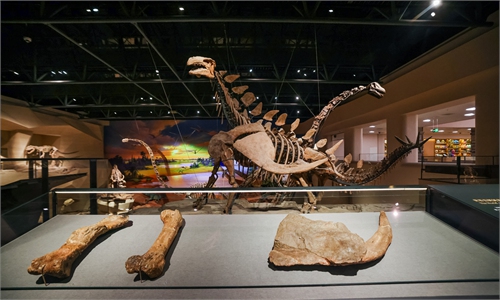
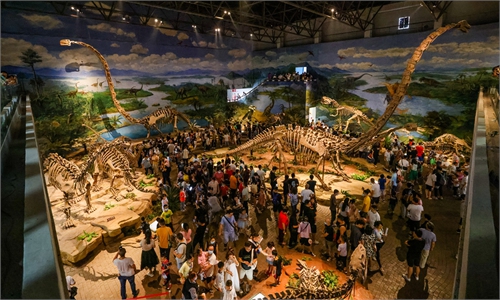
One of the biggest draws is the Dinosaur Hall, where a 26-meter-long Mamenchisaurus skeleton dominates the exhibition space. The fossil of Heyuannia huangi, a dinosaur species discovered in Guangdong Province, is also on display in full, accompanied by an observation platform that allows visitors to view the massive skeleton from different angles.
For many young visitors, the dinosaur exhibition has quickly become the museum's highlight.
"The dinosaur hall is really impressive," said Wang, noting that her son spent the most time there. "The scale of the exhibits and the audio and visual effects make it feel like you have entered another world."
The museum also showcases several significant paleontological discoveries, including the Chinese fossil plant Archaefructus, the dinosaur Iguanodon, the feathered dinosaur Anchiornis, an Ichthyosaur fossil and a Cretaceous dinosaur fossil assemblage from the provinces of Guangdong and Jiangxi. The exhibits highlight China's important role in global paleontological research, according to the Shenzhen Daily.
The museum also places emphasis on the biodiversity of the present day.
The Homeland Hall features more than 1,600 local specimens, including migratory birds from Shenzhen Bay, native plants from Mount Wutong, insects found in urban green spaces and marine species from Dapeng Bay. Together, they form a natural archive of Shenzhen's ecosystems, the Shenzhen Daily reported.
"The museum is not only about showing rare specimens," Shen Yi, a university student from Shenzhen who visited the museum for the first time, told the Global Times. "It helps people like me understand the connections between humans and nature."
Shen said she had visited many types of museums before, but found the natural history museum experience particularly immersive.
"The exhibits are closely connected with the theme of the museum," she said. "It feels like you are learning about nature rather than simply looking at objects behind glass."
The museum's design also reflects its ecological theme. Inspired by the shape of a river delta, the building features smooth, flowing lines that echo the winding form of the nearby Pingshan River. Integrated with Yanziling Mountain and the Yanzi Lake Wetland, the architectural design seeks to create a connection between the building and its surrounding environment.
Unlike many museums that mainly focus on indoor exhibitions, the museum extends beyond traditional indoor exhibition spaces, featuring a more than 600-meter rooftop botanical garden that links nearby ecological areas, including Yanziling Park and the Chikao Water Wetland. The design allows visitors to experience nature beyond the exhibits and makes the building itself part of the learning journey.
"The museum is like an open classroom," Shen said. "After seeing the specimens inside, you can go outside and see how nature actually exists around the city."
In addition, unlike traditional museums that rely mainly on static displays, the Shenzhen Natural History Museum uses digital technology to bring its collections to life, state broadcaster CCTV reported.
Through immersive recreations, the museum restores the environments surrounding exhibits such as deep-space meteorite samples and giant dinosaur skeletons, while presenting diverse ecosystems including forests, grasslands, wetlands and oceans.
The museum also features attractions such as a nature theater and a dome cinema, creating an interactive "natural laboratory" experience designed to engage visitors, especially younger audiences, and inspire their curiosity about science and the natural world, according to CCTV.
RELATED ARTICLES