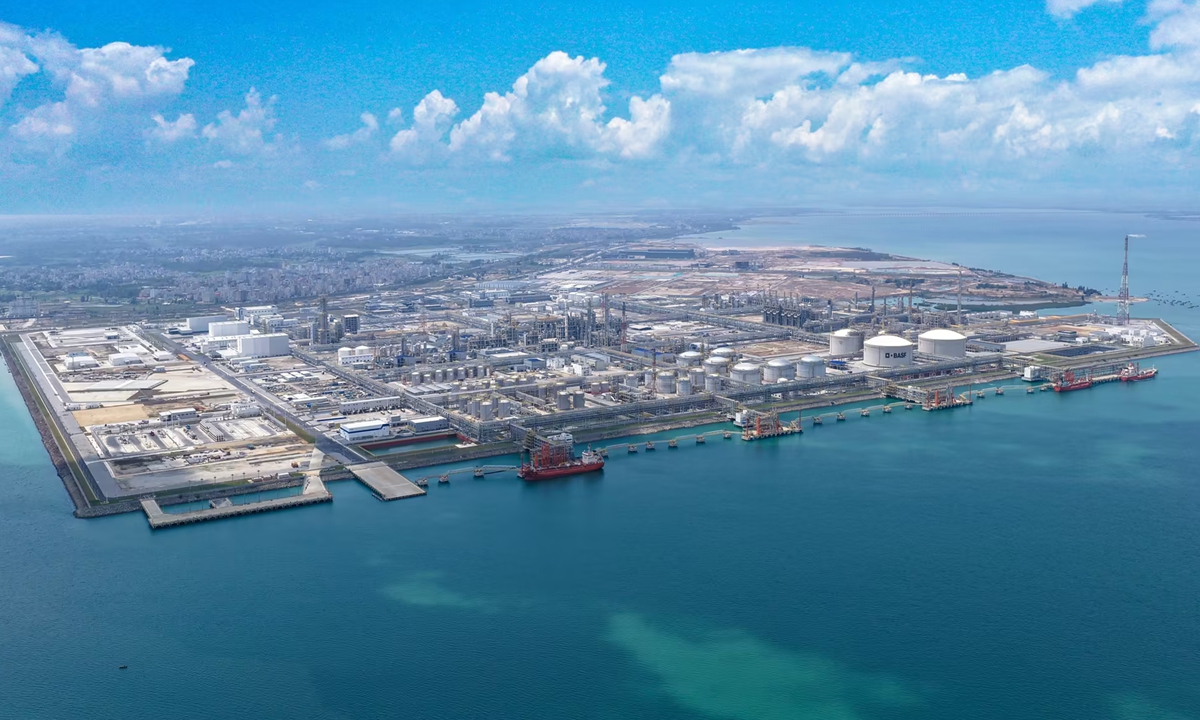
An aerial picture of BASF's Verbund site in Zhanjiang, South China's Guangdong Province Photo: Courtesy of BASF
China and Germany need to enhance communication and cooperation to achieve common development, jointly keep the global industrial and supply chains stable and unimpeded, and contribute to world development and prosperity, Mao Ning, spokesperson of China's Foreign Ministry, told a press conference on Wednesday.
Mao made the remarks as Bloomberg reported that Germany is mapping out vulnerabilities in China's supply chain in order to use this information as leverage against a possible trade war between Germany and China.
Mao noted that "in the globalized world, there's nothing unusual that countries need each other in the industrial chain. China and Germany are comprehensive strategic partners. Our cooperation is mutually beneficial in nature."
Bloomberg reported on Tuesday that the German government is informally mapping China's weaknesses by analyzing trade flows, supply chains and company-level data, according to people familiar with the matter. The vulnerabilities are concentrated in highly specialized products, intermediate goods and services that Chinese companies are still unable to replicate, said the report.
Jian Junbo, director of the Center for China-Europe Relations at Fudan University's Institute of International Studies, told the Global Times on Wednesday that China-Germany relations have long been based on mutual benefit and win-win cooperation under the comprehensive strategic partnership, noting that Germany's reported move is a manifestation of "beggar-thy-neighbor" policies that politicize and economic issues, and it runs counter to the principles of mutual respect and open cooperation repeatedly emphasized by the two sides.
Jian said that the Chinese and German economies are highly complementary and deeply intertwined. "Germany may hold certain advantages over China in some technological fields, but it is equally highly dependent on the Chinese market, as well as on certain products, intermediate goods, and raw materials."
Official data showed that in 2025, bilateral trade grew faster than China's overall foreign trade. Germany remained China's largest trading partner in Europe last year. Meanwhile, China regained its position as Germany's top trading partner following a one-year lapse.
Machinery and electrical products took the lion's share of these trade flows. Imports and exports of such goods between the two countries totaled 1.07 trillion yuan in 2025, rising 5.8 percent year-on-year and accounting for more than 70 percent of bilateral trade, according to the General Administration of Customs.
In addition, multiple German companies have expressed their focus on the Chinese market. For instance, Oliver Blume, CEO of Volkswagen Group, said in April that China is a key driver of its transformation and a vital force behind its global ambitions. Mercedes-Benz noted that China is not only the largest and most important sales market, but also an indispensable innovation and technology hub.
"If the German side weaponizes its own advantages, China can likewise take reciprocal measures. The result would only be mutual harm, failing to achieve the intended goals and instead heightening the instability and unpredictability of bilateral economic and trade relations, without truly resolving the underlying issues," the expert warned.
Bloomberg reported that German officials, speaking on condition of anonymity, stressed that the work should not be viewed as a hostile policy toward China and said Berlin remained committed to economic cooperation.
Jian said that Germany's trade policy toward China exhibits clear contradictions, noting that at its core lies a structural conflict between an export-oriented economic model and rising security anxieties.
On the one hand, Germany has gradually shifted from viewing China as a "complementary partner" to feeling intensifying "competitive pressure," and it seeks to preserve its traditional advantages. On the other hand, Germany remains a highly export-dependent economy, and China has long been one of its most important export markets and sources of profit, the expert noted.
Competition between China and Germany is a normal phenomenon in a market economy. The key lies in viewing bilateral competition with a rational and objective attitude, rather than treating it as a catastrophic threat and resorting to unilateral, targeted measures that only further complicate the issues. Only in this way can the healthy development of China-Germany and, more broadly, China-EU economic and trade relations be truly safeguarded, Jian said.
RELATED ARTICLES