US Senators’ reported warning against Apple buying CXMT and YMTC chips lays bare their political agenda, distorts market competition and increases US firms’ costs: experts
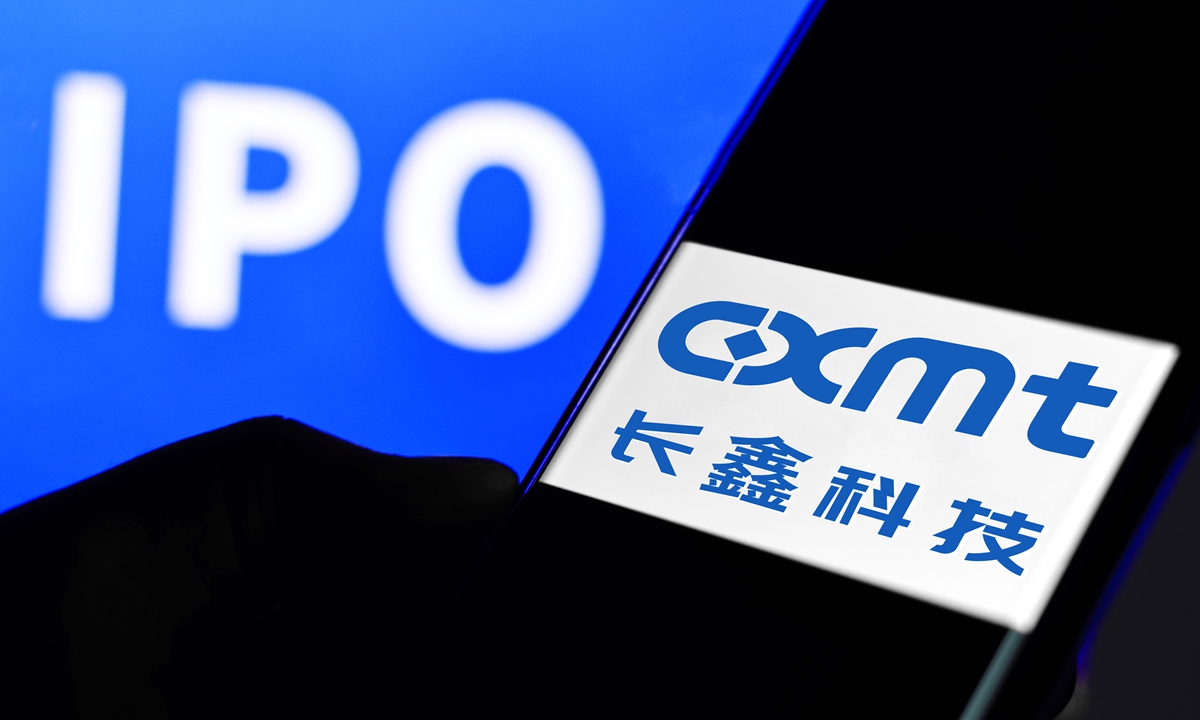
Chinese memory chipmaker CXMT File Photo: VCG
A bipartisan group of US senators has reportedly urged Apple to abandon plans to buy memory chips from Chinese suppliers ChangXin Memory Technologies (CXMT) and Yangtze Memory Technologies Co (YMTC), warning that the iPhone maker risked becoming reliant on a US adversary for crucial components, Bloomberg reported on Wednesday. Chinese industry experts said that US lawmakers' actions are driven by a largely symbolic political agenda and amount to interference in companies' normal commercial decisions.
According to the Bloomberg report, the US lawmakers said Apple should not rely on components from companies the US government has placed on "a recently updated Pentagon list" that viewed as linked to China's military.
In a letter addressed to Apple Chief Executive Officer Tim Cook, the senators said the company should refrain from using memory chips from CXMT and YMTC in its devices, even if the products are destined exclusively for the Chinese market, Bloomberg said.
The senators asked Apple to commit by August 21 to avoid incorporating CXMT or YMTC memory into its products, per the Bloomberg report.
Apple has not responded to the Global Times' requests for comment as of press time on Thursday.
According to Bloomberg, the letter was led by Indiana Republican Jim Banks and New York Democrat Chuck Schumer. Many of the signatories represent states such as Indiana and Idaho, where US and South Korean memory chipmakers Micron Technology and SK Hynix are investing billions of dollars to expand production capacity.
Chinese experts said the lawmakers' attempt to discourage Apple from buying Chinese chips appears to reflect deeper self-interests.
Certain US politicians have been repeatedly using "national security" as a pretext to politicize and instrumentalize companies' normal procurement practices, Ma Jihua, a veteran technology industry analyst, told the Global Times on Thursday.
Ma warned that framing commercial sourcing as a national security threat risks turning supply chain policy into a tool of trade protectionism, noting that in the highly specialized and globally distributed semiconductor supply chain, such artificial decoupling will only distort market competition and increase costs for US companies.
"Corporate procurement is a typical commercial activity and should not be held hostage by political slogans," he said, noting that the semiconductor supply chain is highly globalized and depends on cost, performance, reliability and scale. "When business choices are forced into a political frame, the market becomes less efficient, costs rise and consumers ultimately pay the price.",
Xiang Ligang, a veteran telecom observer, told the Global Times on Thursday that semiconductor sourcing is part of a highly globalized and specialized supply chain, and that forcing companies to avoid certain suppliers for political reasons could reduce sourcing flexibility, raise procurement costs and ultimately hurt innovation.
According to Bloomberg, Apple has been in negotiations to acquire chips from CXMT and YMTC as it grapples with a global squeeze on supplies that's caused memory prices to soar, fueled by unprecedented demand from makers of AI processors including Nvidia.
A Wall Street Journal on July 24 cited people familiar with the matter said that in recent weeks, Apple Chief Executive Tim Cook and top executives have pitched the US administration on a plan to use memory chips from China's CXMT and YMTC in Apple products sold outside the US.
Tech companies including Dell, HP and Apple have reportedly been testing CXMT memory chips as they look for other sources of supply. "The appeal for CXMT chips is price," said Sue Keay, director of the University of New South Wales's AI Institute. It could give Apple leverage over the dominant suppliers Samsung, SK Hynix and Micron, and help it hedge against further shortage-driven price rises, experts said, according to an Australia Broadcasting Corporation News report.
According to Counterpoint Research, a technology research firm, CXMT was the world's fourth biggest DRAM memory chipmaker in 2025 by shipments, taking up roughly 8 percent of the global market. Samsung Electronics accounted for 36 percent, SK Hynix 29 percent and Micron about 24 percent.
In June, Apple raised prices of all its Macs, iPads, home devices and the Vision Pro, attributing the increases to the memory chip shortage, the Bloomberg report said.
Memory chip prices are currently very high, if Apple were blocked from buying from CXMT and YMTC, it would likely have to rely more heavily on a small number of suppliers such as Micron, Samsung and SK Hynix. That could further tighten supply, increase prices and squeeze margins across Apple's product lines, according to Chinese analysts.
Apple's pursuit of a more diversified supply chain is a commercially sensible choice. Artificially cutting off such supply channels would only increase Apple's own cost pressure, drive up end-product prices, and ultimately leave businesses and consumers to foot the bill, Xiang said.
RELATED ARTICLES