ARTS / CULTURE & LEISURE
First AI-generated costume drama on Chinese satellite TV triggers fears about loss of human touch
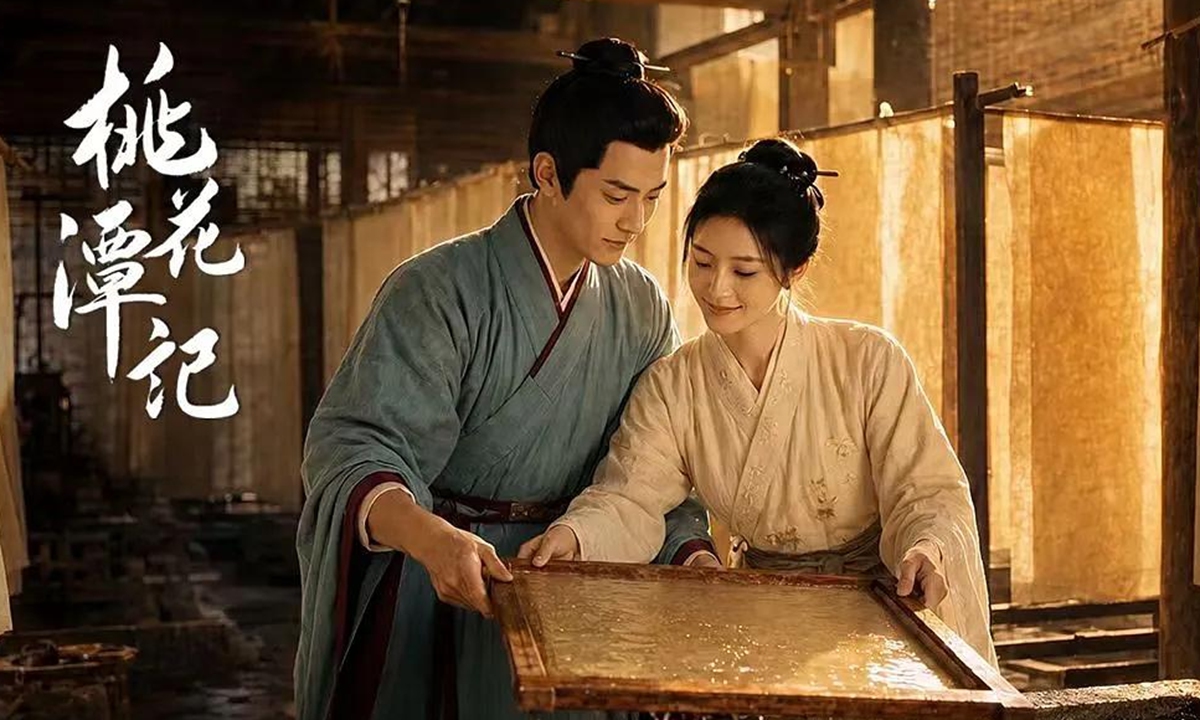
Taohuatanji
A fully AI-generated costume drama is reportedly the first of its kind to air on a Chinese satellite TV channel, sparking widespread online attention and discussion.Airing during prime time on Anhui TV, the drama, named Taohuatanji (Peach Blossom Pond Chronicle), is themed on intangible cultural heritage (ICH) Xuan paper making.
It consists of 20 episodes, each running roughly 10 minutes, while all broadcast footage is clearly marked "AI Production."
Since its release, many viewers have praised the show for its vision and devotion to promoting traditional Chinese culture. On the other hand, some viewers said there are visible AI production flaws, including choppy visuals and repetitive AI-generated faces.
Undeniably, the broadcast of the AI-produced drama marks a milestone. Although the technology still has room for improvement, its debut on a provincial satellite TV channel represents an innovative step toward differentiation and deserves recognition, Shi Wenxue, a Beijing-based cultural critic, told the Global Times on Thursday.
Centered on a national ICH originating in East China's Anhui Province, the drama is part of local authorities' efforts to promote the province's cultural heritage.
Focusing on Xuan papermaking in Jingxian county, the drama incorporates the 108 traditional steps of ancient papermaking into its storyline. The drama tells the legendary tale of a Ming Dynasty (1368-1644) imperial guard who goes undercover at a paper workshop in Jingxian, joining forces with a female artisan to protect Xuan paper craftsmanship and uphold his duty to the nation.
The traditional craft of making Xuan paper was listed as a national-level intangible cultural heritage in 2006 and a world intangible cultural heritage by UNESCO in 2009. The papermaking handicraft from China's Ming and Qing (1644-1911) dynasties is still in use today.
Supporters have hailed the production as a forward-looking experiment, arguing that it represents an innovative effort by the broadcaster to combine traditional ICH with emerging technologies while reducing production costs and improving efficiency. Critics, however, compared the AI-generated series with live-action television dramas, saying that AI productions lack the visual artistry and aesthetic appeal of performances by human actors.
"The drama showcases elements such as Huizhou-style architecture and Xuan paper, and I appreciate its willingness to innovate. Still, I hope future productions will feature more lifelike facial expressions and character designs," posted one Sina Weibo user from Anhui.
"The characters all have the same generic faces, and their eyes convey no emotion. Their smiles and tears feel mechanically generated, leaving viewers unable to sense any genuine emotional depth," said another Sina Weibo user.
While using AI can reduce production times, Shi noted that if they wish to attract audiences, AI production teams must maintain strict standards for content and should not compromise production quality.
AI-generated dramas are merely a new medium for telling Chinese stories. The content they present and the cultural depth they convey are what truly determine their impact and reach, Li Xiaoyang, a professor at the Beijing Film Academy, told the Science and Technology Daily.
AI dramas should not stop at simply "reproducing" images and scenes through technology; instead, they should harness technological innovation to explore the deeper spiritual values within traditional culture that have yet to be fully expressed, transforming themselves into a genuinely vibrant form of art, Li said.
RELATED ARTICLES